G.skill Computers & Networking
16GB G.Skill DDR5-6000 Shootout: Flare X5 vs Ripjaws S5 vs Trident Z5
Choosing the right 16gb g.skill ddr5-6000 memory module is a crucial step when configuring a modern desktop workstation for video editing, 3D rendering, or daily creative tasks. Operating at a data rate of 6000 MT/s with CL36-36-36-96 timings at 1.35V, these modules balance latency, frequency, and signal stability to eliminate workflow bottlenecks and prevent playback…
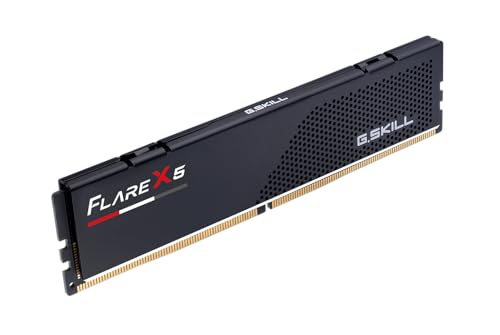
As Amazon Associates, we earn from qualifying purchases. This means we may receive a small commission at no extra cost to you if you click through and make a purchase.
Choosing the right 16gb g.skill ddr5-6000 memory module is a crucial step when configuring a modern desktop workstation for video editing, 3D rendering, or daily creative tasks. Operating at a data rate of 6000 MT/s with CL36-36-36-96 timings at 1.35V, these modules balance latency, frequency, and signal stability to eliminate workflow bottlenecks and prevent playback stutter during heavy project timelines.
This g.skill ddr5 ram comparison evaluates three specific single-stick options from the brand: Flare X5, Ripjaws S5, and Trident Z5 RGB. Although all three deliver identical core bandwidth characteristics as a ddr5 6000 single stick 16gb solution, they differ substantially in physical heat spreader profile, motherboard chipset validation ranges, and integrated illumination.
Which G.Skill DDR5 RAM Modules Should You Buy
All 3 models on this page, side by side
| Model | Our score | Listing |
|---|---|---|
01 G.SKILL Flare X5 Series DDR5 RAM |
Price | |
02 G.SKILL Ripjaws S5 Series DDR5 RAM |
Price | |
03 G.SKILL Trident Z5 RGB Series DDR5 |
Price |
Prices are read from the Amazon product listing and change there, not here. Scores are out of 10, based on listed specifications and buyer feedback.
Why each one is on the list
- For builders prioritizing dedicated AMD platform validation and compact thermal heat spreaders: G.SKILL Flare X5 Series DDR5 RAM.
- For creators working within Intel environments or compact cases requiring low-profile hardware clearance: G.SKILL Ripjaws S5 Series DDR5 RAM.
- For visual artists and live broadcasters looking for customizable chassis illumination and the broadest multi-generation motherboard support: G.SKILL Trident Z5 RGB Series DDR5.
01 G.SKILL Flare X5 Series DDR5 RAM

Best for AMD workstation creators wanting EXPO
Pros
- AMD EXPO and Intel XMP profiles
- Extensive AMD chipset validation
- Low-profile matte black spreader
Cons
- Lacks RGB illumination
- Single stick limits memory bandwidth
The G.SKILL Flare X5 Series DDR5 RAM is a 16GB single-module U-DIMM kit identified under model number F5-6000J3636F16GX1-FX5. Built for desktop personal computing and gaming workflows, this 288-pin Non-ECC stick operates at up to DDR5-6000 with column address strobe timings of CL36-36-36-96 at a rated voltage of 1.35V. It ships with both standard JEDEC default profiles and pre-configured overclocking profiles for AMD EXPO and Intel XMP 3.0. Out of the box, the module initialises at default SPD speeds, enabling immediate operating system configuration before entering the motherboard BIOS to enable full performance.
This g.skill flare x5 ddr5-6000 16gb option is tailored specifically for creative professionals building modern AMD desktop workstations. The listing explicitly confirms validation across AMD platforms including X870, X670, B850, B840, and B650, while retaining support for modern Intel Z890, Z790, B860, and B760 chipsets. For digital artists accustomed to mobile constraints like a dell laptop i5 16gb ram workstation, moving to this desktop module provides substantial memory bandwidth that accelerates real-time media rendering and multi-layered timeline scrubbing.
Where the Flare X5 steps back is in aesthetic flair and legacy Intel chipset support. With product dimensions of 7.01 x 5.24 x 0.67 inches and an item weight of 2.88 ounces, its matte black exterior is unilluminated and built for understated utility. It omits lighting bars entirely, ceding visual appeal to the Trident Z5 RGB. Furthermore, while it serves contemporary Intel motherboards well, the manufacturer listing excludes older Intel 600 series boards like Z690 and H610, which are supported by the Ripjaws S5.
- Single 16GB U-DIMM module rated up to DDR5-6000 CL36-36-36-96 at 1.35V
- Equipped with AMD EXPO and Intel XMP 3.0 overclocking profiles
- Broad platform support across AMD X870, X670, B850, B840, B650 and Intel Z890, Z790, B860, B760
- Minimalist matte black heat spreader with 288-pin Non-ECC architecture
02 G.SKILL Ripjaws S5 Series DDR5 RAM

Best for Compact Intel workstation rigs
Pros
- Broad Intel chipset validation
- Compact low-profile spreader
- Dual XMP and EXPO profiles
Cons
- No integrated lighting
- Narrower AMD platform support
The G.SKILL Ripjaws S5 Series DDR5 RAM, bearing part number F5-6000J3636F16GX1-RS5K, provides a dedicated 16GB single-stick desktop memory solution. It features a rated speed of 6000 MT/s, 288 pins, CL36 latency, and a standard operating voltage of 1.35V. Like its siblings, the module boots at conservative JEDEC default SPD speeds until the user activates its onboard Intel XMP 3.0 or AMD EXPO overclocking profiles within BIOS firmware.
For audio mixers, graphic designers, and video producers assembling builds on a wide selection of Intel motherboards, the g.skill ripjaws s5 ddr5-6000 16gb proves remarkably versatile. Its listing validates operation across Intel Z890, Z790, Z690, H610, B860, B760, and B660 chipsets, in addition to AMD X870 and B650. Users upgrading their home workstations beyond mobile creative machines like a lenovo ideapad 16gb ram will benefit from this module’s responsive data throughput when managing complex audio sample libraries or multi-application suites.
The Ripjaws S5 yields to other models when wider AMD ecosystem validation or visual customization is required. Its validated AMD list focuses on X870 and B650, leaving out AMD platforms like X670, B850, and B840 that are explicitly verified on the Flare X5. In addition, its clean matte black heat spreader features zero LED lighting, making it an unsuited choice if an eye-catching studio showpiece is your primary build goal.
- 16GB single-stick capacity operating at 6000 MT/s with CL36 latency
- Expansive Intel validation encompassing Z890, Z790, Z690, H610, B860, B760, and B660 platforms
- Includes factory overclocking profiles for Intel XMP 3.0 and AMD EXPO
- Low-profile matte black heatsink design suited for dense workstation builds
03 G.SKILL Trident Z5 RGB Series DDR5
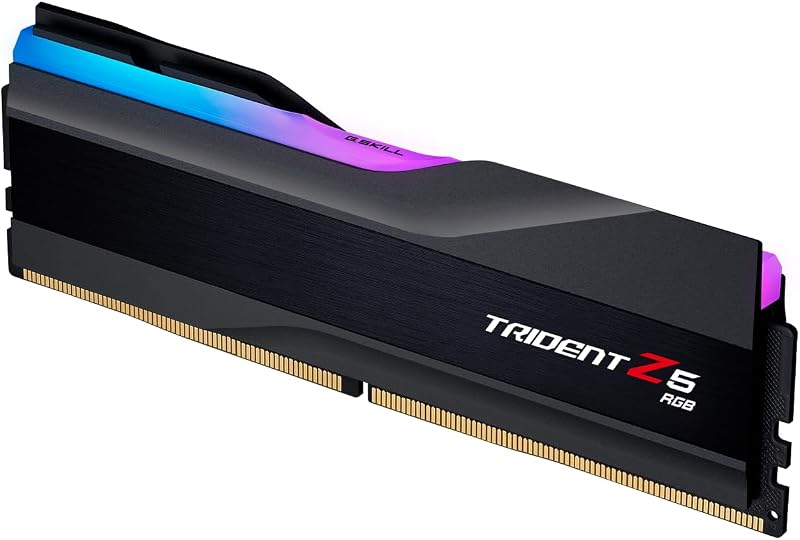
Best for Showcase creator streaming builds
Pros
- Integrated RGB light bar
- Expansive cross-platform validation
- Dual XMP and EXPO profiles
Cons
- Taller heatsink height clearance
The G.SKILL Trident Z5 RGB Series DDR5 (model F5-6000J3636F16GX1-TZ5RK) combines top-tier desktop performance with striking aesthetics. Operating as a 288-pin Non-ECC U-DIMM, it delivers 16GB of capacity rated for 6000 MT/s at CL36-36-36-96 and 1.35V. It integrates both Intel XMP 3.0 and AMD EXPO overclocking profiles, allowing straightforward speed tuning in BIOS on compatible desktop systems.
Regarded as the best g.skill ddr5 ram for creators who stream live or present custom rigs on video, the g.skill trident z5 rgb ddr5-6000 16gb incorporates an illuminated light bar integrated directly into its matte black aluminum heat spreader. Beyond appearance, this stick boasts the widest verified platform coverage among all three models, officially listing Intel Z890, Z790, Z690, B860, B760, and B660 alongside AMD X870, X670, B850, B840, B650, and AMD A620. When evaluating desktop configurations against alternate dual-channel setups like a team group 16gb (2 x 8gb) 288-pin pc ram ddr5 6000 kit, this single 16GB module gives creators an open path to slot in additional memory sticks later without replacing the primary stick.
This module steps aside primarily when physical vertical clearance is limited. The sculpted light bar and reinforced heat spreader add physical height compared to non-RGB designs. In compact desktop builds utilizing expansive twin-tower air heatsinks that extend over memory sockets, the Trident Z5 RGB can create installation interference, making the lower-profile Ripjaws S5 or Flare X5 a more practical fit.
- Engineered with an integrated dynamic RGB light bar on a matte black heat spreader
- High-speed 6000 MT/s data rate with CL36-36-36-96 timings at 1.35V
- Comprehensive validation across Intel 600/700/800 series and AMD 600/800 series motherboards
- Pre-loaded Intel XMP 3.0 and AMD EXPO profiles for streamlined system tuning
What Sets These Models Apart
When executing a g.skill ddr5 ram comparison, all three units share the identical baseline technical foundation of a g.skill ddr5 6000 cl36 16gb memory configuration running at 1.35V. However, their physical configurations and validated chipset ecosystems are targeted at distinct system environments. Choosing the correct model hinges on aligning motherboard platform verification with chassis thermal layouts.
| Model | Visual Styling and Heatsink | Platform Validation Scope | Profile Technology |
|---|---|---|---|
| G.SKILL Flare X5 Series DDR5 RAM | Low-profile matte black heat spreader without lighting | Intel Z890, Z790, B860, B760; AMD X870, X670, B850, B840, B650 | AMD EXPO and Intel XMP 3.0 |
| G.SKILL Ripjaws S5 Series DDR5 RAM | Compact matte black low-profile heat spreader without lighting | Intel Z890, Z790, Z690, H610, B860, B760, B660; AMD X870, B650 | Intel XMP 3.0 and AMD EXPO |
| G.SKILL Trident Z5 RGB Series DDR5 | Matte black heat spreader with integrated RGB light bar | Intel Z890, Z790, Z690, B860, B760, B660; AMD X870, X670, B850, B840, B650, A620 | Intel XMP 3.0 and AMD EXPO |
Buying Tips for G.Skill DDR5 RAM modules
When deciding which g.skill ddr5 ram to buy, your initial focus should be on motherboard firmware and memory Qualified Vendor Lists (QVL). High-frequency DDR5 memory relies on precise signal communication with your central processor’s integrated memory controller. Updating your motherboard BIOS to the latest manufacturer release prior to enabling the g.skill expo xmp ddr5 6000 overclocking profile prevents stability issues, boot loops, and memory training failures.
Another vital architectural consideration is the deployment of a single memory module versus a multi-stick kit. Starting out with a single 16GB module allows creators to assemble an affordable operational editing station immediately, but running a single stick operates in single-channel mode, which limits overall memory bus throughput. G.Skill explicitly warns in all three listings never to mix memory kits or purchase separate modules later to combine into a set, as memory modules are binned to operate together. Mixing separate individual sticks can trigger system instability or prevent the modules from operating at their rated 6000 MT/s speeds.
Finally, measure physical clearances inside your desktop enclosure before making a final selection. Tower air coolers featuring large fin stacks and lower-mounted cooling fans often hang directly above the U-DIMM slots on standard motherboards. In space-restricted or compact micro-ATX chassis, choosing low-profile modules like the Ripjaws S5 or Flare X5 guarantees clean installation, whereas the taller Trident Z5 RGB is best reserved for liquid-cooled builds or cases with generous clearance.
FAQ
Will a 16GB G.Skill DDR5-6000 module boot at full speed right after installation?
No. By default, every G.Skill DDR5 module boots at standard JEDEC SPD baseline frequencies when first installed. To reach the advertised 6000 MT/s frequency and CL36-36-36-96 timings at 1.35V, you must navigate into your motherboard BIOS settings and manually activate the Intel XMP 3.0 or AMD EXPO overclocking profile.
Can I combine two identical 16GB single modules to create a 32GB dual-channel set?
G.Skill strictly cautions against combining separate memory modules. Memory kits are factory binned and matched to run reliably as a unified set. Even when buying two identical part numbers separately, subtle differences between production batches can cause memory training failures, boot instability, or an inability to run at full rated speeds.
What is the functional difference between AMD EXPO and Intel XMP 3.0?
Intel XMP 3.0 and AMD EXPO are firmware profiles designed to configure memory overclocking parameters automatically. Intel XMP was developed specifically for Intel platforms, whereas AMD EXPO is tailored for AMD socket architectures. Because all three G.Skill models reviewed here include both profiles, users can toggle the correct standard regardless of their motherboard ecosystem.
Is 16GB of DDR5-6000 RAM adequate for creative video and photo editing?
A 16GB capacity is sufficient for standard 1080p video editing, multi-track audio production, and basic graphic design workflows. However, complex 4K multi-camera timelines, extensive RAW image stitching, and heavy 3D rendering will consume 16GB rapidly. In those demanding scenarios, starting with a 16GB stick provides an operational workstation, but planning for higher capacity is recommended for sustained professional workflows.
How does heatsink height influence CPU cooler selection?
Heatsink height dictates whether your memory will physically clear large dual-tower air coolers. Modules like the Ripjaws S5 and Flare X5 use compact low-profile designs that slide under hanging cooler fans without issue. In contrast, the Trident Z5 RGB includes an elevated light bar that may require raising cooler fans or opting for an all-in-one liquid cooler to avoid clearance obstacles.


