AmScope Other
AmScope Microscopes Breakdown: Selecting the Right Optics for Your Studio or Bench
Selecting optical equipment for an electronics workbench, biological hobby station, or content production studio requires matching the optical design with your physical workspace. When exploring am scope microscopes, buyers generally navigate two distinct platforms: high-magnification compound instruments built for translucent cellular specimens on glass slides, and low-magnification stereo microscopes configured for inspecting opaque, three-dimensional objects…

As Amazon Associates, we earn from qualifying purchases. This means we may receive a small commission at no extra cost to you if you click through and make a purchase.
Selecting optical equipment for an electronics workbench, biological hobby station, or content production studio requires matching the optical design with your physical workspace. When exploring am scope microscopes, buyers generally navigate two distinct platforms: high-magnification compound instruments built for translucent cellular specimens on glass slides, and low-magnification stereo microscopes configured for inspecting opaque, three-dimensional objects like printed circuit boards, mechanical parts, and mineral samples. Deciding whether your workflow demands vertical transmitted lighting for slide microscopy or extensive working clearance for hands-on assembly determines which optical chassis belongs on your bench.
This amscope microscope comparison evaluates five distinct models across the brand’s catalog, explaining how compound and stereo systems serve different observation and digital capture tasks. The lineup includes the portable M150C monocular instrument, the advanced B120C-E1 and B120 Series compound platforms with integrated USB digital cameras, the versatile SE306R-PZ dual-light stereo viewer, and the heavy-duty SM-4TZ-144A trinocular inspection station with a double-arm boom stand. Reviewing the mechanical specifications across these five models will help you determine which amscope microscope to buy for your studio or laboratory workflow.
Which AmScope Microscopes Should You Buy
All 5 models on this page, side by side


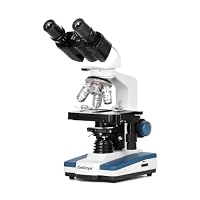

Prices are read from the Amazon product listing and change there, not here. Scores are out of 10, based on listed specifications and buyer feedback.
Why each one is on the list
- Slide Analysis with Basic Digital Capture: Choose the AmScope B120C-E1 LED Binocular Compound Microscope for cellular slide observation paired with an included 1.0 MP USB camera.
- Portable Field Work and Beginning Science: Choose the AmScope M150C1000X All-Metal Optical Glass Lenses for battery-powered operation and sturdy all-metal construction.
- Electronics Soldering and Circuit Inspection: Choose the AmScope SM-4TZ-144A Professional Trinocular Stereo Zoom for continuous zoom, long working clearance, and an adjustable double-arm boom stand.
- High-Resolution Digital Slide Documentation: Choose the AmScope B120 Series Student & Professional for detailed biological evaluation supported by a 5.0 MP camera and a 3D mechanical stage.
- Solid Object Inspection and Macro Dissection: Choose the AmScope SE306R-PZ Forward Binocular Stereo Microscope for straightforward dual lighting on fixed solid specimens.
01 AmScope B120C-E1 LED Binocular Compound Microscope

Best for Entry lab work and digital slide capture
Pros
- 40X to 2500X magnification range
- Even fly-eye LED illumination
- Includes 1.0 MP USB camera and software
Cons
- Modest camera resolution
- Operates only on 110V AC power
The AmScope B120C-E1 LED Binocular Compound Microscope delivers high-power biological magnification spanning from 40X up to 2500X. Designed as an optical platform for educational environments, clinical labs, and home laboratories, this compound unit features a binocular viewing head angled at a comfortable 30 degrees. The internal LED light system incorporates a specialized fly-eye lens designed to spread daylight-balanced illumination evenly across the field of view. This uniform beam ensures clear edge-to-edge observation of thin specimens without distracting hot spots or dark borders across the stage area.
For educators and creators needing immediate image archiving, the amscope b120c-e1 includes a 1.0 MP USB digital camera paired with dedicated microscopy software for Windows computers. Although 1.0 MP resolution is modest compared to standalone cameras, it reliably captures still images and video records for laboratory notes, classroom demonstrations, or online walkthroughs. While users focused on long-distance target optics might look to a cvlife crossbow scope for outdoor sightlines, this compound system prioritizes micro-scale focus accuracy via dual coarse and fine focus adjustments along a heavy metal and plastic frame.
This model is an exceptional solution for examining mounted slides, pond water bacteria, and blood smears. However, because it is a compound system with limited vertical objective clearance, it cannot accommodate solid three-dimensional items like mechanical parts or circuit boards. Those requiring higher digital resolution will prefer the 5.0 MP model in this same family, whereas users needing room to manipulate tools under the lens must look to a stereo platform instead.
- Magnification range extending from 40X to 2500X for detailed cellular and slide viewing
- Daylight-balanced LED illumination with specialized fly-eye lens for even field brightness
- Included 1.0 MP USB digital camera complete with Windows microscopy capture software
- Binocular viewing head set at an ergonomic 30-degree observation angle
02 AmScope M150C1000X All-Metal Optical Glass Lenses

Best for Students needing portable battery-powered slide inspection
Pros
- Dual AC or AA battery cordless power
- Rugged all-metal framework
- 360-degree rotating monocular head
Cons
- Monocular head lacks stereoscopic depth
- No digital camera included
The AmScope M150C1000X All-Metal Optical Glass Lenses is a durable biological compound microscope created for students, beginning hobbyists, and classroom use. Constructed on a sturdy all-metal framework, the amscope m150c utilizes all-optical glass elements that supply five fixed magnification settings: 40X, 100X, 250X, 400X, and 1000X. Its monocular head is set at a 45-degree angle to ease neck strain and rotates 360 degrees, allowing multiple people around a workspace to view the slide without repositioning the microscope base.
A primary mechanical advantage of this unit is its cordless operating capability. The built-in LED illumination system functions through a standard alternating current electrical outlet using the supplied adapter, or it can run untethered using three AA batteries. This makes the instrument one of the most versatile choices as the best amscope microscope for hobbyists engaged in outdoor fieldwork, nature study, or mobile classroom teaching. The stage includes a single lens condenser with an integrated disc diaphragm to manage beam intensity beneath the specimen.
The M150C features separate coarse and fine focusing knobs to assist users in acquiring sharp focal planes quickly. However, the monocular configuration lacks the natural binocular depth comfort found on higher-tier units, and the package does not include a digital capture camera. For introductory science study and portable slide analysis, this compact instrument provides dependable glass optics backed by a 5-year manufacturer warranty.
- Five magnification steps spanning 40X, 100X, 250X, 400X, and 1000X
- Dual-power LED system that runs on an electrical outlet or three AA batteries
- Full 360-degree rotating monocular head with a locked-in eyepiece
- Rugged all-metal body with optical glass lenses and independent coarse and fine focus knobs
03 AmScope SM-4TZ-144A Professional Trinocular Stereo Zoom

Best for Electronics technicians soldering and inspecting circuit boards
Pros
- Continuous 3.5X to 90X zoom range
- Double-arm boom stand with 3-axis mobility
- 144-LED 4-zone controllable ring light
Cons
- Requires large workbench space
- Camera sensor sold separately
The AmScope SM-4TZ-144A Professional Trinocular Stereo Zoom is an industrial-grade inspection microscope engineered for soldering, circuit board rework, and macro mechanical fabrication. Operating across an expansive 3.5X to 90X magnification range, this amscope stereo microscope provides genuine stereoscopic depth perception alongside a generous working distance above your subject. The 0.7X to 4.5X zoom objective delivers seamless continuous zoom adjustment, supplemented by an included 0.5X Barlow lens that extends the focal clearance for rework tools and a 2.0X Barlow lens that doubles the optical magnification.
The defining structural component of the amscope sm-4tz-144a is its double-arm boom stand. Featuring 20-inch horizontal arms seated on a 17-inch vertical column, the assembly lets users position the optical head smoothly along the X, Y, and Z axes. This freedom enables technicians to inspect large circuit boards, engine parts, or dental appliances without base interference. Specimen lighting is supplied by a removable 144-bulb LED ring light that includes rheostat intensity control and four separate lighting zones to eliminate reflections on shiny solder joints.
Because this platform uses a trinocular head, users can attach a third-party camera to the dedicated vertical port while keeping both WH10x super-widefield eyepieces active for simultaneous viewing. The mechanical stability and precision optical glass assembly reflect the meticulous manufacturing standards seen in premium spotting optics like a kowa spotting scope. Keep in mind that this professional workstation demands substantial bench area and does not come bundled with a digital camera sensor.
- Continuous 3.5X to 90X zoom range with included 0.5X and 2.0X Barlow lenses
- Heavy-duty double-arm boom stand delivering flexible three-axis positioning
- 144-bulb LED ring light featuring four independent lighting zones and rheostat control
- Trinocular viewing head with 45-degree inclination and a dedicated vertical camera port
04 AmScope B120 Series Student & Professional

Best for Educators requiring high-resolution digital slide documentation
Pros
- High-resolution 5.0 MP USB camera
- Smooth 3D mechanical stage translation
- Expansive 40X to 2500X magnification
Cons
- Unsuitable for solid opaque objects
- Requires computer connection for capture
The AmScope B120 Series Student & Professional compound microscope (model B120C-E5) is engineered for serious biological research and high-resolution digital imaging. Offering a magnification reach from 40X up to 2500X, this amscope b120 series model uses a daylight-balanced LED illumination system with a specialized fly-eye lens matrix to produce clear, even field lighting. Its Siedentopf binocular head is configured with a 90-degree real angle of view, providing ergonomic comfort for lab researchers and creators spending extended hours evaluating slides.
The major upgrade in this package is the included 5.0 MP USB digital camera paired with an interactive software kit. Compared to entry-level 1.0 MP sensors, this 5.0 MP camera captures fine cellular textures, crisp color gradations, and sharp still photos suitable for lab reports, tutorials, and video broadcasts. Specimen navigation is managed by an integrated 3D mechanical stage that allows precise micro-step movement along both horizontal and vertical axes, eliminating the need to push slide clips manually while tracking moving specimens.
Much like fine-tuning magnification on an optical instrument such as a vortex spotting scope, achieving sharp focus on high-power compound objectives demands smooth, calibrated movements through coaxial focus knobs. While this B120 platform excels at cellular microscopy, histology, and educational biology, its enclosed mechanical stage and tiny working distance make it unsuitable for physical soldering or macro object inspection.
- Magnification range from 40X up to 2500X for detailed microscopic observation
- 5.0 MP USB digital camera with professional imaging software for Windows
- Integrated 3D mechanical stage allowing smooth slide translation across X and Y axes
- Even LED illumination system incorporating an advanced fly-eye condenser lens
05 AmScope SE306R-PZ Forward Binocular Stereo Microscope
Best for Hobbyists inspecting solid objects and macro specimens
Pros
- Versatile top and bottom dual lighting
- Widefield optical glass elements
- Sturdy all-metal pillar stand
Cons
- Stepped magnification without continuous zoom
- Requires manual eyepiece swapping for 80X
The AmScope SE306R-PZ Forward Binocular Stereo Microscope is a dedicated low-magnification benchtop tool built on a rigid metal pillar stand. Equipped with pairs of WF10x and WF20x widefield optical glass eyepieces, this amscope se306r-pz instrument delivers three fixed stereoscopic magnification settings: 20X, 40X, and 80X. The forward-facing binocular head rests at a 45-degree incline, offering clear three-dimensional depth when examining geological samples, plant cuttings, insects, or small mechanical assemblies.
A notable feature of this microscope is its versatile dual-illumination system. The unit includes both built-in incident (top) illumination shining directly down onto solid subjects and transmitted (bottom) illumination projected through a frosted glass stage plate from the base. This dual-light flexibility lets users inspect opaque objects under top lighting, switch to bottom lighting for translucent biological mounts, or combine both light paths when evaluating complex materials on the stage.
Although the SE306R-PZ lacks the continuous zoom control and long reach of an articulated boom stand, its compact pillar base occupies minimal space on a home or workshop bench. Changing magnification requires manually swapping eyepieces or rotating the objective turret between settings. For makers, students, and hobbyists who want a dedicated stereoscopic platform without the footprint of an industrial boom arm, this unit offers durable metal construction backed by a 5-year manufacturer warranty.
- Three discrete stereo magnification settings: 20X, 40X, and 80X
- Dual lighting with independent incident top illumination and transmitted bottom lighting
- Rigid all-metal pillar stand with frosted stage plate and dual stage clips
- Forward widefield binocular head built with optical glass elements for 3D depth
What Sets These Models Apart
Deciding between these five instruments requires comparing optical architectures, magnification limits, illumination capabilities, and digital recording hardware. The table below outlines how these AmScope microscopes differ across fundamental specifications to help guide your purchasing decision.
| Model | Optical Type | Magnification Range | Illumination System | Digital Integration |
|---|---|---|---|---|
| AmScope B120C-E1 | Binocular Compound | 40X – 2500X | LED with Fly-Eye Lens (Transmitted) | 1.0 MP USB Camera with Software |
| AmScope M150C | Monocular Compound | 40X – 1000X | LED (Outlet or 3 AA Batteries) | None Included |
| AmScope SM-4TZ-144A | Trinocular Stereo Zoom | 3.5X – 90X (Continuous) | 144-Bulb 4-Zone LED Ring Light | Trinocular Port (Camera Sold Separately) |
| AmScope B120 Series (B120C-E5) | Binocular Compound | 40X – 2500X | LED with Fly-Eye Lens (Transmitted) | 5.0 MP USB Camera with Software |
| AmScope SE306R-PZ | Forward Binocular Stereo | 20X, 40X, 80X (Stepped) | Dual Incident (Top) and Transmitted (Bottom) | None Included |
Buying Tips for AmScope Microscopes
The primary decision when selecting a microscope is distinguishing between compound and stereo optical designs. Compound models, such as the B120C-E1, B120C-E5, and M150C, use multiple high-magnification lenses in series to observe light transmitting through paper-thin specimens on glass slides. Because the physical clearance between the objective lens and the slide is just a few millimeters, compound microscopes cannot accommodate tools, circuit boards, or large physical parts. If your bench activities center around cellular smears, biological fluids, or botany cross-sections, a compound microscope is the right tool.
Stereo microscopes, represented by the SM-4TZ-144A and SE306R-PZ, serve an entirely different purpose by providing low-power observation with true stereoscopic depth perception. With working distances often extending several inches below the objective, stereo instruments leave ample clearance for soldering irons, tweezers, and assembly tools. If your projects involve assembling small electronics, soldering surface-mount components, examining fossils, or repairing mechanical watch gears, you should choose a stereo microscope with incident illumination.
Consider your digital capture and documentation requirements before picking a model. If you intend to record video demonstrations, share findings with students, or take micro-measurements on a PC, buying a bundled package like the B120C-E1 or B120 Series ensures that the camera sensor and optical tube adapters fit together seamlessly out of the box. For workbench video capture during soldering or assembly tasks, choosing a trinocular stereo model ensures you can mount an external camera sensor without losing binocular viewing through the eyepieces.
FAQ
What is the difference between a compound microscope and a stereo microscope?
A compound microscope provides high magnification between 40X and 2500X to inspect microscopic specimens mounted on clear glass slides using transmitted light. A stereo microscope provides lower magnification, typically between 3.5X and 90X, offering true 3D spatial depth and long working clearance to view and work on solid, opaque objects like circuit boards.
Can I use the AmScope SM-4TZ-144A to view cellular biological slides?
While the SM-4TZ-144A can view macroscopic surface details of glass slides at low power, it cannot resolve individual cells or bacteria. Biological cellular study requires higher magnification ranges above 400X and transmitted substage condensers, which are found on compound microscopes like the B120 series and M150C.
How do the 1.0 MP and 5.0 MP cameras on the B120 models compare?
The 1.0 MP camera bundled with the B120C-E1 is suitable for basic digital previews, casual viewing, and simple record-keeping. The 5.0 MP camera included with the B120 Series (B120C-E5) captures higher pixel resolution, producing much sharper still images for publications, large computer monitors, and accurate digital measurements.
Can the AmScope M150C run without an electrical wall outlet?
Yes, the AmScope M150C features a versatile dual-power illumination design. It operates using the included alternating current wall power adapter or can run cordlessly using three AA batteries, making it suitable for field inspections and mobile learning environments.
What do Barlow lenses do on a stereo zoom microscope?
A Barlow lens modifies the optical magnification and working distance of a microscope. On the SM-4TZ-144A, the 0.5X Barlow lens halves magnification while dramatically increasing the physical working clearance for soldering tools, whereas the 2.0X Barlow lens doubles magnification for closer inspection of fine surface details.


