Anker Computers & Networking
Anker Docking Station Guide: Multi-Display Hubs for Creator Workflows
Selecting the right docking station kvm anker hardware is essential for creators, vloggers, and editors building efficient multi-device desktop workspaces. Modern video production requires substantial display bandwidth, reliable host charging, and dedicated peripheral routing to handle high-speed storage drives, audio interfaces, and external monitors simultaneously. Whether cutting multi-camera timelines or mastering multi-track audio, a robust…

As Amazon Associates, we earn from qualifying purchases. This means we may receive a small commission at no extra cost to you if you click through and make a purchase.
Selecting the right docking station kvm anker hardware is essential for creators, vloggers, and editors building efficient multi-device desktop workspaces. Modern video production requires substantial display bandwidth, reliable host charging, and dedicated peripheral routing to handle high-speed storage drives, audio interfaces, and external monitors simultaneously. Whether cutting multi-camera timelines or mastering multi-track audio, a robust hub eliminates desktop clutter and optimizes workflow responsiveness. Finding the ideal anker kvm docking station setup requires matching your computer operating system and monitor resolutions directly to dock hardware capabilities.
This anker docking station comparison reviews exactly 3 models made by Anker to determine which unit best fits your creative workstation. While all three hubs expand laptop connectivity over high-speed USB-C, they diverge in display management, charging capacities, and port architecture. One model utilizes DisplayLink drivers to run triple 4K monitors on Windows with smart diagnostic telemetry, another delivers native triple 1080p display support in a space-saving vertical chassis, and the third provides 160W multi-device charging with dual-display routing. Understanding these differences clarifies which anker docking station to buy.
Which Anker KVM Docking Stations Should You Buy
All 3 models on this page, side by side
| Model | Our score | Listing |
|---|---|---|
01 Anker Prime Docking Station |
Price | |
02 Anker Laptop Docking Station |
Price | |
03 Anker Prime Docking Station |
Price |
Prices are read from the Amazon product listing and change there, not here. Scores are out of 10, based on listed specifications and buyer feedback.
Why each one is on the list
- For Windows video editors needing three independent 4K displays and 140W host charging, choose the Anker Prime Docking Station.
- For space-conscious creators wanting triple 1080p monitors with an included 135W power adapter, select the Anker Laptop Docking Station.
- For gadget-heavy desks requiring simultaneous fast charging across multiple devices with dual display outputs, pick the secondary Anker Prime Docking Station.
03 Anker Prime Docking Station
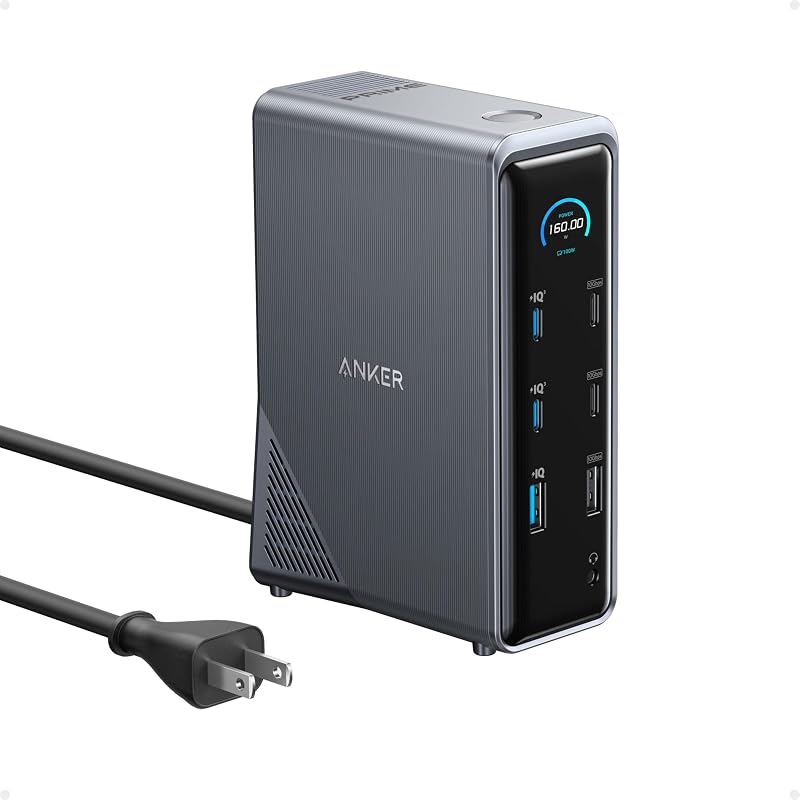
Best for Multi-device high-wattage accessory charging
Pros
- 160W total system charging output
- Three 100W USB-C charging ports
- 10 total high-speed USB ports
Cons
- Dual displays capped at 2K@60Hz
- Incompatible with Linux operating systems

Best for Triple 4K Windows editing workstations
Pros
- Triple 4K external display support
- 140W upstream laptop charging
- Built-in smart telemetry display
Cons
- Requires DisplayLink driver
- MacOS limited to mirrored displays
The Anker Prime Docking Station (model DL7400) is a 14-in-1 desktop hub built for demanding visual editing workflows. Functioning as an anker triple display dock, it incorporates DisplayLink graphics technology to run three external 4K monitors simultaneously on Windows 10 and 11 systems across two HDMI ports and one DisplayPort. This multi-display capacity enables video editors and visual artists to organize full-screen playback, complex timelines, and asset bins without display degradation. The dock sustains power-hungry workstations by delivering up to 140W upstream charging over a 10Gbps USB-C connection, supported by a 160W total wattage rating. If you use multiple external drives, our anker docking station usb c guide details how high-speed host ports balance bandwidth.
Peripheral distribution on this anker 14-in-1 docking station suits high-volume media ingestion and studio monitoring. Among its 7 total USB ports, two front 10Gbps USB-C ports and one 5Gbps USB-C port each provide up to 100W of rapid charging for cameras, mobile devices, and audio accessories. High-speed networking is anchored by a 2.5Gbps Ethernet port for smooth NAS transfers, complemented by a 3.5mm audio jack and integrated SD and microSD card slots. An integrated smart display provides real-time updates on charging wattage, display performance, and fan cooling managed by ActiveShield 3.0.
This model suits Windows editors and multitaskers requiring extensive triple 4K screen real estate. Note that DisplayLink driver installation is required, and DRM-protected streaming services like Netflix or Disney+ may output a black screen while audio plays, which can be resolved in web browsers by disabling hardware acceleration.
- Drives three external 4K displays simultaneously on Windows 10 and 11 using DisplayLink.
- Delivers up to 140W upstream laptop charging with two front 10Gbps USB-C ports providing up to 100W charging.
- Features 2.5Gbps Ethernet, a 3.5mm audio combo jack, and integrated SD and microSD slots.
- Includes a smart diagnostic display and ActiveShield 3.0 fan cooling for temperature control.
02 Anker Laptop Docking Station

Best for Space-saving desk triple display setups
Pros
- Includes 135W power adapter
- Compact vertical desk footprint
- Integrated 104 MB/s SD card reader
Cons
- Triple display capped at 1080p
- MacOS external display mirroring only
The Anker Laptop Docking Station provides a 13-in-1 workstation expansion designed to optimize desk space. Built in a vertical gray profile measuring 3.5 inches long, 1.6 inches wide, and 4.9 inches tall, this compact anker laptop docking station stands upright beside studio monitors to preserve precious desk area. It includes a 135W desktop power adapter in the box, delivering 85W of sustained host laptop charging while simultaneously providing 18W USB-C Power Delivery charging for mobile accessories and camera remotes.
Display connectivity relies on native Multi-Stream Transport across two HDMI ports and one DisplayPort. Users running Windows 10, Windows 11, or ChromeOS can configure triple extended displays at 1080p resolution at 60Hz, or power a single 4K display at 60Hz. Photographers benefit from front SD and microSD card slots transferring data at up to 104 MB/s, while external drives connect to a 10Gbps USB-C port. Three 5Gbps USB-A ports accommodate keyboards, mice, and studio peripherals, supported by Gigabit Ethernet and 3.5mm audio.
This dock suits hobbyists, podcasters, and general creators who want a clean vertical desk setup with triple 1080p display support. It requires host support for DisplayPort Alternate Mode and Power Delivery. Mac users should check an anker macbook dock overview, as macOS limits external displays on this MST dock to mirrored output.
- Expands laptop connectivity with 13 functional ports through a single upstream connection.
- Supplies 85W laptop charging and 18W phone charging using the included 135W power adapter.
- Supports triple 1080p@60Hz displays or a single 4K@60Hz screen on Windows and ChromeOS.
- Features built-in 104 MB/s SD and microSD card readers and a 10Gbps USB-C data port.
03 Anker Prime Docking Station
The secondary Anker Prime Docking Station serves as a high-capacity power and data station for gear-intensive creative desks. Generating 160W of total output wattage, this anker usb-c workstation dock charges up to four devices simultaneously through three USB-C ports that deliver up to 100W maximum each, alongside a 12W USB-A port. Creators juggling camera batteries, portable lights, tablets, and audio gear can power their equipment without cluttering their desks with individual wall adapters.
Data routing is handled by an expansive 10-port USB array within a 14-in-1 layout, supporting transfer speeds up to 10Gbps for rapid file movement between external drives. For video, the dock provides dual HDMI ports that drive two external displays up to 2K resolution at 60Hz on DisplayPort 1.4 laptops, or dual 1080p at 60Hz on DisplayPort 1.2 laptops. Users evaluating multi-monitor setups can consult an anker dual monitor hub comparison for additional setup perspectives.
This 14-in-1 model suits creators and vloggers managing numerous rechargeable production tools alongside high-speed external storage. It gives way to the triple-display DisplayLink dock when 4K resolution is required across external panels, as its video output tops out at 2K@60Hz and does not support 5120×1440 ultra-wide screens. It is also incompatible with Linux, and macOS laptops are limited to mirrored external displays.
- Delivers 160W total power to charge up to four devices at the same time.
- Features three high-speed USB-C charging ports capable of up to 100W output each.
- Provides 10 total USB ports supporting file transfer rates reaching up to 10Gbps.
- Drives dual displays up to 2K@60Hz via dual HDMI ports on DisplayPort 1.4 systems.
What Sets These Models Apart
Understanding how these Anker hubs differ helps determine which anker multi monitor docking station fits your workspace requirements. The triple-display DisplayLink Prime dock emphasizes ultra-high video bandwidth with triple 4K output on Windows and smart screen telemetry. The vertical 13-in-1 dock provides an all-in-one solution with an included 135W power adapter and compact vertical housing for triple 1080p setups. The dual-display Prime dock functions as an intense multi-device charging hub with three 100W USB-C ports and a massive 10-port USB array.
| Feature | Anker Prime Docking Station (Triple Display) | Anker Laptop Docking Station (13-in-1) | Anker Prime Docking Station (Dual Display) |
|---|---|---|---|
| Display Output | Triple 4K via DisplayLink (2x HDMI, 1x DP) | Triple 1080p@60Hz or single 4K@60Hz (2x HDMI, 1x DP) | Dual 2K@60Hz via DP 1.4 or dual 1080p (2x HDMI) |
| Host Charging | 140W upstream via USB-C (160W total wattage) | 85W host charging (135W power adapter included) | 100W upstream via USB-C (160W total wattage) |
| USB Port Count | 7 USB ports (10Gbps USB-C and 5Gbps USB-A) | 4 USB ports (10Gbps USB-C, 5Gbps USB-A) | 10 USB ports (up to 10Gbps data speeds) |
| Special Features | Smart display, active fan, 2.5Gbps Ethernet | Vertical chassis, Gigabit Ethernet, SD reader | Three 100W USB-C charging ports, dual HDMI |
Buying Tips for Anker KVM Docking Stations
Before choosing an anker kvm docking station, confirm your laptop port capabilities. Native multi-display hubs relying on Multi-Stream Transport require a host USB-C port supporting DisplayPort Alternate Mode and Power Delivery. In contrast, DisplayLink hubs transmit graphical data over standard USB channels via software drivers, allowing triple 4K output on compatible Windows laptops even when native video lines are limited. You can check our anker computer hub analysis for further details on how protocol variations affect multi-monitor setups.
Power capacity is another key factor for creator setups. Video rendering and audio production draw substantial power from host laptops. Make sure your chosen dock supplies equal or higher upstream wattage than your laptop stock charger to avoid battery drain during intense rendering sessions. Additionally, review whether the dock includes its own power supply or requires an external adapter.
Finally, balance peripheral bandwidth across your available ports. If your workflow involves transferring large video files from SD cards while working off an external solid-state drive, ensure your dock features separate 10Gbps data ports. Placing lower-speed devices like keyboards and mice on 5Gbps or 480Mbps ports prevents bus congestion and keeps high-speed storage running smoothly.
FAQ
Do Anker docking stations support extended displays on macOS?
On both the 13-in-1 Anker Laptop Docking Station and the dual-monitor Anker Prime Docking Station, macOS restricts connected external monitors to mirrored mode, meaning all external screens display identical video output. While data transfer and laptop charging function normally on Mac hardware, users needing independently extended dual or triple displays on macOS must verify host multi-stream support or look into DisplayLink solutions with appropriate software drivers installed.
Why does video streaming show a black screen on the DisplayLink Prime dock?
On the DisplayLink-powered Anker Prime Docking Station, digital rights management (DRM) restrictions can prevent protected streaming video from displaying properly. When using platforms like Netflix, Prime Video, or Disney+, the DisplayLink driver may show a black screen while audio plays. Anker explains that this can be fixed when streaming in a web browser by disabling hardware acceleration in the browser settings.
What is the difference between DisplayLink technology and native DP Alt Mode?
DisplayPort Alternate Mode delivers uncompressed video signals directly from your computer graphics processor through dedicated physical wires in the USB-C cable without requiring extra software drivers. DisplayLink uses host software drivers to compress video data into standard USB packets, sending them to an internal chip in the dock that outputs the video to external monitors.
Can the front USB-C ports on Anker Prime docks connect external monitors?
No, the front USB-C ports on these Anker Prime docking stations are designed for high-speed data transfer and high-wattage device charging only. While they supply up to 100W of charging power and 10Gbps data rates, they do not support DisplayPort Alternate Mode video output. External monitors must be plugged into the dedicated HDMI or DisplayPort connections.
Does the Anker Laptop Docking Station include a power supply?
Yes, the 13-in-1 Anker Laptop Docking Station includes a 135W DC power adapter in the package. This adapter provides up to 85W of charging power to the connected laptop while simultaneously supplying 18W to the front USB-C charging port for mobile devices, along with running all connected peripherals.


