Gskyer Tools & Outdoors
Gskyer Astronomical Refracting Telescopes: Complete Model Comparison
A dependable gskyer astronomical refracting telescope balances objective lens aperture, steady tripod mounting, and accessible smartphone integration to deliver rewarding views of the night sky. Refracting telescopes are particularly popular among amateur stargazers, families, and content creators because their sealed optical tubes require virtually no routine optical collimation, resist internal dust accumulation, and yield crisp,…
As Amazon Associates, we earn from qualifying purchases. This means we may receive a small commission at no extra cost to you if you click through and make a purchase.
A dependable gskyer astronomical refracting telescope balances objective lens aperture, steady tripod mounting, and accessible smartphone integration to deliver rewarding views of the night sky. Refracting telescopes are particularly popular among amateur stargazers, families, and content creators because their sealed optical tubes require virtually no routine optical collimation, resist internal dust accumulation, and yield crisp, high-contrast imagery of lunar topography and bright planetary targets. Choosing the proper instrument depends heavily on whether your observation workflow centers on quick grab-and-go travel sessions, backyard planetary imaging, or learning manual equatorial tracking for deeper celestial targets.
This comprehensive gskyer telescope comparison evaluates four distinct optical systems from Gskyer to determine which gskyer telescope to buy for your personal skywatching environment. Across the lineup, you will find compact 70mm and 80mm travel refractor options with dedicated phone adapters, an extended focal length 90mm refractor engineered for higher optical power, and an aperture-rich 130mm Newtonian reflector that utilizes a German equatorial mount. While all four packages include Barlow lenses and optical-grade coatings, their mechanical mountings, physical tube lengths, and light-gathering capacities address notably different viewing priorities.
Which Gskyer Refracting Telescopes Should You Buy
All 4 models on this page, side by side


Prices are read from the Amazon product listing and change there, not here. Scores are out of 10, based on listed specifications and buyer feedback.
Why each one is on the list
- Travel-focused stargazers, outdoor hikers, and casual beginners who want maximum portability and a dedicated storage pack will get the most utility from the 70mm Gskyer Telescope.
- Backyard lunar observers and planetary enthusiasts seeking higher focal magnification with an upright terrestrial viewing prism should choose the Gskyer Telescope 600x90mm AZ Astronomical Refractor.
- Deep sky hobbyists and aspiring astrophotographers who require maximum light gathering and slow-motion celestial tracking should step up to the Gskyer 130EQ Professional Astronomical Reflector Telescope.
- Students and astronomy beginners who need extra stability via a stainless steel tripod platform and enhanced 80mm light gathering should select the 80mm Gskyer Telescope.
04 Gskyer Telescope
Best for Students and families wanting steady backyard stargazing
Pros
- Rigid adjustable stainless steel tripod
- Upgraded 80mm light-gathering aperture
- High quality BAK4 erecting prism
Cons
- Narrower 0.87-degree field of view
- Lower optical magnification ceiling than 130EQ

Best for Beginner skywatchers prioritizing portable travel observation
Pros
- Includes custom travel carry bag
- Smartphone adapter and wireless shutter remote
- Fully coated optical glass lens
Cons
- Modest 70mm aperture for deep sky
- Lightweight aluminum tripod prone to vibrations
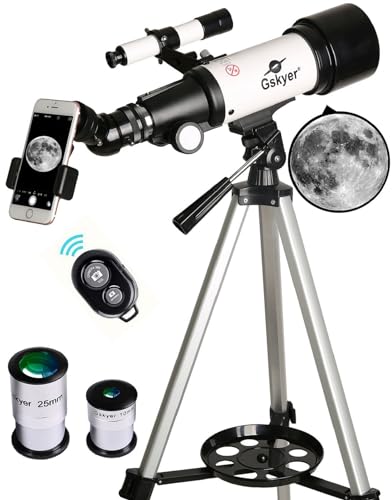
The 70mm Gskyer Telescope serves as an ultra-portable optical system tailored specifically for beginners, students, and traveling hobbyists. Featuring an objective lens aperture of 70mm paired with a 400mm focal length at an f/5.7 focal ratio, this compact optical tube collects ample light to reveal crisp details along the lunar terminator line, bright star clusters, and prominent terrestrial landmarks. Its optical glass lens elements are fully coated with high-transmission optical films to enhance image brightness while keeping internal reflections under control.
For mobile creators and skywatchers eager to document lunar cycles, this model includes a custom gskyer telescope phone adapter setup along with a wireless camera remote. This mobile bundle allows you to mount your smartphone directly over the eyepiece and trigger exposures without physically touching the phone screen, thereby eliminating vibration blur during sensitive night captures. If you spend extended nights documenting observation sessions in remote dark-sky locations, keeping your mobile accessories powered with an anker multi charger ensures your phone battery stays topped off throughout long imaging windows.
The mechanical assembly is anchored by a lightweight altazimuth mount attached to an adjustable aluminum alloy tripod. A 5×24 finderscope with internal cross-hair lines helps you pinpoint bright targets before looking through the primary eyepiece. The full assembly packs neatly inside the included canvas travel carry bag, making it an exceptional grab-and-go choice. However, its lightweight aluminum legs and modest 70mm aperture yield to larger aperture models in the lineup when pushing magnification past 100x or targeting faint deep-sky targets.
- Features a 70mm aperture and 400mm (f/5.7) focal length with fully coated optical glass lenses.
- Includes two replaceable eyepieces and a 3x Barlow lens that trebles magnifying power up to a 120x zoom ratio.
- Comes equipped with a 5×24 optical finderscope with mounting bracket and internal crosshairs for fast target acquisition.
- Supplied with a tailored carry bag, smartphone adapter, wireless camera shutter remote, and an adjustable aluminum alloy tripod.
02 Gskyer Telescope 600x90mm AZ Astronomical Refractor

Best for Adult hobbyists seeking high magnification planetary views
Pros
- Large 90mm objective lens aperture
- Three included eyepieces plus 3x Barlow
- Erecting BAK7 prism for terrestrial use
Cons
- Heavier 17.5-pound total system weight
- Longer 60-centimeter optical tube
Stepping up substantially in focal reach and resolving power, the Gskyer Telescope 600x90mm AZ Astronomical Refractor targets adult hobbyists and serious beginners who demand sharper planetary and lunar observations. With its generous 90mm objective lens and 600mm focal length operating at f/6.7, this refractor collects significantly more incoming light than smaller travel tubes. The multi-coated glass optical components deliver crisp, high-contrast imagery, making it well-suited for resolving lunar craters, Jupiter’s Galilean moons, and terrestrial landscapes across long viewing distances.
This refractor package includes three distinct eyepieces providing native 24X, 60X, and 120X magnification levels, alongside a 3x Barlow lens to multiply potential magnification for planetary analysis. Gskyer pairs the optical tube with a 48-degree erecting BAK7 prism, ensuring that daytime terrestrial viewing produces upright, correctly oriented images rather than inverted astronomical perspectives. A larger 6×30 finderscope offers superior light transmission over smaller finder scopes, allowing observers to center dim targets in the field of view with minimal effort.
The telescope mounts to an adjustable aluminum tripod with working heights extending from 31.5 inches to 49 inches, accommodating both seated and standing observers. At a total system weight of 17.5 pounds and an optical tube length of 60 centimeters, this refractor establishes a sturdy, semi-permanent observation station for patios and backyards. While it sacrifices the shoulder-pack mobility of 70mm travel designs, it provides a stable altazimuth platform with simple tool-free assembly and includes astronomy software to guide evening observation plans.
- Equipped with a 90mm objective aperture and 600mm (f/6.7) focal length using multi-coated glass optics.
- Includes three eyepieces (24X, 60X, 120X), a 3x Barlow lens, and an upgraded 6×30 finderscope.
- Features a 48-degree erecting BAK7 prism for correct-image terrestrial viewing as well as sky observation.
- Supported by a heavy-duty aluminum tripod adjustable between 31.5 inches and 49 inches in height.
03 Gskyer 130EQ Professional Astronomical Reflector Telescope

Best for Amateur astronomers tracking faint celestial objects
Pros
- Wide 130mm light-gathering primary mirror
- German equatorial mount for celestial tracking
- Bluetooth camera remote without app setup
Cons
- Equatorial mount requires polar alignment setup
- Reflector design requires open tube maintenance
The Gskyer 130EQ Professional Astronomical Reflector Telescope represents a major departure in optical and mechanical design from the brand’s refractor lineup. Built around a 130mm (5.1-inch) Newtonian reflector primary mirror with an all-glass optical pathway, this telescope gathers substantially more light than refractor tubes in the same class. Its 650mm focal length and fast f/5 focal ratio produce exceptionally bright optical views, making it a capable tool for examining the Moon, planetary surfaces, brighter nebulae, open star clusters, and Andromeda.
Unlike altazimuth designs that adjust simply up-down and left-right, the 130EQ utilizes a German equatorial mount (EQ-130). This precision mounting mechanism allows users to align one axis with Earth’s polar rotational axis, enabling smooth single-axis manual tracking as celestial targets move across the night sky. The optical tube incorporates a toothless focusing base that provides smooth, precise micro-adjustments without gear slippage. Gskyer also bundles a Bluetooth camera remote compatible with iPhone and Android devices, allowing vibration-free snapshot capture without requiring dedicated app installations.
When you finish a long evening tracking celestial coordinates and return inside to log celestial coordinates or catalog astrophotography clips at your editing desk, using a supportive paylesshere home office chair desk computer chair adjustable ergonomic chair lumbar support armrest helps maintain comfort during late-night processing. While the 130EQ provides the greatest light grasp and a 307X maximum magnification ceiling in the Gskyer collection, its equatorial counterbalance system and open reflector tube require a higher learning curve during setup compared to instant altazimuth refractors.
- Features a 5.1-inch (130mm) primary mirror aperture with a fast 650mm (f/5) focal configuration.
- Engineered with an EQ-130 German equatorial mount for smooth manual tracking along celestial right ascension.
- Equipped with a smooth toothless focusing base, 3 eyepieces, a 3X Barlow lens, and a reflex finderscope.
- Includes a Bluetooth camera remote compatible with iOS and Android devices for wireless shutter triggering.
04 Gskyer Telescope
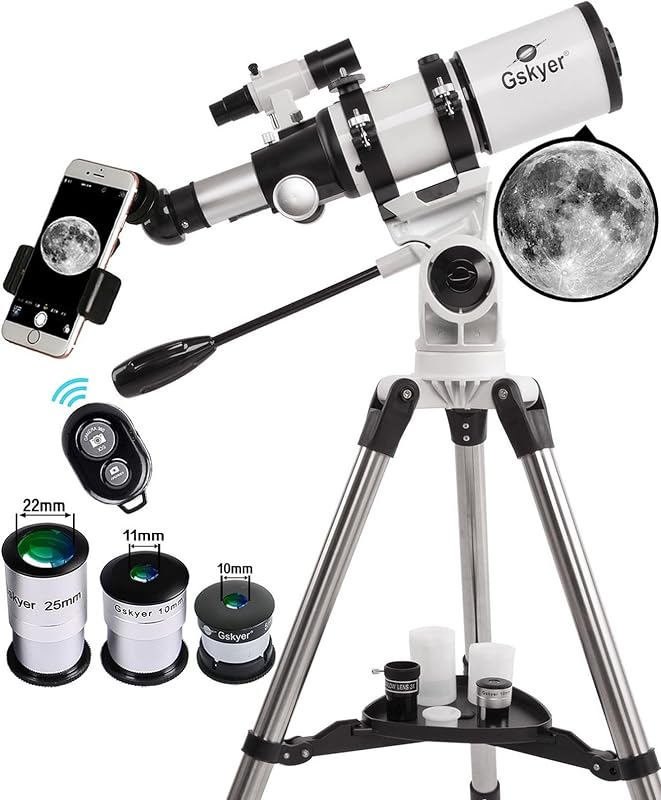
Balancing substantial light collection with manageable physical proportions, the 80mm Gskyer Telescope refractor is specifically configured for families, inquisitive young students, and beginner skywatchers. With an 80mm (3.15-inch) optical glass aperture and a 400mm focal length, this optical tube captures noticeably more light than a 70mm lens while maintaining a compact 40-centimeter optical tube profile. The glass lens assembly is fully coated with high-transmission optical films that elevate image clarity while shielding observer vision during high-contrast observation.
The kit features three distinct eyepieces (a 25mm for 16X, a 10mm for 40X, and a 5mm for 80X) alongside a 3X Barlow lens that expands practical observation options up to an 80x zoom ratio. To ensure crystal-clear visual performance for both lunar gazing and daytime nature observation, Gskyer equips this model with a premium 48-degree erecting BAK4 prism and an optical 6*30 finderscope complete with a sturdy mounting bracket. An integrated smartphone attachment and Bluetooth shutter remote streamline the process of snapping clear moon pictures through the eyepiece barrel.
A notable mechanical upgrade on this 80mm configuration is its full-size adjustable stainless steel tripod, which provides greater torsional rigidity and vibration damping than standard lightweight aluminum tubes. An integrated accessory tray keeps secondary eyepieces organized and off damp grass. If you review captured smartphone moon photography or digital star charts alongside your telescope station, examining images on a calibrated screen such as an acer 27 inch monitor reveals fine crater details captured by the 80mm lens. While its 0.87-degree field of view is narrower than the ultra-wide 70mm travel model, the added optical aperture and stainless steel mount create a steadier viewing experience.
- Features an 80mm (3.15-inch) aperture and 400mm focal length optical tube with fully coated glass optics.
- Includes three distinct eyepieces (16X, 40X, 80X), a 3X Barlow lens, and a 6*30 optical finderscope with bracket.
- Equipped with an erecting 48-degree BAK4 glass prism for upright terrestrial viewing and crisp lunar contrast.
- Supported by a heavy-duty adjustable stainless steel tripod with an accessory tray, phone adapter, and Bluetooth remote.
What Sets These Models Apart
| Model | Optical Design & Aperture | Focal Length & Ratio | Mount Type | Tripod Construction |
|---|---|---|---|---|
| Gskyer Telescope (70mm) | 70mm Refractor | 400mm (f/5.7) | Altazimuth (AZ) | Adjustable Aluminum Alloy |
| Gskyer Telescope 600x90mm AZ Astronomical Refractor | 90mm Refractor | 600mm (f/6.7) | Altazimuth (AZ) | Adjustable Aluminum (31.5 to 49 in) |
| Gskyer 130EQ Professional Astronomical Reflector Telescope | 130mm (5.1 in) Reflector | 650mm (f/5) | German Equatorial (EQ-130) | Adjustable Full Size |
| Gskyer Telescope (80mm) | 80mm Refractor | 400mm (f/5) | Altazimuth (AZ) | Adjustable Stainless Steel |
Buying Tips for Gskyer Refracting Telescopes
When selecting among gskyer refracting telescopes, aperture size serves as the most critical optical specification. Aperture dictates how much light the telescope gathers, directly influencing how bright faint deep-sky targets appear and how clearly fine planetary surface details can be resolved. A 70mm refractor offers brilliant wide-field views of the Moon’s seas and larger star clusters while remaining exceptionally light. Moving up to an 80mm or 90mm objective lens markedly enhances brightness and contrast, allowing you to see smaller lunar rilles, cloud bands on Jupiter, and the rings of Saturn from suburban backyards.
Mounting stability is equally vital when choosing an astronomical instrument. Altazimuth mounts, found on the 70mm, 80mm, and 90mm Gskyer refractors, operate with simple vertical and horizontal panning motions that are intuitive for beginners, children, and terrestrial spotting. However, for serious sky tracking, an equatorial mount like the EQ-130 requires initial polar alignment but rewards the observer with continuous single-axis tracking of celestial bodies as the Earth rotates. Furthermore, tripod materials impact real-world use: aluminum tripods prioritize lightweight transport, whereas stainless steel tripods offer superior vibration dampening when focusing at higher magnifications.
Eyepiece selection and smartphone capture accessories round out your viewing workflow. Gskyer telescopes incorporate modular 1.25-inch eyepiece barrels compatible with the included 3x Barlow lenses. For best optical results, always locate targets using your lowest magnification eyepiece first before introducing higher-magnification oculars or Barlow elements. When utilizing the mobile phone adapter, ensure the phone camera lens is aligned directly over the optical center of the eyepiece before tightening the retention clamp, and deploy the included wireless Bluetooth remote to capture photos without shaking the optical tube.
FAQ
How do you set up the Gskyer telescope phone adapter for smartphone photography?
To configure the smartphone adapter, attach your chosen eyepiece into the telescope diagonal or focusing drawtube and bring your target into sharp manual focus. Next, clamp your smartphone into the adapter bracket so that your primary phone camera lens aligns precisely over the center of the adapter opening. Slide the adapter collar over the eyepiece housing, tighten the retention knob firmly, and adjust your phone’s digital display to center the circular field of view. Trigger exposures using the supplied wireless Bluetooth remote to prevent camera shake.
What is the difference between an altazimuth mount and an equatorial mount on Gskyer telescopes?
An altazimuth (AZ) mount moves in two intuitive axes: altitude (up and down) and azimuth (left and right), functioning very much like a standard camera tripod. This makes altazimuth refractors quick to set up for both terrestrial and astronomical viewing. An equatorial (EQ) mount has its polar axis angled to match Earth’s rotational axis. Once aligned with the celestial pole, observers only need to adjust a single slow-motion control knob to track celestial objects as they drift across the night sky.
What celestial objects can you see with a 70mm or 80mm Gskyer refractor?
Both 70mm and 80mm Gskyer refractors provide stunning, detailed views of lunar craters, mountain ridges, and maria along the Moon’s day-night terminator. In dark skies, they easily resolve Jupiter and its four bright Galilean moons, Saturn’s primary ring system, the phases of Venus, double stars like Albireo, and open star clusters such as the Pleiades. Deep-sky targets like the Orion Nebula and Andromeda Galaxy are visible as faint, luminous patches.
When should you use the 3x Barlow lens included with Gskyer telescopes?
The 3x Barlow lens trebles the magnifying power of any eyepiece it is paired with. You should use the Barlow lens primarily on bright targets such as the Moon, Jupiter, or Saturn on nights with calm, clear atmospheric conditions. To maintain optical clarity, it is best to combine the Barlow lens with lower-magnification eyepieces (such as a 25mm or 20mm) rather than pairing it with ultra-short focal length oculars, which can produce dim, difficult-to-focus images if atmospheric seeing is unstable.
Do Gskyer refracting telescopes require optical collimation or complex maintenance?
No, Gskyer refracting telescopes feature permanently aligned optical glass lenses sealed inside rigid metal tubes, which eliminates the need for routine collimation. Unlike Newtonian reflector telescopes that rely on exposed mirrors requiring periodic alignment and dust cleaning, refractors maintain their optical calibration over years of normal use. Maintenance is limited to dusting the exterior tube and using dedicated optical lens cloths and cleaning solutions on exposed lens surfaces when necessary.


