Homey vs Quoya: Smart Home Hubs Compared by Specs
This guide compares Homey and Quoya smart home hubs using published specifications. You see protocol support, voice integration, and local automation details for 2 products.

As Amazon Associates, we earn from qualifying purchases. This means we may receive a small commission at no extra cost to you if you click through and make a purchase.
As an Amazon Associate we earn from qualifying purchases. Links on this page are affiliate links.
You are looking at the homey vs quoya smart home hub comparison, but these devices serve different roles. Homey is a central automation hub that connects various smart devices using multiple wireless protocols. Quoya is a motorized curtain track that integrates with voice assistants for window covering control. Both support Alexa and Google Home, yet their functions and connectivity methods differ significantly. You need to decide which fits your automation needs.
Primary Function
Smart Home Hub
Motorized Curtain Track
Wireless Protocols
Zigbee, Matter, Thread
Wi-Fi
Network Connectivity
Ethernet
Wired Power
Control Method
App, Voice, Desktop App
App, Remote, Voice
Color
Black
White
Choose the first if
- You need a central hub to manage multiple device types via Zigbee or Thread.
- You prefer local processing and Ethernet connectivity for reliability.
- You want to build advanced workflows using a desktop app.
Choose the second if
- You specifically want to automate curtain opening and closing.
- You prefer a simple Wi-Fi connection without extra hardware.
- You want a physical remote control included for manual operation.
Verdict
Choose Homey if you need a versatile hub to unify many smart devices. Choose Quoya if your primary goal is motorized window treatments. They solve different problems within a smart home setup.
Homey Hub vs Quoya Curtain Specs
smart home compatibility
Edge: Homey Pro mini Black Hub
Homey Pro mini supports a broad range of protocols including Zigbee, Matter, and Thread, with optional Z-Wave, Bluetooth, and Infrared via a separate bridge. It integrates with Apple Siri, Amazon Alexa, and Google Home. Quoya QL600 connects via Wi-Fi to the Tuya or Smart Life app. It works with Amazon Alexa and Google Home for voice control. Homey offers deeper local automation and multi-protocol support. Quoya focuses on simple curtain control through standard smart home ecosystems. Homey handles more device types and complex workflows.
wireless connectivity
Edge: Homey Pro mini Black Hub
Homey Pro mini uses Ethernet for its network connection, ensuring a stable wired link to your router. It processes data locally for privacy and reliability. Quoya QL600 connects via Wi-Fi to the Tuya or Smart Life app. It also supports a battery-powered option with a Zigbee hub, though the listed model is wired Wi-Fi. Homey provides a dedicated Ethernet port for consistent performance. Quoya relies on wireless Wi-Fi connectivity. Homey’s wired approach may offer better stability for critical automations compared to Wi-Fi.
automation features
Edge: Homey Pro mini Black Hub
Homey Pro mini features Homey Flow for creating personalized routines. You can build advanced workflows using the desktop app. It supports local data processing, allowing automations to run even when the internet is down. Quoya QL600 offers automatic opening and closing schedules. You can set one-way or two-way central opening. It adapts to window types and includes a remote. Homey provides comprehensive, customizable automation across many devices. Quoya offers specific scheduling for curtains. Homey is better for complex, multi-device routines.
build and size
Edge: Quoya QL600 Motorized Curtain Track
Homey Pro mini is a compact black hub measuring 3.9 inches by 3.9 inches by 1 inch. It is designed for discreet placement. Quoya QL600 is a white motorized track with a reinforced aluminum rail. It comes in sections up to 118 inches long. The track weighs 6.61 pounds. Homey is a small, portable hub. Quoya is a large, structural component for windows. Homey fits easily on a shelf. Quoya requires ceiling or wall mounting. The size difference reflects their different roles in the smart home.
privacy and backups
Edge: Homey Pro mini Black Hub
Homey Pro mini emphasizes privacy with local data processing. You can back up settings and automations locally or to the cloud. This ensures you can restore your setup anytime. Quoya QL600 uses the Tuya or Smart Life app for control. It does not mention local processing or user-controlled backups in the provided data. Homey gives you direct control over your data storage. Quoya relies on the app provider’s cloud infrastructure. Homey offers stronger privacy controls for your automation settings.
Which hub suits your setup best
You want full local automation and privacy
Our pick: Homey Pro mini Black Hub
Homey Pro mini processes data locally, keeping your information secure even if the internet goes down. It supports Zigbee, Matter, and Thread natively, with optional Z-Wave and Bluetooth via a bridge. You get unlimited features without a subscription, making it ideal for complex routines and device management.
You need quiet, motorized curtains
Our pick: Quoya QL600 Motorized Curtain Track
Quoya QL600 is a motorized curtain track, not a hub. It features a whisper-quiet motor and hidden brackets for a clean look. The system connects via Wi-Fi to the Tuya app, allowing voice control with Alexa or Google Home. It includes all hardware needed for installation and automation scheduling.
You seek broad brand compatibility
Our pick: Homey Pro mini Black Hub
Homey Pro mini works with over 1000 brands, integrating popular devices like Sonos, Ecobee, and Yale. Its multi-protocol support ensures seamless connection with Zigbee, Matter, and Thread devices. You can build advanced workflows using the desktop app, ensuring all your smart home gear operates from a single, reliable interface.

Homey Pro mini Black Hub
Best for: local automation with Matter and Thread
- Wireless Protocols
- Zigbee, Matter, Thread
- Ecosystem Compatibility
- Apple Siri, Amazon Alexa, Google Home
- Network Connectivity
- Ethernet
- Smart Home Compatibility
- Amazon Alexa, Google Assistant, Apple HomeKit, Matter
- Color
- Black
- Dimensions
- 3.9 × 3.9 × 1 inches
The Homey Pro mini is a compact smart home hub measuring 3.9 by 3.9 by 1 inches. It supports Zigbee, Matter, and Thread protocols with Ethernet connectivity. You can automate devices using Homey Flow and manage routines via the desktop app. The hub works with Apple Siri, Amazon Alexa, and Google Home. It processes data locally for privacy and requires no subscription for cloud services or remote access.
- Supports Zigbee, Matter, and Thread protocols
- Uses Ethernet for wired network connectivity
- Compatible with Apple Siri, Alexa, and Google Home
- Offers local data processing for privacy
- No monthly subscription required for features
- Z-Wave, Bluetooth, and Infrared require the separate Homey Bridge
- Compact 1-inch height may limit internal component cooling options
- Smaller form factor compared to full-sized hubs
- You want local control without monthly fees
- You use Matter and Thread devices
- You prefer Ethernet over Wi-Fi for stability
- You need Z-Wave or Infrared without buying extra hardware
- You prefer Wi-Fi connectivity over Ethernet
- You want a hub with built-in Z-Wave support
Verdict: Homey Pro mini Smart Hub is a compact, subscription-free hub for users who value local processing and modern protocols like Matter and Thread. It suits those who already own or plan to buy the Homey Bridge for Z-Wave and Infrared support.
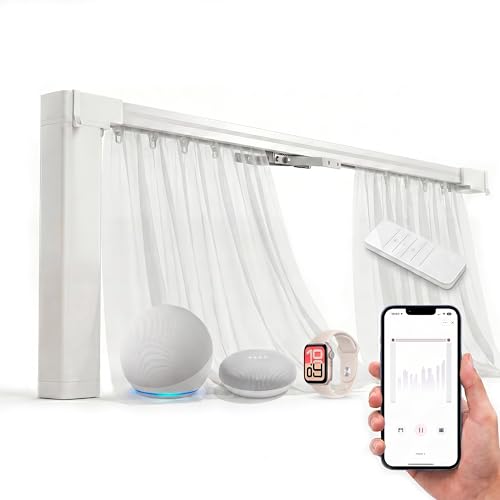
Quoya QL600 Motorized Curtain Track
Best for: standard windows with hidden ceiling mounts
- Ecosystem Compatibility
- Alexa, Google Home
- Wireless Connectivity
- Wi-Fi
- Color
- White
- Control Method
- App Control, Remote Control, Voice Control
- Dimensions
- 1.2 × 118 × 118 inches
- Weight
- 6.61 pounds
The Quoya QL600 is a motorized electric curtain track with a 118-inch width. It connects via Wi-Fi to Alexa and Google Home for voice control. The system includes a remote and app scheduling. It uses hidden ceiling brackets for a clean look. This white track fits standard curtain hooks. It suits you if you want automated window treatments without visible hardware.
- Supports Alexa and Google Home voice commands
- Includes remote control and app scheduling
- Uses hidden clip-on ceiling brackets
- Reinforced aluminum rail for smooth operation
- 118-inch width is smaller than the 16.4 ft and 22.9 ft options available
- Requires separate purchase of wall bracket kits for non-ceiling mounting
- Wired power connection limits placement flexibility compared to battery models
- You want hidden brackets for a seamless ceiling look
- You use Alexa or Google Home for voice control
- Your window fits within the 118-inch track width
- You need wall mounting without buying extra brackets
- You prefer battery-powered operation for easier installation
- Your window exceeds the 118-inch maximum width
Verdict: Quoya QL600 118 in Motorized Curtain Track is a solid choice for standard-sized windows where you prioritize a clean, hidden aesthetic and voice control integration.
Specifications side by side
| Spec | Homey Pro mini Black Hub | Quoya QL600 Motorized Curtain Track |
|---|---|---|
| Wireless Protocols | Zigbee, Matter, Thread | – |
| Ecosystem Compatibility | Apple Siri, Amazon Alexa, Google Home | Alexa, Google Home |
| Network Connectivity | Ethernet | – |
| Smart Home Compatibility | Amazon Alexa, Google Assistant, Apple HomeKit, Matter | – |
| Wireless Connectivity | – | Wi-Fi |
| Color | Black | White |
| Connectivity | Thread | Wired |
| Wireless Protocol | Zigbee | – |
| Control Method | Alexa | App Control, Remote Control, Voice Control |
| Wired Connectivity | Ethernet | – |
| Compatibility | Google Home | – |
| Dimensions | 3.9 × 3.9 × 1 inches | 1.2 × 118 × 118 inches |
| Weight | – | 6.61 pounds |
| Model | HOMEY-PRO-MINI-US-01 | QL600 |
| Size | – | Up to 9.8 ft / 118 in (3 m) |
Frequently asked questions
Can Homey Pro mini control Quoya QL600 curtains?
Yes, you can link them if you use a compatible voice assistant. Homey supports Amazon Alexa, Google Home, and Apple HomeKit. Quoya QL600 offers voice control. You likely need to connect both devices to the same assistant app to enable cross-device routines and commands.
Does Homey Pro mini require a subscription?
No, the Homey Pro mini operates without a monthly fee. It is designed as a subscription-free hub. This allows you to manage local automation and modern protocols like Matter and Thread without recurring costs. You only pay for the hardware itself.
How large is the Homey Pro mini hub?
The Homey Pro mini is compact, measuring 3.9 inches in width and length. Its height is just 1 inch. This small footprint makes it easy to place on a shelf or desk without taking up much space in your home automation setup.
What wireless protocols does Homey support natively?
Homey Pro mini supports Zigbee, Matter, and Thread. It also connects via Ethernet. For Z-Wave and Infrared, you need the separate Homey Bridge. This native support helps you connect a wide variety of smart devices directly to the hub.
How long can the Quoya QL600 curtain track be?
The Quoya QL600 supports tracks up to 118 inches, or about 9.8 feet. This length suits standard windows. The track is white and weighs 6.61 pounds. It uses Wi-Fi for connectivity and allows control via app, remote, or voice commands.
Is Homey compatible with Apple HomeKit?
Yes, Homey Pro mini works with Apple HomeKit. It also supports Amazon Alexa and Google Home. This broad compatibility lets you choose your preferred assistant. You can control your smart home devices using Siri, Alexa, or Google Assistant through the Homey ecosystem.


