Sony Cameras & Drones
Sony G Lens Buyer’s Guide: Finding the Right Optic for Your Setup
Selecting the right optic for an E-mount camera body comes down to matching focal range, aperture, and autofocus capabilities to your actual production environment. Whether you are framing talking-head video, balancing a camera on a motorized gimbal, capturing field sports, or shooting street photography, Sony offers specialized optics engineered to take advantage of its camera…

As Amazon Associates, we earn from qualifying purchases. This means we may receive a small commission at no extra cost to you if you click through and make a purchase.
Selecting the right optic for an E-mount camera body comes down to matching focal range, aperture, and autofocus capabilities to your actual production environment. Whether you are framing talking-head video, balancing a camera on a motorized gimbal, capturing field sports, or shooting street photography, Sony offers specialized optics engineered to take advantage of its camera sensors and tracking autofocus algorithms. Understanding which optical tier fits your workflow prevents carrying excessive weight in your camera bag while ensuring you get the image quality and speed your projects demand.
This guide examines six distinct Sony camera lenses across standard zooms, compact primes, and long-range telephotos to help you decide which optic belongs in your kit. By looking at build choices, motor systems, and optical configurations across these six models, you can identify how each design manages depth of field, autofocus tracking, and everyday portability in the field.
Which Sony Camera Lenses Should You Buy
All 6 models on this page, side by side
| Model | Buyer rating | Listing |
|---|---|---|
01 Sony FE 24-70mm F2.8 GM II Sony FE 24-70mm F2.8 GM II |
Price | |
02 Sony FE 35mm f 1.4 GM Sony FE 35mm f 1.4 GM |
Price | |
03 Sony E 70-350mm f 4.5-6.3 G Sony E 70-350mm f 4.5-6.3 G |
Price | |
04 Sony FE 20-70mm f 4 G Sony FE 20-70mm f 4 G |
Price | |
05 Sony FE 40mm f 2.5 G Sony FE 40mm f 2.5 G |
Price | |
06 Sony FE 200-600mm f 5.6-6.3 G Sony FE 200-600mm f 5.6-6.3 G |
Price |
Prices and ratings are read from the Amazon product listing and change there, not here. Every rating is the average left by Amazon buyers, not a score from this site.
Why each one is on the list
- Commercial video producers and event photographers needing an f/2.8 zoom: Sony FE 24-70mm F2.8 GM II
- Cinematic creators and low-light portrait shooters wanting shallow depth of field: Sony FE 35mm f 1.4 GM
- APS-C sports and wildlife photographers seeking lightweight reach: Sony E 70-350mm f 4.5-6.3 G
- Solo video shooters, vloggers, and landscape hybrid creators: Sony FE 20-70mm f 4 G
- Everyday carry, street shooters, and minimalist content creators: Sony FE 40mm f 2.5 G
- Full-frame wildlife, birding, and aviation specialists: Sony FE 200-600mm f 5.6-6.3 G
01 Sony FE 24-70mm F2.8 GM II

Best for Commercial hybrid shooters and event videographers
Pros
- Constant f/2.8 aperture
- Four XD linear motors
- Lightweight redesigned barrel
Cons
- Heavier than f/4 zoom alternatives
The Sony FE 24-70mm F2.8 GM II represents the standard workhorse zoom in the G Master lineup, delivering high-end optical resolution and autofocus tracking in a body engineered to be the lightest in its category. Weighing 24.6 ounces (695 grams), this second-generation zoom is 16 mm shorter and approximately 18 percent smaller in overall volume than its predecessor. That reduction in physical mass makes it significantly easier to balance on handheld camera stabilizers or carry throughout all-day documentary shoots without fatigue.
Internally, the optical layout incorporates two Extreme Aspherical (XA) elements, two Extra-low Dispersion (ED) glass elements, and two Super ED elements paired with a floating focus mechanism. These optical components control chromatic and spherical aberrations to produce high contrast and corner-to-corner clarity even when shooting wide open at f/2.8. Drive duties are handled by four XD Linear Motors that support high-speed continuous shooting up to 30 frames per second and video recording up to 4K 120p on compatible bodies. When searching for a capable sony e mount lens for demanding production gigs, this standard zoom provides uncompromising autofocus precision.
Video creators will appreciate that the barrel mechanics minimize focus breathing, focus shift, and axial shift while zooming, keeping frame composition stable during focal transitions. The lens also supports in-camera breathing compensation on compatible camera bodies, and it integrates optical image stabilization to help keep handheld compositions steady. While videographers looking for extreme wide angles or ultra-telephoto reach will look elsewhere, this optic remains the primary choice for hybrid professionals needing a reliable f/2.8 standard zoom.
- Constant f/2.8 maximum aperture across the entire 24-70mm zoom range
- Four high-thrust XD Linear Motors for fast, quiet autofocus tracking
- Compact 24.6 oz build with XA, ED, and Super ED glass elements
- Nano AR Coating and Fluorine front element coating to resist marks and flare
02 Sony FE 35mm f 1.4 GM
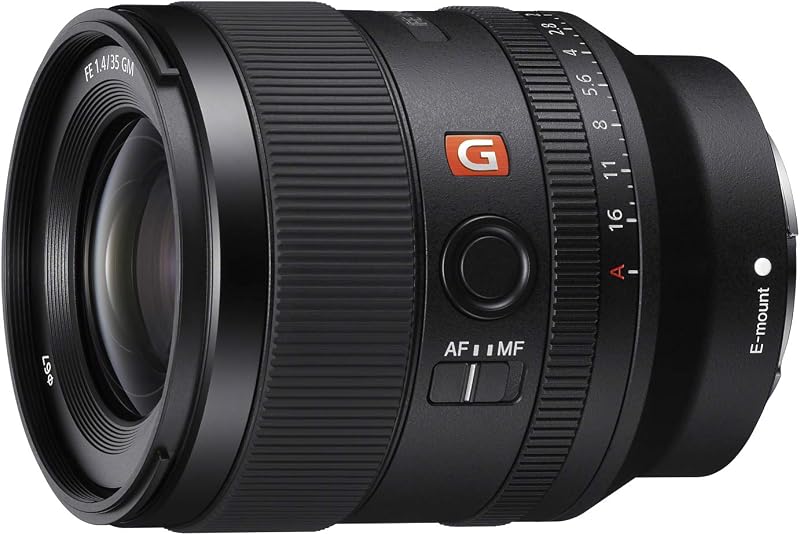
Best for Cinematic filmmakers and low-light portrait photographers
Pros
- Bright f/1.4 aperture
- 11-blade circular diaphragm
- Dual XA glass elements
Cons
- Fixed focal length lacks zoom flexibility
The Sony FE 35mm f 1.4 GM delivers a classic wide-angle perspective paired with an ultra-bright f/1.4 maximum aperture, making it an essential creative tool for environmental portraiture, documentary filming, and low-light indoor storytelling. By combining two XA elements with an ED glass element, the optical formula maintains corner-to-corner sharpness from maximum aperture downward while suppressing chromatic fringing around high-contrast edges.
A major highlight of this prime is its 11-blade circular aperture mechanism, which creates smooth, circular background bokeh that sets subjects apart from complex backgrounds. The physical build remains compact and portable, sporting dust and moisture resistance alongside a fluorine front element coating and Nano AR Coating II to prevent ghosting when pointing directly into practical stage lights or low sun angles. Focusing is driven by an XD linear focus drive system, delivering rapid and quiet autofocus response for both high-frame-rate photography and critical video focus pulls.
For creators deciding which optic to pair with a modern full-frame body, this prime is a prime candidate when planning a sony a7iv lens package for narrative video or low-light events. The built-in optical stabilization noted in the listing provides extra stability when working handheld in dim settings. Creators who need the flexibility to change focal lengths instantly on a dynamic run-and-gun assignment may find a standard zoom more practical, but this prime excels whenever subject separation and light-gathering capability are top priorities.
- Fast f/1.4 maximum aperture for shallow depth of field and dim lighting
- 11-blade circular aperture design producing round background bokeh
- XD linear focus drive system for swift, silent tracking response
- Two XA elements and Nano AR Coating II for resolving fine detail
03 Sony E 70-350mm f 4.5-6.3 G
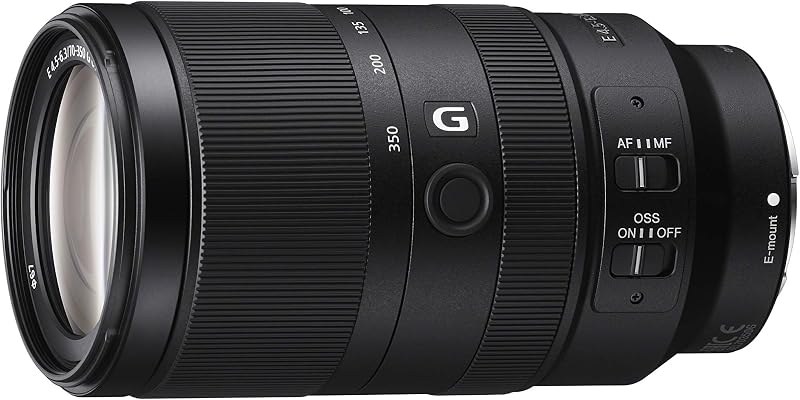
Best for APS-C sports and wildlife photographers
Pros
- 5x telephoto reach in 22oz body
- Built-in Optical SteadyShot
- XD linear motor AF
Cons
- APS-C coverage limits full-frame resolution
- Variable f/4.5-6.3 maximum aperture
Designed specifically for APS-C sensor camera bodies, the Sony E 70-350mm f 4.5-6.3 G provides an extensive 5x super-telephoto zoom range in a surprisingly portable form factor. Offering an effective 35mm full-frame focal equivalent of 105mm to 525mm, this lens weighs just 22 ounces, allowing sports, action, and nature photographers to shoot handheld without the cumbersome weight typically associated with 500mm-class reach.
The internal optical construction brings high-resolution G lens image quality across the entire frame, maintaining clarity even when zoomed to the 350mm maximum focal length. Autofocus drive is powered by an XD Linear Motor, giving shooters the responsiveness needed to lock onto fast-moving birds, field athletes, or unpredictable wildlife. Built-in Optical SteadyShot image stabilization works alongside the internal focus drive to steady compositions at long focal lengths, significantly reducing blur caused by natural hand tremors during telephoto framing.
Because this model is built around an APS-C image circle, using it on full-frame bodies requires engaging an APS-C crop mode, which reduces final megapixel output. The variable f/4.5-6.3 aperture also makes it better suited for daylight outdoor shooting than low-light arena environments. For travel photographers, trail hikers, and hobbyists carrying an APS-C body, the lightweight construction and 525mm equivalent reach make it an exceptional telephoto companion.
- Extended 70-350mm range providing 105-525mm equivalent reach on APS-C bodies
- Remarkably portable telephoto design weighing approximately 22 ounces
- Integrated Optical SteadyShot stabilization for sharp handheld shooting
- XD Linear Motor enabling fast, precise subject tracking
04 Sony FE 20-70mm f 4 G

Best for Solo vloggers and landscape videographers
Pros
- Ultra-wide 20mm start point
- Dual XD linear focus drive
- Close minimum focusing distance
Cons
- F/4 aperture gathers less light
The Sony FE 20-70mm f 4 G redefines the traditional standard zoom by extending the wide end down to an ultra-wide 20mm while maintaining the standard 70mm short-telephoto boundary. This wider field of view is a massive benefit for content creators who film handheld walking vlogs or balance their rig on a gimbal, as the extra width preserves a comfortable framing angle even after 16:9 cropping or electronic image stabilization is enabled.
Focus drive duties are managed by two XD Linear Motors, which provide up to 60 percent faster autofocus speeds and twice the tracking precision of earlier generations. The drive system smoothly maintains focus on subjects during high-speed burst shooting at up to 30 frames per second and high-frame-rate video capture at up to 4K 120p. The lens barrel has been optically engineered to suppress focus breathing, focus shift, and axial shift during zooming, while supporting in-camera breathing compensation features. Solo videographers searching for versatile optics for a sony vlogging camera setup will find this focal range covers wide scenes and close-up talking shots equally well.
Close-up performance is another distinct advantage of this design, utilizing Advanced Aspherical (AA) elements to deliver a minimum focus distance of 11.8 inches at the wide end and 9.8 inches at the telephoto end when using autofocus, reaching up to 0.39x maximum magnification. While the f/4 constant maximum aperture does not offer the same low-light depth of field as an f/2.8 lens, the unmatched wide-angle versatility and compact footprint make it one of the most flexible hybrid lenses available.
- Expanded 20-70mm focal range starting at an ultra-wide 20mm perspective
- Dual XD Linear Motors yielding fast, silent autofocus tracking
- Minimal focus breathing with support for camera breathing compensation
- Macro-style close focus down to 9.8 inches with 0.39x magnification
05 Sony FE 40mm f 2.5 G
Best for Street photographers and compact travel vloggers
Pros
- Ultra-compact aluminum exterior
- Three aspheric elements
- Dual camera format compatibility
Cons
- No optical image stabilization
When physical size and discretion are top priorities, the Sony FE 40mm f 2.5 G stands out as an ultra-compact prime that fits easily into a jacket pocket or small everyday sling bag. Constructed with a high-grade aluminum exterior, this lens combines durability and clean tactile handling in a featherweight package that suits street photography, travel documentation, and lightweight video capture on full-frame or APS-C bodies alike.
Despite its diminutive form factor, the optical formula integrates three aspheric elements to deliver corner-to-corner sharpness and control optical distortions. The f/2.5 maximum aperture provides solid light-gathering ability for evening walks and casual indoor environments, along with natural subject-to-background separation. Sony treats the glass with Nano AR Coating to suppress internal reflections and maintain clean contrast when shooting in backlit outdoor conditions.
The 40mm focal length provides a natural, human-eye field of view of 46 degrees that sits comfortably between standard 35mm and 50mm perspectives. Because this model relies on camera sensor stabilization rather than built-in optical stabilization, it pairs best with stabilized camera bodies for slow-shutter handheld work. For documentary shooters who want to remain low-profile and avoid drawing attention with bulky optics, this compact prime delivers dependable G-series resolving power.
- Ultra-compact, low-profile footprint with high-grade aluminum barrel
- Three aspheric glass elements ensuring edge-to-edge sharpness
- Versatile 40mm focal length with an f/2.5 maximum aperture
- Compatible with both full-frame and APS-C format E-mount camera bodies
06 Sony FE 200-600mm f 5.6-6.3 G
Best for Dedicated wildlife and aviation photographers
Pros
- Massive 200-600mm telephoto reach
- Five ED glass elements
- Direct Drive SSM focus
Cons
- Large and heavy telephoto form factor
For photographers pursuing subjects that cannot be approached closely, the Sony FE 200-600mm f 5.6-6.3 G provides serious super-telephoto reach. Covering a 200mm to 600mm zoom range on full-frame sensors, this optic is engineered specifically for birding, safari wildlife, airshows, and outdoor track athletics where reaching past normal telephoto boundaries is an absolute necessity.
The optical construction incorporates five ED glass elements alongside an aspherical lens element to minimize chromatic aberration, color fringing, and spherical distortion across the entire focal band. Sony applies Nano AR Coating to suppress ghosting and glare when working under harsh daylight skies. Fast, accurate autofocus is driven by a Direct Drive Supersonic Wave Motor (DDSSM) system, which provides the high positioning accuracy and torque needed to move the internal telephoto glass elements silently while tracking erratic motion.
To assist shooters working without a tripod, the lens features built-in Optical image stabilization to steady framing at extreme focal lengths up to 600mm, where hand movement is magnified dramatically. The maximum focal length of 60 centimeters (600mm) and telephoto build mean this is a substantial optic that requires dedicated space in a backpack. However, for wildlife enthusiasts and sports specialists needing premium tracking speed and reach without multi-optic complexity, it remains a standout performer.
- Super-telephoto 200-600mm focal range designed for wildlife and sports
- Five ED glass elements and one aspherical element for high resolution
- Direct Drive Supersonic Wave Motor for quiet, accurate autofocus positioning
- Built-in Optical image stabilization to steady long-distance compositions
What Sets These Models Apart
| Lens Model | Focal Range & Max Aperture | AF Motor System | Primary Application |
|---|---|---|---|
| Sony FE 24-70mm F2.8 GM II | 24-70mm, f/2.8 constant | Four XD Linear Motors | Professional hybrid events and studio work |
| Sony FE 35mm f 1.4 GM | 35mm, f/1.4 | XD Linear focus drive | Cinematic video, portraits, and low light |
| Sony E 70-350mm f 4.5-6.3 G | 70-350mm, f/4.5-6.3 variable | XD Linear Motor | Lightweight APS-C outdoor wildlife and sports |
| Sony FE 20-70mm f 4 G | 20-70mm, f/4 constant | Two XD Linear Motors | Vlogging, gimbal work, and travel video |
| Sony FE 40mm f 2.5 G | 40mm, f/2.5 | The listing does not specify | Street photography and discreet travel carry |
| Sony FE 200-600mm f 5.6-6.3 G | 200-600mm, f/5.6-6.3 variable | Direct Drive SSM | Long-distance wildlife, aviation, and field action |
Buying Tips for Sony Camera Lenses
When conducting a sony g lens comparison, understanding the difference between standard G and G Master tiers is essential. G Master optics represent Sony’s flagship optical engineering, incorporating Extreme Aspherical elements and specialized coatings designed to deliver high resolution at wide-open apertures like f/1.4 or f/2.8, along with smooth background bokeh. Standard G lenses focus on high performance in balanced, portable form factors, often offering unique focal spans like 20-70mm or ultra-compact pancake-style prime housings that match practical hybrid shooting demands.
Your video requirements should strongly influence which sony camera lens to buy. Modern video capture relies heavily on internal linear motor technology to track subjects smoothly without audible focus noise bleeding into microphones. Lenses utilizing XD Linear Motors also support in-body breathing compensation on compatible Alpha bodies, preventing subtle focal shifts from altering your composition during video pulls. If you frequently balance cameras on gimbals, constant-aperture standard zooms or compact primes will keep your rig well-balanced without requiring constant motor recalibration.
Sensor format compatibility is another key factor when choosing among the best sony g lenses. While full-frame (FE) lenses can be used seamlessly on both full-frame and APS-C camera bodies, APS-C dedicated lenses like the E 70-350mm project a smaller image circle. Using an APS-C lens on a full-frame body automatically triggers a crop mode, reducing your image resolution. Evaluate your primary camera body and your need for low-light speed versus telephoto reach before deciding on the final optic for your production bag.
FAQ
What is the main difference between Sony G vs G Master lenses?
Sony G Master lenses sit at the top of Sony’s optical lineup, engineered for maximum optical resolution and smooth background bokeh using Extreme Aspherical (XA) elements and wider constant apertures like f/1.4 and f/2.8. Sony G lenses deliver excellent optical clarity and fast autofocus in more compact, portable barrels, often utilizing f/4 constant apertures or variable apertures to prioritize mobility and versatile zoom ranges.
Can I use the Sony E 70-350mm on a full-frame camera?
Yes, the Sony E 70-350mm mounts directly onto full-frame Sony E-mount cameras, but because it is designed for APS-C sensors, the camera will automatically switch to APS-C crop mode. This mode uses the center portion of the sensor, giving you an effective 105-525mm focal range while capturing files at a reduced megapixel count compared to full-frame mode.
Is the Sony FE 20-70mm f 4 G wide enough for vlogging?
Yes, the 20mm focal length on the Sony FE 20-70mm f 4 G provides a broad angle of view that is particularly well-suited for handheld filming and vlogging. It leaves ample margin in the frame to accommodate aspect ratio adjustments or active digital stabilization crop without cutting into your framing.
Does the Sony FE 40mm f 2.5 G have optical image stabilization?
No, the listing specifies that the Sony FE 40mm f 2.5 G does not feature built-in optical image stabilization. It relies on the in-body image stabilization (IBIS) present in compatible Sony camera bodies to steady handheld shots at slower shutter speeds.
How fast is the autofocus tracking on modern Sony XD Linear Motor lenses?
Lenses equipped with Sony’s XD Linear Motors, such as the FE 24-70mm F2.8 GM II and FE 20-70mm f 4 G, are capable of tracking moving subjects during high-speed continuous still bursts up to 30 frames per second and high-speed video capture up to 4K 120p on compatible camera bodies.


