SwitchBot Smart Automatic Curtain Opener or SwitchBot AI Hub? Which SwitchBot Model to Buy
We compare the SwitchBot smart automatic curtain opener and AI hub using published specifications. You get clear details on motor strength, voice assistant support, and connectivity options.

As Amazon Associates, we earn from qualifying purchases. This means we may receive a small commission at no extra cost to you if you click through and make a purchase.
As an Amazon Associate we earn from qualifying purchases. Links on this page are affiliate links.
The switchbot smart automatic curtain opener vs AI hub comparison highlights two distinct SwitchBot products. One automates window treatments, while the other manages camera data and local smart home logic. You need to decide between physical curtain control and centralized AI processing. Both devices integrate with modern smart home ecosystems, but they serve different functions. This guide compares their specifications to help you choose the right hardware for your specific setup.
Primary Function
Automates curtains with a 2x stronger motor
Processes camera AI and local NVR storage
Smart Home Compatibility
Alexa, Google Home, HomeKit
Home Assistant, Matter
Wireless Protocols
Bluetooth, Matter
Matter, BLE
Camera Support
Not listed
Supports up to 8 cameras with local storage
Color
White
Coal
Choose the first if
- You want to automate existing curtains without drilling
- You use Apple HomeKit, Alexa, or Google Home
- You need silent operation under 25dB for bedrooms
Choose the second if
- You need local storage for multiple security cameras
- You use Home Assistant for advanced home automation
- You want AI context for visitors and pets via OpenClaw
Verdict
Choose the Curtain Opener if you prioritize physical automation of window treatments and broad ecosystem compatibility. Select the AI Hub if you require local video storage, Home Assistant integration, and advanced camera AI features. The choice depends entirely on whether you need to move curtains or manage camera data.
Curtain Opener vs AI Hub
smart home compatibility
Edge: Tie
The SwitchBot Curtain Opener 2025 with Hub3 supports Alexa, Google Home, and Apple HomeKit via Bluetooth and Matter. You get broad voice assistant support and seamless integration with existing smart home ecosystems. The SwitchBot AI Hub focuses on Home Assistant and Matter, offering a more technical foundation for local control. It acts as an edge hub for faster automations. If you rely on Apple Home or standard voice assistants, the Curtain Opener is the better fit. If you prefer Home Assistant for granular local control, the AI Hub provides the necessary infrastructure for advanced users.
everyday use
Edge: Tie
The Curtain Opener handles physical tasks, moving heavy curtains up to 15 kg with a strong motor. It features a quiet silent mode under 25dB and uses positioning magnets to prevent light gaps without recurring calibration. The AI Hub manages digital tasks, storing event recordings locally on a MicroSD card or external drive. It supports up to 8 cameras and provides AI context for visitors or pets. You use the Curtain Opener to automate window treatments for privacy and light control. You use the AI Hub to secure your home and process camera data locally. They serve completely different daily functions.
wireless connectivity
Edge: SwitchBot AI Hub with Local NVR
The Curtain Opener relies on Bluetooth for direct control and uses Matter for smart home integration. This setup requires the included Hub3 for broader connectivity. The AI Hub connects via Dual-Band Wi-Fi and supports Matter and BLE protocols. It acts as a local edge hub, enabling faster automations for select SwitchBot BLE devices. The AI Hub offers more robust network connectivity options for a central hub. The Curtain Opener is designed for specific device control rather than network management. Your choice depends on whether you need a dedicated curtain motor or a network hub.
build
Edge: Tie
The Curtain Opener measures 7 inches in width, 11 inches in height, and 8 inches in length. It is available in white and includes positioning magnets for compact installation. The AI Hub measures 5.79 inches in width, 2.2 inches in height, and 7.8 inches in length. It is available in coal or black. The Curtain Opener is larger to accommodate the motor and guide wheel mechanism. The AI Hub is slimmer, designed for discreet placement near network equipment or cameras. The Curtain Opener has a 8kg load capacity for standard curtains. The AI Hub includes a 16GB MicroSD card for storage.
compatibility
Edge: Tie
The Curtain Opener is not compatible with extendable rods less than 5/8 inches in diameter. It requires installation on existing rods or rails. The AI Hub does not include IR control, so it cannot control TVs or air conditioners directly. It requires a separate SwitchBot Hub with IR for those devices. The AI Hub supports OpenClaw for AI skills and requires an AI+ subscription for advanced features. The Curtain Opener works with the SwitchBot app for timer and remote control. Both devices integrate with the SwitchBot ecosystem, but they support different types of hardware and automations.
Which SwitchBot device fits your setup
You want automated curtains with voice control
Our pick: SwitchBot Curtain Opener 2025 with Hub3
This model handles physical window treatments using a strong motor for loads up to 15 kg. It supports Matter and Apple HomeKit via Bluetooth. You get precise control with positioning magnets and silent operation under 25dB. It requires no drilling for easy installation on existing rods.
You need local camera storage and AI logic
Our pick: SwitchBot AI Hub with Local NVR
This hub manages up to 8 cameras with local storage on a 16GB MicroSD card. It runs Home Assistant and supports OpenClaw for context-aware actions. You get faster local automations via BLE. It connects via dual-band Wi-Fi and acts as a Matter bridge for your devices.
You seek a Matter bridge with edge computing
Our pick: SwitchBot AI Hub with Local NVR
The AI Hub pre-installs Home Assistant and includes a Matter bridge. It processes data locally using BLE for select devices, improving automation speed. You can expand storage to 1TB via MicroSD or 16TB via external drive. It supports OpenClaw for chat-based control of connected smart home gear.

SwitchBot Curtain Opener 2025 with Hub3
Best for: Heavy curtains on existing rods
- Wireless Protocols
- Bluetooth, Matter
- Ecosystem Compatibility
- Alexa, Google Home, HomeKit
- Smart Home Compatibility
- Amazon Alexa, Google Assistant, Apple HomeKit
- Color
- White
- Control Method
- App Control, Remote Control, Alexa
- Dimensions
- 8 × 7 × 11 inches
This two-pack of curtain openers includes the SwitchBot Hub 3 for Matter and HomeKit integration. The motor handles up to 15 kg loads and moves over 4 mm bumps. Silent mode operates below 25 dB. You get app control, timer settings, and precise positioning via magnets. It suits users wanting whole-home automation without drilling.
- Handles curtains up to 15 kg
- Matter and Apple HomeKit support
- Silent mode under 25 dB
- No-tool installation on existing rods
- Requires Hub 3 for smart features
- Incompatible with rods under 16 mm
- Limited to Bluetooth and Matter protocols
- You want to automate heavy curtains
- You use Apple Home or Matter ecosystems
- You need quiet operation for bedrooms
- You have rods thinner than 16 mm
- You prefer standalone devices without hubs
- You need Z-Wave or Zigbee connectivity
Verdict: SwitchBot Curtain Opener 2-Pack with Hub 3 fits users with heavy curtains who want quiet, precise automation via Matter or HomeKit. It is best for existing rod setups requiring hub-based control.
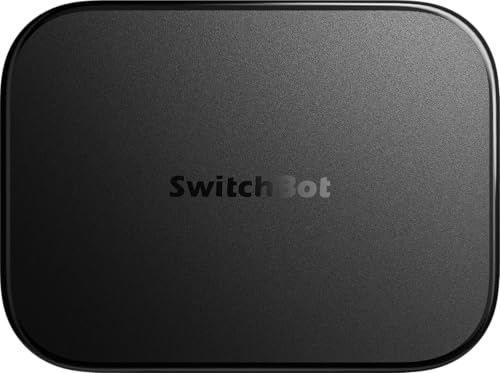
SwitchBot AI Hub with Local NVR
Best for: local camera storage and Home Assistant users
- Wireless Protocols
- Matter, BLE
- Ecosystem Compatibility
- Home Assistant
- Network Connectivity
- Dual-Band Wi-Fi
- Device Capacity
- 8 cameras
- Entry Method
- Built-In Camera
- Dimensions
- 7.8 × 5.79 × 2.2 inches
This SwitchBot AI Hub connects up to 8 compatible cameras for local event storage and context-aware automation. It includes a 16GB MicroSD card and supports expansion to 1TB or 16TB drives. The device runs Home Assistant and features a Matter bridge. Dual-band Wi-Fi and BLE protocols ensure stable connectivity. It is designed for users who want local control and AI camera integration without relying solely on cloud services.
- Supports up to 8 compatible cameras for centralized management
- Includes 16GB MicroSD card for local event recording
- Home Assistant pre-installed with Matter bridge support
- Built-in OpenClaw support for camera context and device actions
- Requires AI+ subscription for camera AI features
- Does not include IR control for TVs or air conditioners
- Dimensions of 7.8 x 5.79 x 2.2 inches require dedicated space
- You want to store camera events locally on a drive
- You use Home Assistant for smart home automation
- You have compatible SwitchBot or RTSP cameras
- You need built-in IR control for appliances
- You do not want to pay for an AI+ subscription
- You prefer a hub without Home Assistant pre-installed
Verdict: SwitchBot AI Hub with OpenClaw is a robust hub for users with multiple cameras who prioritize local storage and Home Assistant integration. It suits those ready to manage camera contexts and automations through a Matter-enabled edge device.
Specifications side by side
| Spec | SwitchBot Curtain Opener 2025 with Hub3 | SwitchBot AI Hub with Local NVR |
|---|---|---|
| Wireless Protocols | Bluetooth, Matter | Matter, BLE |
| Ecosystem Compatibility | Alexa, Google Home, HomeKit | Home Assistant |
| Network Connectivity | – | Dual-Band Wi-Fi |
| Device Capacity | – | 8 cameras |
| Smart Home Compatibility | Amazon Alexa, Google Assistant, Apple HomeKit | Matter |
| Wireless Connectivity | – | Wi-Fi |
| Entry Method | – | Built-In Camera |
| Color | White | Coal |
| Connectivity | Bluetooth | – |
| Compatible Platform | – | Home Assistant |
| Control Method | App Control, Remote Control, Alexa | – |
| Band | – | Dual-Band |
| Compatibility | Google Home, Apple Home | – |
| Dimensions | 8 × 7 × 11 inches | 7.8 × 5.79 × 2.2 inches |
| Model | curtain | W8002100 |
Frequently asked questions
Can the SwitchBot Curtain Opener work without Wi-Fi?
Yes, it uses Bluetooth for direct control. You can operate it via the app or a physical remote without an internet connection. However, full automation and voice assistant features require the included Hub 3 to bridge the signal to your smart home network.
Does the AI Hub support local video storage?
Yes, the SwitchBot AI Hub with Local NVR is designed for local camera storage. This allows you to keep video footage on the device itself rather than in the cloud. It is ideal for users who prioritize privacy and want to avoid subscription-based cloud services.
Is the Curtain Opener compatible with Apple HomeKit?
Yes, the SwitchBot Curtain Opener 2025 with Hub3 supports Apple HomeKit. You can control your curtains using Siri or the Home app. This integration works alongside Amazon Alexa and Google Assistant, giving you flexible control options across different smart home ecosystems.
What is the main function of the SwitchBot AI Hub?
The SwitchBot AI Hub manages camera data and local smart home logic. It serves as a central point for Home Assistant users and supports Matter-enabled edge devices. Its primary role is processing AI tasks and storing video locally for connected security cameras.
Can I control the curtains with voice commands?
Yes, you can use voice commands with the Curtain Opener. It is compatible with Amazon Alexa, Google Assistant, and Apple HomeKit. You simply need to enable the SwitchBot skill or add it to your respective platform to control opening and closing via voice.
Does the AI Hub require a separate camera?
No, the SwitchBot AI Hub features a built-in camera. This entry method allows it to capture video directly without needing an external device. You can use this integrated camera for local storage and AI processing tasks within your smart home setup.


