What Is Wireless Connectivity? A Guide for Smart Thermostats Buyers (2026)
Learn how wireless connectivity works for smart thermostats. Compare 6 models based on Wi-Fi specs to ensure remote control and reliable software updates.

As Amazon Associates, we earn from qualifying purchases. This means we may receive a small commission at no extra cost to you if you click through and make a purchase.
As an Amazon Associate we earn from qualifying purchases. Links on this page are affiliate links.
Understanding Wireless Connectivity For Smart Thermostats
Wireless connectivity explained is the foundation of modern climate control. It allows your thermostat to communicate with your home network and your mobile device. This spec determines how you control the temperature and how the device updates its software.
Most smart thermostats use Wi-Fi as their primary connection method. This standard protocol lets the device join your existing 2.4 GHz or 5 GHz network. You do not need a separate hub or bridge for these models. The thermostat connects directly to your router, just like your laptop or smartphone.
When you look at product listings, you will see this labeled as Wi-Fi. Some manufacturers may specify the frequency band. A 2.4 GHz connection offers better range through walls. A 5 GHz connection provides faster data speeds but has shorter range. Check the specifications to see which bands are supported. Dual-band support is common in newer models.
This connectivity is critical for remote access. It enables you to adjust settings from anywhere using an app. You can change the temperature while you are at work or on vacation. The device also sends status updates to your phone. You receive alerts if the system detects an issue or if the filter needs changing.
Software updates are another key benefit. Manufacturers fix bugs and add features through over-the-air updates. Your thermostat downloads these patches directly from the internet. This keeps the device secure and functional without manual intervention.
Stability matters. A weak Wi-Fi signal can cause the thermostat to disconnect. This leads to missed schedules or delayed commands. Ensure your router is within a reasonable range of the installation spot. Walls and large metal appliances can interfere with the signal. Strong connectivity ensures reliable performance every day.
Wi-Fi Connectivity Options Listed
Wi-Fi
Wi-Fi allows your thermostat to connect to your home network. This enables remote control via mobile apps. You can adjust temperatures from anywhere. The device receives automatic software updates. This keeps features current and security tight. Most models support voice assistants like Alexa or Google Assistant. You need a stable internet connection. The Google Nest Smart Wi-Fi Thermostat offers a compact design for Google Home users. The Ecobee Smart Thermostat Essential provides multi-platform compatibility. Honeywell Home T6 Pro suits conventional systems. Wi-Fi is the standard for smart climate control. It ensures your settings sync across devices. This spec is essential for full remote management.
Wi-Fi
This connectivity type supports standard home networks. It lets you monitor energy usage remotely. You can create schedules from your phone. The thermostat stays online for cloud features. Voice control integration is common with this spec. Ecobee models often include room sensors. The Ecobee Smart Thermostat Premium adds air quality tracking. The Ecobee Enhanced model supports HomeKit. These devices require a reliable Wi-Fi signal. Weak signals may cause sync delays. Most buyers find this connection method sufficient. It balances cost with full smart functionality. You get consistent performance for daily heating and cooling. This option covers the needs of most households.
Is Wi-Fi Worth The Hassle?
Who needs it
You should prioritize Wi-Fi connectivity if you value remote access to your home’s climate. This spec allows you to adjust temperatures from anywhere using a mobile app. You do not need to be physically present to change settings. The device also receives automatic software updates. These updates keep features current and security tight. If you travel often or work long hours, this convenience is essential. You can ensure your home is comfortable before you arrive. The connection relies on your existing home network. This means no extra hubs are required. The thermostat communicates directly with your router. This direct link simplifies setup. You get real-time status updates on your phone. This transparency helps you manage energy use effectively. For most users, the ability to control the thermostat remotely is a significant advantage. It transforms a simple heating or cooling device into a smart, responsive system. You gain control and peace of mind.
Who can skip it
You can ignore Wi-Fi connectivity if you prefer simplicity and reliability over remote features. Some users find constant connectivity stressful. They worry about network outages or security vulnerabilities. If you only adjust the thermostat manually, Wi-Fi adds little value. You might prioritize a display with clear, large buttons instead. A physical interface is easier to use for everyone in the household. You do not need an app for basic temperature changes. Some people prefer dedicated remotes or wall-mounted controls. These options do not depend on your home internet. They work independently of network status. If you live in an area with poor Wi-Fi coverage, the connection may be unstable. In such cases, a non-connected thermostat is more reliable. You avoid potential glitches or dropped signals. Focus on accurate sensors and durable build quality. These factors ensure consistent comfort without digital distractions. Simple is often better for those who want a set-and-forget solution.
Wireless Terms Explained
Wi-Fi
Wireless networking using radio waves. Connects your thermostat to your home router. Enables remote control via apps and automatic software updates for security and features.
Bluetooth
Short-range wireless technology. Helps pair your phone with the thermostat during setup. Often works alongside Wi-Fi for initial configuration and local control.
Zigbee
Low-power mesh networking protocol. Allows devices to relay signals to each other. Common in smart home ecosystems for connecting sensors and hubs without Wi-Fi.
Z-Wave
Another mesh networking standard. Operates on a different frequency than Wi-Fi to reduce interference. Ensures reliable communication between compatible smart home devices and controllers.
Router
The device distributing your internet connection. Your thermostat connects to this via Wi-Fi. A strong signal here ensures stable remote access and timely updates.
Signal Strength
Measures how well your device connects to the network. Weak signals cause delays or disconnections. Place your router centrally to maintain a strong, consistent connection.
Frequency
The radio band used for communication. Most Wi-Fi uses 2.4 GHz or 5 GHz. Check compatibility to ensure your thermostat connects reliably to your home network.
| # | Product | Best for | Price |
|---|---|---|---|
| 1 | Google Nest Smart Wi-Fi Thermostat | Google Home users seeking a compact Wi-Fi thermostat | |
| 2 | Ecobee Smart Thermostat Essential Wi-Fi | Basic smart control with major voice assistants | |
| 3 | Ecobee Smart Thermostat Premium with SmartSensor | multi-platform voice control and room sensors | |
| 4 | Ecobee Smart Thermostat Enhanced | homes needing C-wire adapters and HomeKit | |
| 5 | Ecobee Smart Thermostat Essential | Compact Energy Star certified Wi-Fi control | |
| 6 | Honeywell Home T6 Pro Wi-Fi Thermostat | Conventional systems with C-wire and Alexa or HomeKit |

Google Nest Smart Wi-Fi Thermostat
Best for: Google Home users seeking a compact Wi-Fi thermostat
- Wireless Connectivity
- Wi-Fi
- Smart Home Compatibility
- Google Home, Google Assistant, Matter
- C-Wire Requirement
- Not required in most homes
- Dimensions
- 3.31 × 3.31 × 1.07 inches
- Weight
- 4.96 ounces
The Google Nest Thermostat in Sand uses Wi-Fi to connect to your home network. It measures 3.31 inches wide and 1.07 inches thick. The device requires a phone or tablet with the Google Home app. It works with Google Assistant and Matter-certified voice assistants. This compact unit fits most homes without a C wire. It suits you if you want a small, energy-efficient thermostat that integrates with the Google ecosystem.
- Compact design measures 3.31 x 3.31 x 1.07 inches
- Compatible with Google Home, Google Assistant, and Matter
- Works without a C wire in most homes
- Includes HVAC monitoring to alert you to system issues
- Heavier at 4.96 ounces compared to lighter competitors
- Limited to Google Home and Matter voice assistants
- You use Google Home or Matter-certified devices
- You want a compact thermostat that fits most walls
- You need HVAC monitoring for system maintenance
- You rely on Apple HomeKit or Alexa exclusively
- You have a heating only or cooling only system without a C wire
- You prefer a thermostat with a built-in display
Verdict: Google Nest Sand Thermostat is a compact, Wi-Fi-enabled option for users invested in the Google ecosystem. It fits best in homes where space is limited and Google Assistant is the primary voice control method.

Ecobee Smart Thermostat Essential Wi-Fi
Best for: Basic smart control with major voice assistants
- Wireless Connectivity
- Wi-Fi
- Smart Home Compatibility
- Alexa, Google Assistant, HomeKit
- C-Wire Requirement
- Adapter sold separately
- HVAC Compatibility
- 24 VAC, heat pump, dual fuel
- HVAC Stages
- 2H/1C or 1H/2C, 2H/1C heat pump
- Color
- White
The ecobee Smart Thermostat Essential offers Wi-Fi connectivity and a color touchscreen for remote temperature control. It supports Apple HomeKit, Google Assistant, and Alexa integration. The unit measures 3.62 inches wide and weighs 3.2 ounces. It handles 2H/1C and 1H/2C systems. You get energy tracking via the app. This model suits users who want basic smart features without premium extras.
- Supports Apple HomeKit, Google Assistant, and Alexa
- Color touchscreen for local control
- Tracks energy consumption in the app
- Compatible with 2H/1C and 1H/2C HVAC stages
- Heavier at 3.2 ounces compared to lighter competitors
- Fewer HVAC stages than premium models with 3H/2C support
- Requires separate purchase for room sensors and Power Extender Kit
- You use Apple HomeKit, Google Assistant, or Alexa
- You have a 2H/1C or 1H/2C HVAC system
- You want energy tracking without premium sensors
- You need integrated room sensors included
- You require 3H/2C HVAC support
- You prefer a lighter device under 3 ounces
Verdict: The ecobee Essential Smart Thermostat fits users who want core smart features and multi-platform compatibility without the bulk of premium sensors or higher stage support.

Ecobee Smart Thermostat Premium with SmartSensor
Best for: multi-platform voice control and room sensors
- Wireless Connectivity
- Wi-Fi
- Smart Home Compatibility
- Alexa, Siri, Google Home
- C-Wire Requirement
- Power Extender Kit included
- Room Sensor Support
- Included
- Color
- Black
- Dimensions
- 1.02 × 4.09 × 4.09 inches
The ecobee Smart Thermostat Premium features Wi-Fi connectivity and includes a SmartSensor to manage room-specific comfort. It integrates with Alexa, Google Home, and Apple HomeKit. The unit has a 3-year warranty and includes a Power Extender Kit for homes without a C-wire. It suits buyers seeking integrated air quality monitoring and voice control options.
- Includes a SmartSensor for room-specific temperature adjustments
- Built-in support for Alexa, Siri, and Google Home
- Power Extender Kit included for C-wire-free installation
- Built-in air quality monitor with filter change reminders
- Heavier build at 1.32 pounds compared to lighter competitors
- Requires an Apple home hub to enable Siri functionality
- 3-year warranty is shorter than the industry-leading 3-year warranty mentioned in other contexts
- You want a SmartSensor included for better room comfort
- You use Apple HomeKit and have a home hub
- You need a Power Extender Kit for installation
- You prefer a lighter device under 1 pound
- You do not have an Apple home hub for Siri
- You want a warranty longer than 3 years
Verdict: The ecobee Premium Smart Thermostat fits buyers who value included room sensors and multi-platform voice assistant support. It is best for homes needing C-wire solutions and air quality tracking.
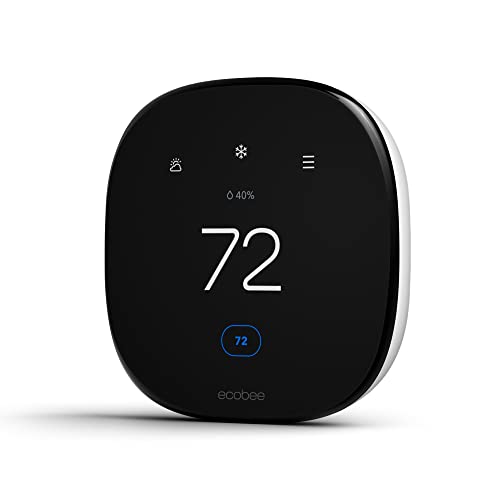
Ecobee Smart Thermostat Enhanced
Best for: homes needing C-wire adapters and HomeKit
- Wireless Connectivity
- Wi-Fi
- Smart Home Compatibility
- Alexa, Google Assistant, HomeKit
- HVAC Compatibility
- 90% of HVAC systems
- Color
- Black
- Dimensions
- 0.94 × 4.09 × 4.09 inches
- Weight
- 1.1 pounds
This ecobee unit uses Wi-Fi for remote control via the app. It includes a Power Extender Kit for homes lacking a C-wire. Built-in occupancy sensing adjusts temperatures automatically. It supports Apple HomeKit, Alexa, and Google Assistant. The device measures 4.09 inches square and weighs 15.9 ounces. It suits users wanting smart scheduling and energy savings with broad smart home integration.
- Includes Power Extender Kit for C-wire-less installations
- Supports Apple HomeKit, Alexa, and Google Assistant
- Built-in occupancy sensing for automatic adjustments
- 3-year warranty coverage
- Heavier build at 15.9 ounces compared to lighter competitors
- Shorter 3-year warranty versus the 5-year warranty on the ecobee Premium model
- Larger physical footprint at 4.09 inches square
- You need a Power Extender Kit included for installation
- You want Apple HomeKit compatibility alongside Wi-Fi control
- You prefer automatic temperature adjustments based on occupancy
- You require a longer warranty than 3 years
- You want a lighter device under 15 ounces
- You prefer a smaller unit under 4 inches square
Verdict: ecobee Enhanced Wi-Fi Thermostat fits users who need C-wire solutions and HomeKit support. It is a solid choice for those prioritizing occupancy sensing over minimal weight.
Ecobee Smart Thermostat Essential
Best for: Compact Energy Star certified Wi-Fi control
- Wireless Connectivity
- Wi-Fi
- Smart Home Compatibility
- Siri, Alexa, Google Assistant
- Color
- White
- Dimensions
- 0.91 × 3.62 × 3.62 inches
- Weight
- 3.2 ounces
The ecobee Smart Thermostat Essential is a white, programmable Wi-Fi thermostat designed for energy efficiency. It measures 3.62 by 3.62 inches with a slim 0.91-inch depth. Weighing 3.2 ounces, it supports Apple HomeKit, Amazon Alexa, and Google Assistant. This model suits buyers seeking a compact, certified unit that integrates with major voice platforms without requiring premium sensors.
- Energy Star certification for efficiency
- Supports Apple HomeKit, Alexa, and Google Assistant
- Compact 3.62-inch square faceplate
- Lightweight 3.2-ounce build
- Smaller 3.62-inch display compared to premium models
- Basic programmable interface without advanced sensors
- No included remote temperature sensor
- You want an Energy Star certified thermostat
- You use Apple HomeKit or Alexa
- You prefer a compact wall unit
- You need included remote sensors
- You require a larger display
- You want premium smart features
Verdict: The ecobee Smart Thermostat Essential fits users who need reliable Wi-Fi connectivity and multi-platform voice support in a small, lightweight package. It is ideal for basic smart home integration without the bulk of higher-end models.
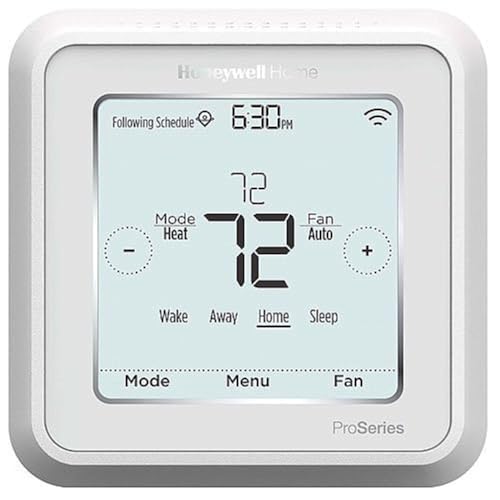
Honeywell Home T6 Pro Wi-Fi Thermostat
Best for: Conventional systems with C-wire and Alexa or HomeKit
- Wireless Connectivity
- Wi-Fi
- Smart Home Compatibility
- Apple HomeKit, Amazon Alexa
- C-Wire Requirement
- Required
- HVAC Stages
- 2H/1C heat pump, 2H/2C conventional
- Color
- White
- Dimensions
- 5 × 2.3 × 6 inches
The Honeywell Lyric T6 Pro supports Wi-Fi connectivity for remote control via Apple HomeKit and Amazon Alexa. It handles 2 heat and 2 cool stages for conventional systems or 2H/1C for heat pumps. The unit requires a C-wire for power. Its compact 4-inch square design fits standard wall spaces. This thermostat suits users who need reliable smart scheduling without complex installation.
- Supports Wi-Fi for remote access
- Compatible with Apple HomeKit and Amazon Alexa
- Handles 2 heat and 2 cool stages
- Offers multiple programming schedules including 7-day
- Requires a C-wire for power
- Limited to 2 heat and 2 cool stages
- Supports only two smart home ecosystems
- You have a conventional HVAC system with 2H/2C capacity
- You use Apple HomeKit or Amazon Alexa for control
- You need a thermostat that supports geofencing
- You do not have a C-wire available
- You need support for more than 2 heat stages
- You require compatibility with Google Home or other platforms
Verdict: Honeywell Lyric T6 Pro Wi-Fi Thermostat fits homes with conventional 2H/2C systems and existing Apple HomeKit or Alexa setups. It delivers essential Wi-Fi scheduling without extra ecosystem support.
Specifications side by side
| Spec | Google Nest Smart Wi-Fi Thermostat | Ecobee Smart Thermostat Essential Wi-Fi | Ecobee Smart Thermostat Premium with SmartSensor | Ecobee Smart Thermostat Enhanced | Ecobee Smart Thermostat Essential | Honeywell Home T6 Pro Wi-Fi Thermostat |
|---|---|---|---|---|---|---|
| Smart Home Compatibility | Google Home, Google Assistant, Matter | Alexa, Google Assistant, HomeKit | Alexa, Siri, Google Home | Alexa, Google Assistant, HomeKit | Siri, Alexa, Google Assistant | Apple HomeKit, Amazon Alexa |
| C-Wire Requirement | Not required in most homes | Adapter sold separately | Power Extender Kit included | – | – | Required |
| HVAC Compatibility | – | 24 VAC, heat pump, dual fuel | – | 90% of HVAC systems | – | – |
| HVAC Stages | – | 2H/1C or 1H/2C, 2H/1C heat pump | – | – | – | 2H/1C heat pump, 2H/2C conventional |
| Room Sensor Support | – | – | Included | – | – | – |
| HVAC System Compatibility | – | – | – | – | – | Heat Pump, Conventional |
| Wireless Connectivity | Wi-Fi | Wi-Fi | Wi-Fi | Wi-Fi | Wi-Fi | Wi-Fi |
| Color | Sand | White | Black | Black | White | White |
| Control Method | – | Alexa | Alexa | Alexa | Alexa | – |
| Compatibility | Google Home | Google Home | Google Home | Google Home | Google Home | – |
| Dimensions | 3.31 × 3.31 × 1.07 inches | 0.91 × 3.62 × 3.62 inches | 1.02 × 4.09 × 4.09 inches | 0.94 × 4.09 × 4.09 inches | 0.91 × 3.62 × 3.62 inches | 5 × 2.3 × 6 inches |
| Weight | 4.96 ounces | 3.2 ounces | 1.32 pounds | 1.1 pounds | 3.2 ounces | 12 ounces |
| Size | 1.07 x 3.31 x 3.31 Inches | 1-Pack | 2.9 x 4.09 x 4.09 inches | Pack of 1 | – | 4.06 inches square |
| Model | GA02082-US | EB-STATE7-01 | EB-STATE6-01 | EB-STATE6L-01 | – | TH6220WF2006 |
Frequently asked questions
Can I control my thermostat if my Wi-Fi goes down?
Yes. The thermostat continues to follow its internal schedule. You can still adjust settings manually on the device. However, you lose remote access via your phone. Automatic software updates also pause until the connection returns. This ensures basic comfort remains intact during outages.
Does Wi-Fi connectivity require a C-wire?
It depends on the model. Some units, like the Ecobee Premium, include power adapters for homes without a C-wire. Others may need a dedicated power wire. Check the specific product specifications. The data shows some models list C-wire solutions as a key feature for installation.
Which voice assistants work with Wi-Fi thermostats?
Most modern models support major platforms. The Ecobee Essential and Premium work with Amazon Alexa, Google Assistant, and Apple HomeKit. The Google Nest Thermostat is optimized for Google Home. Honeywell Home models support Alexa and HomeKit. Verify compatibility before buying to ensure it matches your ecosystem.
Is Wi-Fi better than Bluetooth for thermostats?
Wi-Fi is superior for remote control. It connects your device to your home router, allowing you to change settings from anywhere. Bluetooth only works for short-range pairing during setup. You cannot adjust temperatures remotely with Bluetooth alone. Wi-Fi also handles automatic software updates for security.
Do I need a hub for Wi-Fi thermostats?
No. Wi-Fi thermostats connect directly to your home network. They do not require a separate smart home hub. This simplifies installation. You just connect the device to your router. This direct connection enables mobile app control and voice assistant integration without extra hardware.
How does Wi-Fi affect thermostat security?
Wi-Fi enables automatic software updates. These updates patch security vulnerabilities and add new features. This keeps your device protected against threats. Regular updates are essential for maintaining a secure smart home environment. Without Wi-Fi, you might miss critical security improvements for your climate control system.
Can I use my thermostat with Apple HomeKit?
Yes, if the model supports it. The Ecobee Essential, Premium, and Enhanced models all work with Apple HomeKit. The Honeywell Home T6 Pro also supports it. The Google Nest Thermostat does not list HomeKit compatibility. Check the attributes section to confirm if it fits your Apple ecosystem.


