Roku TV & Streaming
55-Inch Roku Smart TV Comparison: Which Display Fits Your Setup?
Finding the right 55 in roku smart tv comes down to matching your production, gaming, and entertainment demands with the appropriate panel hardware and motion processing. Whether you are reviewing video edits, monitoring live streams, playing modern console titles, or simply enjoying high-bitrate streaming media, a 55-inch display offers an expansive canvas that fits comfortably…

As Amazon Associates, we earn from qualifying purchases. This means we may receive a small commission at no extra cost to you if you click through and make a purchase.
Finding the right 55 in roku smart tv comes down to matching your production, gaming, and entertainment demands with the appropriate panel hardware and motion processing. Whether you are reviewing video edits, monitoring live streams, playing modern console titles, or simply enjoying high-bitrate streaming media, a 55-inch display offers an expansive canvas that fits comfortably into home studios, creative workspaces, and living rooms without dominating the entire space. The integrated Roku operating system unifies your workflow with simple navigation, quick switching between connected HDMI sources, and direct support for wireless casting standards like Apple AirPlay 2 and Google Cast.
This roku smart tv comparison examines exactly four models built on the Roku OS platform, each catering to distinct technical needs and creative workflows. While all four units share the popular 55-inch form factor and 4K resolution, they diverge significantly across backlight architecture, dynamic range formats, native refresh rates, and processing capabilities. From standard 60Hz QLED panels designed for casual content consumption and studio playback to high-refresh Mini-LED configurations engineered for tear-free gaming and reference-grade contrast, this guide breaks down how each display performs so you can determine which roku smart tv to buy.
Which Roku Smart TVs Should You Buy
All 4 models on this page, side by side
| Model | Buyer rating | Listing |
|---|---|---|
01 TCL 55-Inch Class R7D Series 4K TCL 55-Inch Class R7D Series 4K |
Price | |
02 Hisense 55" Class E6SR Series Hi-QLED Hisense 55" Class E6SR Series Hi-QLED |
Price | |
03 Roku Smart TV Roku Smart TV |
Price | |
04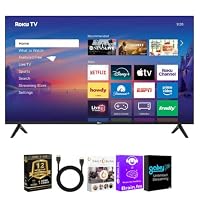 Roku Select Series 4K QLED Smart Roku Select Series 4K QLED Smart |
Price |
Prices and ratings are read from the Amazon product listing and change there, not here. Every rating is the average left by Amazon buyers, not a score from this site.
Why each one is on the list
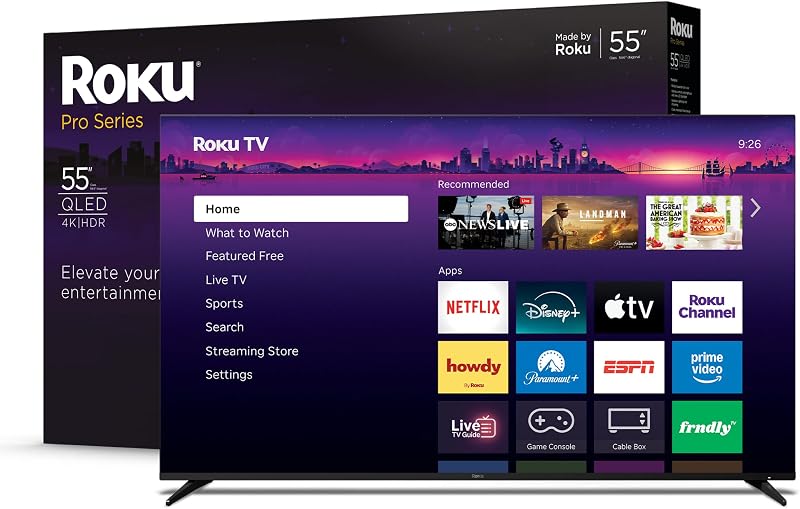
Best for High-framerate gaming and reference contrast monitoring
Pros
- Native 120Hz refresh rate
- Mini-LED full array dimming
- FreeSync Premium Pro and VRR
- Backlit rechargeable Voice Remote Pro
Cons
- Premium hardware footprint
- Higher power requirements
- TCL 55-Inch Class R7D Series 4K: Best for content creators who rely on flexible wireless casting via Google Cast and Apple AirPlay 2 alongside smooth MEMC motion processing for sports and action footage.
- Hisense 55″ Class E6SR Series Hi-QLED: Best for budget-minded video editors and movie buffs seeking dedicated Dolby Vision decoding, AI upscaling, and room-filling DTS Virtual:X sound.
- Roku Smart TV: Best for competitive console gamers, motion graphic designers, and discerning viewers who demand a native 120Hz panel, Mini-LED local dimming, and FreeSync Premium Pro.
- Roku Select Series 4K QLED Smart: Best for hobbyists seeking an all-in-one studio bundle with comprehensive HDR format support, Dolby Atmos decoding, and bundled connection accessories.
01 TCL 55-Inch Class R7D Series 4K

Best for Studio creators needing versatile smart casting
Pros
- Motion Rate 240 with MEMC
- Google Cast and AirPlay 2
- HDR10+ and HLG support
- FullView bezel-less design
Cons
- Native 60Hz refresh rate
- Lacks Dolby Vision support
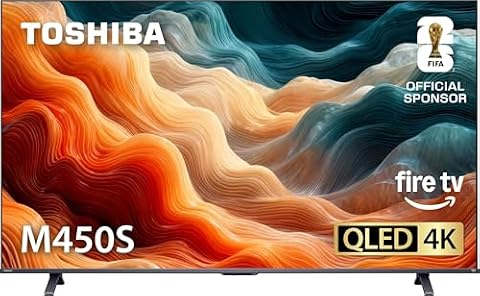
The TCL 55-Inch Class R7D Series 4K serves as a capable, media-friendly centerpiece for creators and viewers seeking balanced everyday performance. Built around a true 4K UHD 3840×2160 QLED panel, this television utilizes an LED backlight to produce vibrant colors and high contrast. Content producers reviewing timeline footage will appreciate its broad HDR compatibility, which encompasses Open HDR, HDR10, HDR10+, and HLG. The inclusion of Motion Rate 240 with MEMC frame interpolation reduces judder and visual motion blur during fast-moving athletic broadcasts, handheld camera sequences, and high-tempo action scenes, ensuring the image remains crisp during rapid on-screen movement.
For smart home connectivity and creator workflows, the tcl r7d series 55 stands out by incorporating both Google Cast and Apple AirPlay 2 straight out of the box. Vloggers and mobile videographers can wirelessly mirror high-resolution dailies, horizontal b-roll clips, or photo albums directly from laptops, iPhones, or Android devices without installing third-party bridge software. Voice control integration extends to Amazon Alexa, Google Home, and Apple HomeKit, allowing you to incorporate the television into smart studio lighting scenes and automated workstation routines. If your studio space requires a larger secondary screen for viewing from a distance, checking out a larger screen like a tcl roku 65 inch smart tv may also be worth exploring.
Physical connectivity on this roku 55 inch tv 4k includes three HDMI ports with eARC/ARC support, enabling clean single-cable routing to external audio interfaces or dedicated studio monitors. It also features a USB input and an optical digital audio output with Dolby Digital+ passthrough to ensure clean audio transmission. Console gamers benefit from Auto Low Latency Mode, which automatically disables extraneous post-processing the moment a console sends an active video signal, minimizing controller response delay. While its native panel refresh rate tops out at 60Hz, its FullView bezel-less metal aesthetic delivers an unobtrusive visual profile suited for clean video editing suites.
- True 4K UHD QLED panel with Open HDR, HDR10, HDR10+, and HLG support
- Motion Rate 240 with MEMC technology to reduce motion blur and judder
- Integrated Google Cast, Apple AirPlay 2, and Apple HomeKit compatibility
- Three HDMI inputs with eARC/ARC and Dolby Digital+ passthrough
02 Hisense 55″ Class E6SR Series Hi-QLED
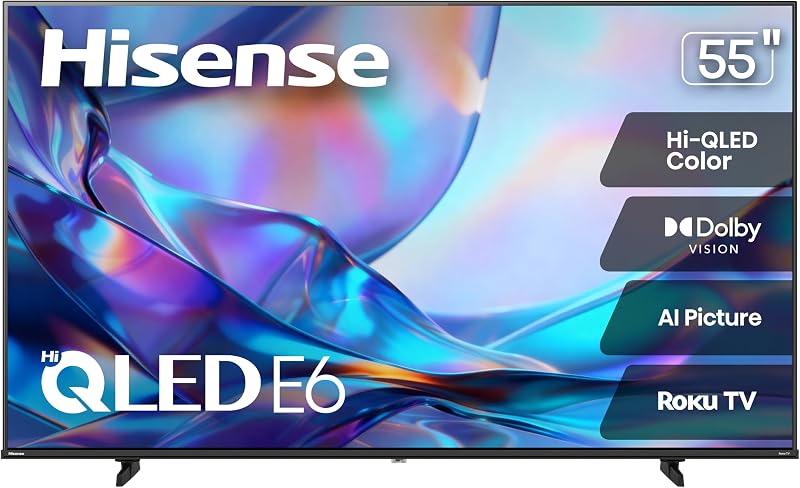
Best for Color-focused editors wanting Dolby Vision on budget
Pros
- Hi-QLED wide color gamut
- Dolby Vision dynamic contrast
- AI 4K upscaler processing
- DTS Virtual:X audio
Cons
- 60Hz refresh rate ceiling
- Direct LED lacks local dimming
The Hisense 55″ Class E6SR Series Hi-QLED focuses heavily on dynamic contrast, refined color science, and intelligent signal upscaling. Featuring Direct LED backlighting paired with a Hi-QLED wide color gamut layer, this screen is calibrated to deliver authentic skin tones and saturated hues that avoid unnatural clipping. The standout visual feature of the hisense e6sr 55 is its native Dolby Vision support, complementing HDR10 and HLG decoding. For video editors grading commercial work or cinephiles watching modern streaming releases, Dolby Vision dynamically adjusts color and tone curves frame by frame, preserving shadow detail and bright highlights simultaneously.
To assist with mixed-resolution media workflows, Hisense equips this model with AI Picture processing and an integrated AI 4K Upscaler. Creators reviewing archival 1080p footage, legacy camera captures, or compressed network feeds will notice improved edge definition, reduced macroblocking, and minimized noise artifacts. Audio reproduction is managed through DTS Virtual:X sound processing, which expands the perceived soundstage, clarifies dialogue tracks, and creates a more three-dimensional listening environment without the immediate need for a multi-channel studio soundbar.
Gamers and fast-paced media editors benefit from Game Mode Plus, which incorporates Auto Low Latency Mode and Variable Refresh Rate to smooth out frame pacing fluctuations and prevent screen tearing on modern consoles. Like other premium Roku displays, it includes Apple AirPlay support alongside compatibility with Google Assistant and Amazon Alexa. While the physical panel operates at a native 60Hz display refresh rate, the combination of VRR, deep color rendering, and slim 2.9-inch physical profile makes it an attractive contender for creators seeking the best 55 inch roku tv for visual color grading and casual playback.
- Hi-QLED color technology with Dolby Vision, HDR10, and HLG dynamic range support
- AI Picture engine featuring an intelligent AI 4K upscaler and noise reduction
- DTS Virtual:X audio processing for dialogue clarity and virtualized surround sound
- Game Mode Plus incorporating Variable Refresh Rate and Auto Low Latency Mode
03 Roku Smart TV
The Roku Smart TV represents the top tier of the manufacturer’s first-party lineup, commonly designated as the roku pro series 55 inch. Engineered specifically for demanding video enthusiasts, serious gamers, and digital media artists, this flagship screen combines Mini-LED backlighting with Quantum Dot QLED color enhancement. By utilizing thousands of individual mini-LED diodes arranged into a Full Array Local Dimming array, this display achieves a striking 5000:1 contrast ratio. It provides precise light placement that renders pitch blacks alongside radiant specular highlights with minimal haloing or light bleed.
Visual fidelity is elevated further through Roku Smart Picture Max, an AI-powered processing suite that analyzes incoming video frames in real time to refine sharpness, balance saturation, and optimize dynamic range based on scene composition. In terms of motion clarity, this screen functions as a true 55 inch roku tv 120hz display, boasting a native 120Hz panel refresh rate. This hardware speed ensures fluid motion rendering for high-framerate action cameras, live sports broadcasts, and high-performance gaming. PC and console gamers can take advantage of AMD FreeSync Premium Pro, VRR, and ALLM, delivering instantaneous responsiveness and completely tear-free visual output.
Roku complements this high-end panel with an elevated physical design and accessories. The glossy screen finish accentuates perceived contrast and depth, while the minimalist chassis is designed to mount virtually flush against the wall when paired with compatible mounts. Everyday control is handled by the rechargeable Roku Voice Remote Pro, which features backlit buttons for dark editing suites, hands-free voice search, and a lost-remote finder alert. For creators evaluating whether to upgrade from smaller secondary screens like a 50 inch roku display, this Pro Series model provides an undeniable jump in refresh rate, black levels, and panel luminance.
- Mini-LED backlight with Full Array Local Dimming and a 5000:1 contrast ratio
- Native 120Hz refresh rate with AMD FreeSync Premium Pro, VRR, and ALLM
- Dolby Vision IQ, HDR10+, HDR10, and HLG dynamic range optimization
- Includes rechargeable Roku Voice Remote Pro with backlit buttons and hands-free voice
04 Roku Select Series 4K QLED Smart

Best for Hobbyists seeking an all-in-one media bundle
Pros
- Dolby Vision and HDR10+ support
- Dolby Atmos audio decoding
- VRR and ALLM gaming support
- Includes HDMI cable and protection plan
Cons
- 60Hz native refresh rate
- Heavier 60-pound unit weight
The Roku Select Series 4K QLED Smart bundle provides a comprehensive entertainment and monitoring solution designed to get users up and running immediately. Built around a 4K UHD 3840×2160 Quantum Dot QLED panel, this television delivers rich color saturation, crisp fine-line resolution, and balanced dynamic range. Content creators and home theater fans benefit from extensive high dynamic range support, as the roku select series 55 inch decodes Dolby Vision, HDR10+, HDR10, and HLG content, allowing you to view modern streaming masters and user-generated video precisely as intended.
Audio is handled with high fidelity thanks to onboard Dolby Atmos decoding alongside standard Dolby Audio processing. When paired with compatible multi-channel speaker setups or Atmos-capable soundbars, this television accurately positions directional sound cues, enhancing production spatial awareness and movie immersion. On the connectivity front, the television includes multiple HDMI inputs, high-speed USB ports, an Ethernet jack for hardwired network stability, and optical digital audio out. Apple AirPlay 2 and Apple Home support are built directly into the system for seamless screen mirroring from MacBooks, iPads, and iPhones, and users with compact secondary spaces might also compare this footprint against a smaller 40 inch roku model before finalizing their room layout.
Gaming capabilities on the Select Series include Auto Low Latency Mode, Variable Refresh Rate, and a dedicated Game Mode to reduce input delay and maintain smooth rendering during fast-paced play sessions. While the native panel refresh rate is 60Hz, its Quantum Dot color palette and robust HDR toolset make it an exceptional daily workstation display. The bundle configuration adds extra peace of mind by including a high-speed premium HDMI cable, an extended streaming bundle, and a 12-Month CPS Protection Plan right inside the packaging, ensuring your investment remains protected against unexpected operational issues.
- Quantum Dot QLED 4K UHD display with Dolby Vision, HDR10+, and HLG
- Built-in Dolby Atmos decoding and Dolby Audio acoustic processing
- Gaming support featuring Variable Refresh Rate, ALLM, and Game Mode
- Comprehensive bundle including a premium HDMI cable and 12-Month CPS Plan
What Sets These Models Apart
Comparing these four Roku smart displays highlights distinct engineering choices across backlighting, refresh rates, and HDR format decoding. While all four units share the intuitive Roku OS interface and 3840×2160 resolution, the underlying panel technology dictates the quality of contrast, motion smoothness, and color reproduction you will experience in real-world use. The table below outlines the core technical specifications across all four models.
| Model | Backlight & Panel Type | Native Refresh Rate | HDR Formats Supported | Key Gaming Technologies |
|---|---|---|---|---|
| TCL 55-Inch Class R7D Series 4K | LED Backlight, QLED Panel | 60Hz (Motion Rate 240) | Open HDR, HDR10, HDR10+, HLG | ALLM (Auto Low Latency Mode) |
| Hisense 55″ Class E6SR Series Hi-QLED | Direct LED, Hi-QLED Panel | 60Hz | Dolby Vision, HDR10, HLG | Game Mode Plus, VRR, ALLM |
| Roku Smart TV (Pro Series) | Mini-LED Full Array, QLED | 120Hz | Dolby Vision IQ, HDR10+, HDR10, HLG | FreeSync Premium Pro, VRR, ALLM |
| Roku Select Series 4K QLED Smart | LED Backlight, Quantum Dot QLED | 60Hz | Dolby Vision, HDR10+, HDR10, HLG | Game Mode, VRR, ALLM |
The most pronounced divergence occurs in backlight control and panel refresh rates. The Roku Pro Series utilizes a sophisticated Mini-LED matrix with Full Array Local Dimming, yielding a 5000:1 contrast ratio that significantly outperforms the standard Direct LED and edge-lit systems found on the TCL, Hisense, and Roku Select models. Furthermore, the Pro Series stands alone with a native 120Hz refresh rate and AMD FreeSync Premium Pro, making it the premier choice for fast-action content and competitive gaming, whereas the other three models rely on 60Hz panels augmented by software motion smoothing or standard VRR.
Buying Tips for Roku Smart TVs
When selecting a 55-inch Roku smart TV, your primary consideration should be ambient lighting and panel contrast. If your editing studio or living room features large windows or overhead studio lamps, a display with a high-efficiency QLED quantum dot layer ensures sufficient color luminance to overcome glare. In dark or light-controlled editing environments, backlight architecture becomes paramount; a television equipped with Mini-LED full array local dimming eliminates the grayish backlight haze common to standard LED displays, rendering accurate black tones that are critical when reviewing cinematic color grades.
Your content source hardware also dictates which features are essential. Gamers playing on current-generation consoles or high-output editing PCs should look specifically for native 120Hz panels, Variable Refresh Rate, and Auto Low Latency Mode. These technologies prevent frame tearing, eliminate stutter during rapid camera pans, and minimize the delay between your input and on-screen execution. If you primarily stream video or review timeline cuts, a 60Hz screen equipped with advanced frame interpolation like MEMC or Motion Rate processing will provide smooth playback without the cost of high-refresh silicon.
Finally, consider the ecosystem and physical audio inputs of your workspace. While all Roku televisions run the same core interface, individual hardware listings vary in their smart home integrations and peripheral ports. Creators who rely on MacBooks or iOS gear should verify native Apple AirPlay 2 compatibility for low-latency screen mirroring. Likewise, ensure the television offers an eARC-capable HDMI port if you intend to route uncompressed Dolby Atmos or multi-channel PCM audio directly into a dedicated studio receiver, soundbar, or audio monitor setup.
FAQ
Can a 55-inch Roku TV serve as a secondary video editing monitor?
Yes, a 55-inch Roku TV can serve effectively as a secondary preview monitor thanks to its 3840×2160 4K resolution and low-latency game modes. By connecting your editing workstation via HDMI and activating Game Mode or Auto Low Latency Mode, the television bypasses heavy post-processing filters to reduce mouse tracking lag. Models featuring QLED panels and wide HDR format support allow creators to verify how client videos, streaming exports, and color grades will render across commercial consumer displays.
What is the difference between native 120Hz and Motion Rate 240?
A native 120Hz refresh rate means the physical display panel refreshes its visual hardware 120 times every second, allowing it to display true 120fps video signals from compatible gaming consoles and PCs without frame dropping. Motion Rate 240, by contrast, refers to a software-based motion enhancement technology running on a physical 60Hz panel. It uses Motion Estimation, Motion Compensation (MEMC) and backlight scanning to simulate smoother motion and reduce perceptible judder during fast camera pans.
Do all 55-inch Roku smart TVs support Dolby Vision?
No, Dolby Vision support varies by individual model and hardware licensing. Among the models compared, the Hisense E6SR, Roku Smart TV Pro Series, and Roku Select Series feature native Dolby Vision or Dolby Vision IQ decoding to optimize dynamic contrast frame by frame. The TCL R7D Series focuses instead on Open HDR, HDR10, HDR10+, and HLG, delivering static and dynamic metadata optimization through alternative high dynamic range standards.
How does Roku Smart Picture Max adjust the image automatically?
Roku Smart Picture Max is an AI-driven processing feature found on select high-end displays like the Roku Pro Series. The system continuously inspects incoming video signals and identifies the specific type of content being displayed, such as sports, cinematic movies, or animated shows. It then adjusts backlight intensity, local dimming zones, sharpness curves, and color saturation dynamically without requiring manual menu adjustments from the user.
Which gaming features matter most on a 55-inch Roku screen?
The three most critical gaming features are Auto Low Latency Mode (ALLM), Variable Refresh Rate (VRR), and high panel refresh rates. ALLM ensures the television switches automatically into its fastest response profile when a console is detected. VRR synchronizes the screen’s refresh cycle directly to the console’s rendering output to eliminate screen tearing, while a native 120Hz panel ensures fluid visual tracking during fast-paced competitive gameplay.