Philips Monitors & Displays
Top Philips Monitors Compared for Multi-Display Editing Workflows
Setting up an efficient phillips dual monitor workspace requires selecting panels that directly support your visual demands, whether you assemble video sequences, edit high-resolution stills, or manage expansive audio timelines. A dual-display layout doubles desktop space, allowing creators to keep reference previews, project bins, and script notes open alongside their primary editing software without constantly…
As Amazon Associates, we earn from qualifying purchases. This means we may receive a small commission at no extra cost to you if you click through and make a purchase.
Setting up an efficient phillips dual monitor workspace requires selecting panels that directly support your visual demands, whether you assemble video sequences, edit high-resolution stills, or manage expansive audio timelines. A dual-display layout doubles desktop space, allowing creators to keep reference previews, project bins, and script notes open alongside their primary editing software without constantly switching active windows. Finding the right display pairing comes down to balancing panel technology, refresh rate capabilities, and physical dimensions so your side-by-side screens operate as a cohesive workstation rather than two mismatched panels competing for desk space.
This philips monitor comparison evaluates 3 distinct displays to help you decide which philips monitor to buy for an optimized dual-screen environment. These models differ primarily in their panel chemistry, refresh rates, physical dimensions, and port selections: one option utilizes a high-speed 180Hz IPS panel engineered with ultra-low motion blur for dynamic timeline scrubbing, while the other two incorporate high-contrast VA panels running at 100Hz in 24-inch and 27-inch form factors tailored for extended editing sessions and office productivity.
Which Philips Monitors Should You Buy
All 3 models on this page, side by side
| Model | Buyer rating | Listing |
|---|---|---|
01 Philips 24" Gaming Monitor FHD 180Hz Philips 24" Gaming Monitor FHD 180Hz |
Price | |
02 Philips 241V8LBS 24" Philips 241V8LBS 24" |
Price | |
03 Philips 271V8LBS 27" Full HD Monitor Philips 271V8LBS 27" Full HD Monitor |
Price |
Prices and ratings are read from the Amazon product listing and change there, not here. Every rating is the average left by Amazon buyers, not a score from this site.
Why each one is on the list
- Fast timeline playback, color-critical editing, and hybrid gaming: Philips 24″ Gaming Monitor FHD 180Hz
- Compact dual-screen creator suites and budget-conscious productivity: Philips 241V8LBS 24″
- Expanded visual canvas for timeline scrubbing and multi-track audio tracking: Philips 271V8LBS 27″ Full HD Monitor
01 Philips 24″ Gaming Monitor FHD 180Hz
Best for Fast timeline editing and high-framerate creators
Pros
- 180Hz refresh rate
- 5ms MPRT response time
- IPS panel with HDR10
- HDMI 2.1 and DisplayPort 1.4
Cons
- Glossy screen finish reflects glare
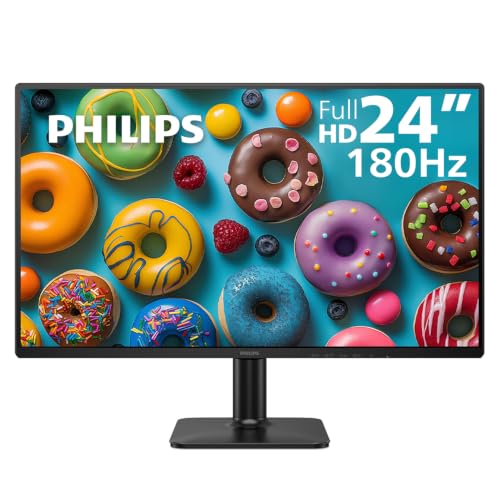
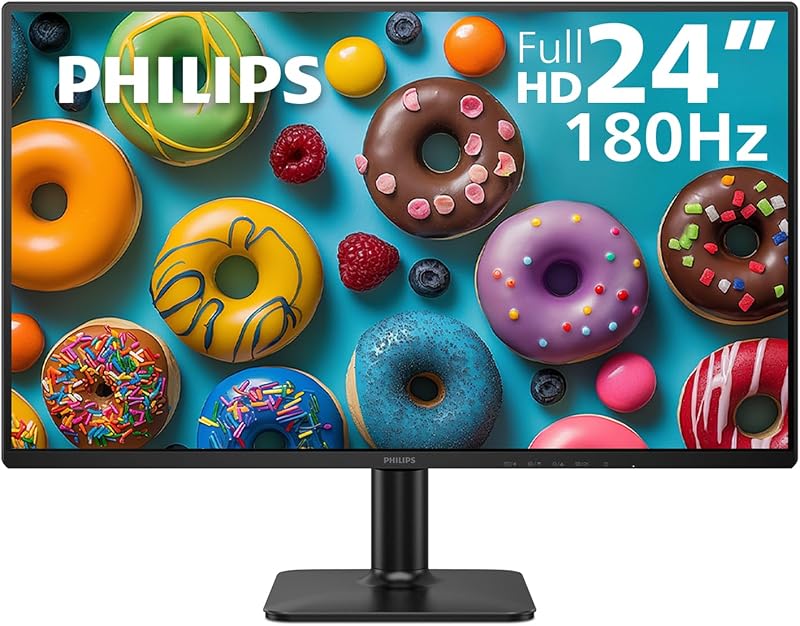
Creators seeking fluid motion rendering alongside reliable color representation will find the Philips 24″ Gaming Monitor FHD 180Hz well suited for an active editing suite. Built around a 23.8-inch Full HD 1080p IPS panel, this display provides wide viewing angles that keep color fidelity intact when tilted inward on an angled dual-screen arm. The defining performance attribute is its 180Hz refresh rate combined with a 0.5ms MPRT response time, delivering clean cursor tracking, crisp timeline scrubbing, and smooth video playback without visible smearing. For editors who cut action footage or switch between production work and gaming, the panel incorporates Adaptive Sync variable refresh rate support and HDR10 contrast enhancement to eliminate screen tearing.
Connectivity is modern and versatile, featuring HDMI 2.1 and DisplayPort 1.4 inputs that connect cleanly to current-generation graphics cards or an hp mini pc. The physical construction highlights ultra-slim bezels that minimize the visual gap when placing two screens edge to edge, creating an immersive canvas. Extended editing sessions are supported by integrated LowBlue Mode and Flicker-Free backlight technology, while VESA mount support allows straightforward attachment to third-party desk arms. The screen finish is glossy, delivering deep visual punch under controlled indoor studio lighting.
When deploying the philips 24 gaming monitor fhd 180hz in a multi-display arrangement, it functions best as your primary preview or active timeline monitor. While its IPS panel provides superior viewing stability and motion clarity compared to traditional office screens, users who prioritize maximum static contrast for low-light cinematic color grading may prefer the 4,000:1 contrast ratio found on the VA alternatives. Nonetheless, its responsive 180Hz refresh rate, 0.5ms response time, and modern port selection make it a capable centerpiece for demanding workflows.
- 23.8-inch Full HD 1920×1080 IPS panel with wide viewing angles
- 180Hz refresh rate with 0.5ms MPRT response time for fluid playback
- Adaptive Sync VRR support and HDR10 contrast enhancement
- Ultra-slim bezels with HDMI 2.1, DisplayPort 1.4, and VESA mount support
02 Philips 241V8LBS 24″

Best for Budget-focused dual screen productivity
Pros
- 4,000:1 deep contrast ratio
- 100Hz smooth refresh rate
- Compact lightweight chassis
- Eye care with EasyRead mode
Cons
- Lacks DisplayPort connectivity
The Philips 241V8LBS 24″ is engineered for workstations centered around writing, audio editing, coding, and general digital production where text clarity and contrast take priority over peak frame rates. Featuring a 23.8-inch Full HD VA panel, this model provides a 4,000:1 contrast ratio that renders deep black levels and sharp typography. Operating at a smooth 100Hz refresh rate, it represents a substantial step up from standard 60Hz displays by reducing eye fatigue during fast document scrolling and window navigation. Adaptive-Sync technology is included to ensure tear-free playback across fluctuating frame rates.
Integrating this display into a streamlined workstation is straightforward due to its compact 2-inch depth and manageable 10.3-pound weight. Installing a pair of these panels on a mount it monitor desk mount dual arm establishes a balanced, symmetrical dual-screen workspace that clears significant desktop space for editing consoles, audio interfaces, and studio gear. Connectivity includes an HDMI port alongside a legacy VGA input, ensuring compatibility with modern workstations as well as utility PCs. Built-in eye care features include Flicker-Free technology, LowBlue Mode, and EasyRead mode, which adjusts image parameters to mimic paper for comfortable reading.
Within a philips dual monitor setup, the philips 241v8lbs 24 serves effectively as a dedicated auxiliary screen for holding script notes, file directories, communication tools, or audio mixers. Its high 4,000:1 contrast makes reading text and monitoring dark user interfaces comfortable in low-light editing bays. However, because it relies on a 100Hz VA panel rather than a high-speed IPS display, it gives way to the 180Hz gaming model when working on color-critical video correction or fast-motion previewing where wide off-axis viewing consistency is required.
- 23.8-inch Full HD 1920×1080 VA panel with 178-degree viewing angles
- 4,000:1 contrast ratio delivering deep blacks and crisp readability
- 100Hz refresh rate with Adaptive-Sync for smooth motion
- Flicker-Free technology, LowBlue Mode, EasyRead mode, and VESA mount compatibility
03 Philips 271V8LBS 27″ Full HD Monitor

Best for Large-format timeline and document viewing
Pros
- Expansive 27-inch display area
- 4,000:1 contrast with SmartImage
- Matte glare-reducing screen finish
- Adaptive-Sync tear-free playback
Cons
- Lower 1080p pixel density at 27 inches
Creators who need an expansive visual canvas without increasing workstation clutter will appreciate the scale of the Philips 271V8LBS 27″ Full HD Monitor. Featuring a 27-inch Full HD VA display, this monitor delivers a 4,000:1 contrast ratio and wide 178-degree viewing angles, maintaining consistent image clarity across its broader surface area. Operating at 100Hz with Adaptive-Sync support, it keeps timeline scrolling, media playback, and everyday computing tasks smooth and artifact-free. Unlike its smaller counterparts, this model includes a matte screen finish that diffuses overhead studio lighting and window reflections.
Image quality on this display is bolstered by Philips SmartImage and SmartContrast technologies, which dynamically optimize contrast and backlighting based on displayed content. The panel offers 250 nits of brightness and a pixel pitch of 0.31mm, making interface icons and text easily legible from a comfortable viewing distance. Connectivity includes HDMI and VGA inputs, while VESA mount compatibility allows flexible integration into multi-screen arm configurations. Like other philips productivity monitors, it incorporates LowBlue Mode, Flicker-Free backlighting, and EasyRead mode to minimize eye strain during marathon project sessions.
For editors implementing a philips multi monitor workflow, the philips 271v8lbs 27 provides substantial screen real estate for sprawling multi-track audio timelines, broad spread-sheet schedules, or video bin organization. Creators who sit slightly further back from their desks will appreciate the larger physical surface area compared to 24-inch screens. However, because its 1080p resolution is spread over a 27-inch diagonal, the pixel density is lower than that of the 23.8-inch models. Users requiring razor-sharp pixel density or ultra-high refresh rates will prefer the 24-inch 180Hz model for detailed graphic work, utilizing this 27-inch screen as an expansive secondary overview display.
- 27-inch Full HD 1920×1080 VA display with wide 178-degree viewing angles
- 4,000:1 contrast ratio with SmartImage and SmartContrast optimization
- 100Hz refresh rate with Adaptive-Sync for tear-free video rendering
- Matte screen finish with HDMI, VGA, and VESA mount support
What Sets These Models Apart
| Feature | Philips 24″ Gaming Monitor FHD 180Hz | Philips 241V8LBS 24″ | Philips 271V8LBS 27″ Full HD Monitor |
|---|---|---|---|
| Panel Type & Size | 23.8-inch IPS | 23.8-inch VA | 27-inch VA |
| Refresh Rate & Response | 180Hz, 0.5ms MPRT | 100Hz, the listing does not specify ms | 100Hz, the listing does not specify ms |
| Contrast Ratio | The listing does not specify | 4,000:1 | 4,000:1 |
| Video Inputs | HDMI 2.1, DisplayPort 1.4 | HDMI, VGA | HDMI, VGA |
| Screen Finish | Glossy | Glossy | Matte |
The primary distinction among these three displays centers on the choice between fast IPS responsiveness and high-contrast VA clarity. The 24-inch gaming monitor is built around high-speed visual performance, offering a 180Hz refresh rate, 0.5ms response time, and DisplayPort 1.4 connectivity that cater directly to motion graphics and real-time editing playback. In contrast, the two office-oriented displays emphasize deep 4,000:1 contrast ratios and eye-care reading modes, making them exceptionally comfortable for text-heavy, audio, and organizational tasks at 100Hz. Choosing between the two VA models comes down to physical scale: the 24-inch model preserves tighter pixel density on smaller desks, while the 27-inch model provides an expansive canvas with a glare-resistant matte screen finish.
Buying Tips for Philips Monitors
When selecting the best philips monitors for dual screen setups, matching the panel characteristics to your primary daily tasks is essential. An IPS panel provides superior off-axis viewing consistency and responsive frame rendering, making it the preferred choice for color grading, graphic creation, and video editing preview monitors. Conversely, VA panels deliver high 4,000:1 contrast ratios that produce deep blacks, making them ideal for text reading, audio track sequencing, and coding in dimly lit studios. Combining an IPS monitor as your primary screen with a VA monitor as your secondary display can create a balanced workstation covering both visual precision and comfortable document reference.
Physical arrangement and desk ergonomics also play a major role in workstation productivity. Consider your desk depth when deciding between 24-inch and 27-inch displays; 24-inch screens offer crisp pixel density at 1080p for standard viewing distances, while 27-inch panels make interface elements larger and easier to read from further away. Utilizing VESA mounts allows you to align screen heights precisely, angle side displays inward, and elevate both monitors above the desk surface to create room for audio monitors, keyboards, and creator accessories. Creators evaluating multi-display options can also compare these traditional layouts against an asus dual mode monitor if their projects require switching between distinct refresh and resolution profiles.
Finally, verify your computer hardware connectivity before setting up a dual-display workstation. The 180Hz model requires DisplayPort 1.4 or HDMI 2.1 to achieve its maximum refresh rate, while the 100Hz models utilize standard HDMI and legacy VGA inputs. Ensure your graphics card, laptop dock, or workstation hub has sufficient video outputs to drive both displays at their native 1080p resolutions and refresh rates simultaneously to avoid display downscaling or sluggish cursor movement.
FAQ
Can you use two different Philips monitor models in a dual setup?
Yes, combining two different Philips models in a single dual setup is common and practical. Many creators use the 24-inch 180Hz IPS monitor as their primary display for color work and video playback, while placing a 24-inch or 27-inch 100Hz VA monitor alongside it for scripts, audio bins, and project files. Adjusting display scaling in your operating system ensures smooth cursor transitions between screens.
How do you connect two Philips monitors to a single computer?
To connect two Philips displays, your computer or docking station must have two independent video outputs. For example, you can connect the 180Hz monitor using a DisplayPort or HDMI cable, and the second monitor using an HDMI cable. If your laptop only features USB-C ports, a dual-display hub or adapter supporting HDMI and DisplayPort will allow both screens to run independently in extended desktop mode.
Is 1080p Full HD resolution sufficient for a dual monitor creator setup?
Full HD 1080p resolution provides clear image quality, particularly on 23.8-inch panels where pixel density remains sharp. On a dual-monitor desk, two 1080p displays deliver a combined resolution of 3840×1080, providing ample horizontal space for editing timelines on one screen while dedicating the other to full-screen video previews or production assets without overloading your system graphics card.
What are the practical benefits of a 100Hz or 180Hz refresh rate for creators?
Higher refresh rates deliver smoother cursor movement, fluid window dragging, and reduced motion blur when scrubbing through high-framerate timelines. While 60Hz is standard for basic computing, 100Hz and 180Hz refresh rates reduce perceived visual stutter and eye strain during long editing sessions, providing a noticeably more responsive desktop experience.
Are these Philips monitors compatible with aftermarket dual-monitor arms?
All three Philips models featured in this guide include VESA mount compatibility, allowing them to be mounted directly onto standard aftermarket desk arms or wall mounts. Using a dual-arm desk mount enables precise height and tilt adjustments, creates a flush bezel alignment, and frees up valuable desk space beneath the screens.