HP Chromebook Touchscreen Laptop Lineup: Field Workflow Comparison
Finding the right hp chromebook touchscreen laptop is an exercise in matching hardware mobility with real-world production demands. For video producers, field reporters, and digital hobbyists, a reliable touchscreen interface speeds up media indexing, shot tagging, and script revisions while working away from a studio desk. ChromeOS delivers instant boot times, cloud-native file integration, and…

As Amazon Associates, we earn from qualifying purchases. This means we may receive a small commission at no extra cost to you if you click through and make a purchase.
Finding the right hp chromebook touchscreen laptop is an exercise in matching hardware mobility with real-world production demands. For video producers, field reporters, and digital hobbyists, a reliable touchscreen interface speeds up media indexing, shot tagging, and script revisions while working away from a studio desk. ChromeOS delivers instant boot times, cloud-native file integration, and low power consumption, making these machines compelling companions for travel kits and remote production bags. Choosing between available configurations requires looking past simple exterior styling to analyze screen resolution, hinge durability, processing overhead, and physical port connectivity.
This field analysis reviews six distinct touchscreen Chromebooks manufactured by HP, highlighting how their internal specifications and physical layouts serve mobile workflows. The lineup spans from compact 14-inch convertibles built for handheld review to traditional clamshell notebooks and an expansive 17.3-inch desktop replacement running ChromeOS Flex. Storage configurations vary from basic 32GB flash arrays up to rapid 128GB solid-state drives, while processing platforms range from dual-core Celeron silicon to quad-core chips and newer Intel N-series architectures. Reviewing these mechanical and computational differences allows you to choose an agile production partner that matches your exact creative routine.
Which HP Touchscreen Chromebooks Should You Buy
All 6 models on this page, side by side

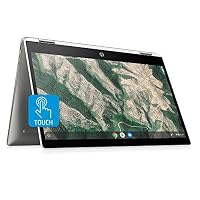


Prices and ratings are read from the Amazon product listing and change there, not here. Every rating is the average left by Amazon buyers, not a score from this site.
Why each one is on the list
- Precision Scripting and Media Intake: The HP Chromebook 14 x360 Plus combines a tall 1200p anti-glare touch display, 128GB of responsive UFS storage, and a drop-tested convertible chassis for working creators.
- Handwritten Notes and Storyboarding: The HP Chromebook x360 14-inch HD Touchscreen features edge-to-edge protective glass and active pen compatibility for sketching production layouts on location.
- Lightweight Audio Monitoring: The HP Chromebook 14-inch HD Touchscreen Laptop pairs a slim clamshell design with custom B&O stereo speakers for checking audio clips on the road.
- External Display Output: The HP 14″ HD Chromebook Laptop incorporates a built-in HDMI port and quad-core processing for direct connection to production monitors and projectors without adapters.
- Expansive Timeline and Document Viewing: The HP 17.3″ Touchscreen Chromebook brings a large workspace, 8GB of system RAM, and fast NVMe storage for focused data organization on ChromeOS Flex.
- Rapid-Recharge Mobile Writing: The HP Chromebook 14 Laptop offers quad-core performance, up to 14 hours of battery longevity, and fast recharge support for creators on extended shoot days.
01 HP Chromebook 14 x360 Plus
Best for Field note-taking on long shoots
Pros
- Quad-core Celeron processing power
- Long 14-hour run time
- Fast Charge battery replenishment
Cons
- Basic 1366×768 panel sharpness
- Non-convertible clamshell only

Best for Detailed script writing and mobile review
Pros
- Crisp 1200p anti-glare touchscreen
- Fast 128GB UFS storage
- Durable MIL-STD 810H chassis
Cons
- 4GB RAM limits heavy tab multitasking
- Upgraded unit ships resealed
The HP Chromebook 14 x360 Plus is engineered for creators who demand screen clarity and structural versatility in field conditions. Built around an Intel N150 processor with integrated Intel UHD Graphics, the system handles multi-tab research, cloud storage syncing, and real-time script editing smoothly. The hardware configuration includes 4GB of high-speed LPDDR5 system memory and a 128GB UFS storage drive, offering noticeably snappier read and write rates than traditional flash memory when loading media libraries or saving local production docs. As noted in the listing disclosure, this system has been resealed following component upgrades and includes a one-year HP warranty covering the remaining factory hardware.
Visual workspace quality is a clear highlight on this model. The 14-inch WUXGA touchscreen delivers an expanded 1920×1200 resolution with narrow borders, giving creators vertical workspace advantages when reviewing long video transcripts or shot logs. Rated at 300 nits of brightness and treated with an anti-glare coating, the screen remains readable under fluctuating ambient light, while the 360-degree hinge allows instant transitions between conventional laptop typing, tent mode for client previews, and flat tablet manipulation. The chassis has undergone MIL-STD 810H environmental testing, providing reassurance when packed into gear bags alongside camera bodies and light stands. Creators comparing flexible form factors will find this model a strong benchmark in an hp chromebook 2 in 1 evaluation.
Peripherals connect easily through a thoughtful arrangement of modern and legacy ports, including USB-C, USB-A, and a 3.5mm combo audio jack. Wireless communications leverage Wi-Fi 6 and Bluetooth 5.4 protocols, ensuring low latency when pairing wireless monitoring headphones or transferring assets across wireless networks. For production meetings and remote client checks, the integrated FHD webcam utilizes temporal noise reduction to keep video feeds clear under uneven indoor lighting, assisted by a physical webcam privacy shutter for operational security. ChromeOS update support extends through June 2033, ensuring a long operational lifespan for mobile creators.
- 14-inch WUXGA 1920×1200 anti-glare touch display with 300 nits brightness
- MIL-STD 810H tested chassis with 360-degree four-mode hinge
- 128GB high-speed UFS solid-state storage and 4GB LPDDR5 memory
- FHD webcam with temporal noise reduction and integrated privacy shutter
02 HP Chromebook x360 14-inch HD Touchscreen

Best for Handwritten storyboards and sketching
Pros
- Flexible 360-degree convertible hinge
- Edge-to-edge glass pen support
- Upgradable memory slot design
Cons
- Modest 32GB internal storage
- Lower resolution 768p panel
Designed with a focus on tactile interaction and tactile media drafting, the HP Chromebook x360 14-inch HD Touchscreen utilizes advanced 3D metal-forming manufacturing to deliver a rigid, streamlined convertible chassis. Finished in Ceramic White with Mineral Silver accents, the machine weighs 3.5 pounds and provides four operational orientations: standard laptop, angled stand, tent, and tablet. It is powered by an Intel Celeron N4000 dual-core processor with a 1.1 GHz base frequency and burst capability up to 2.6 GHz, accompanied by integrated Intel UHD Graphics 600. The memory configuration pairs 4GB of LPDDR4-2400 SDRAM with 32GB of eMMC flash storage, though the motherboard features an accessible memory slot for future capacity expansion.
The display consists of an edge-to-edge glass multitouch surface spanning 14.0 inches diagonally with an HD SVA micro-edge layout at 1366×768 resolution. This glass surface supports pen input, allowing visual artists and video directors to mark up scripts, draw rough scene layouts, or navigate editing interfaces with natural stylus motions. While the 768p resolution provides less pixel density than full high-definition panels, the edge-to-edge glass construction produces smooth finger glide and enhanced structural protection against surface scratches when used handheld in tablet mode.
Battery endurance is rated for up to 12 hours and 30 minutes under mixed usage, providing enough continuous runtime to cover an entire day on location without hunting for wall outlets. ChromeOS provides native access to the Google Play Store, enabling seamless installation of mobile creative suites, offline note-taking utilities, and scriptwriting tools. The device gives way to the 14 x360 Plus when higher display resolutions and greater onboard storage are essential, but remains an appealing platform for creators prioritizing pen-enabled storyboarding.
- 360-degree convertible hinge supporting laptop, tablet, stand, and tent modes
- Edge-to-edge glass multitouch 14.0-inch HD screen with stylus pen support
- Upgradable system memory architecture featuring an accessible slot
- Up to 12 hours and 30 minutes of mixed-use battery endurance
03 HP Chromebook 14-inch HD Touchscreen Laptop

Best for Vlog audio monitoring and rough cuts
Pros
- B&O tuned stereo speaker system
- Lightweight 3.2-pound clamshell
- Over 12-hour battery endurance
Cons
- Base 32GB eMMC storage
- Dual-core Celeron performance ceiling
The HP Chromebook 14-inch HD Touchscreen Laptop takes a traditional notebook approach, eschewing folding hinges in favor of a stable clamshell build designed for consistent lap typing and table production. Enclosed in a Mineral Silver chassis weighing 3.2 pounds, it pairs mobility with standard operational ergonomics. Power is delivered by an Intel Celeron N4000 processor alongside Intel HD Graphics 500, supported by 4GB of system RAM and 32GB of embedded MultiMediaCard storage. This hardware balance suits straightforward field duties such as drafting articles, tracking shoot schedules in spreadsheets, and responding to production messages.
Multimedia intake benefits from custom hardware engineering on the audio side. HP equipped this notebook with stereo speakers tuned by the audio specialists at Bang & Olufsen, delivering crisper dialogue separation and balanced mid-tones compared to typical budget speakers. For video creators who need to quickly review field interview audio or listen to podcast dialogue without reaching for monitor headphones, these B&O tuned speakers provide a distinct utility. The 14-inch micro-edge display incorporates responsive touch functionality, enabling rapid scrolling through timeline clips and web resources.
Operational longevity is backed by an internal battery offering over 12 hours of runtime, keeping you productive during long transit legs between filming locations. Cloud integration via Google Play and standard ChromeOS security ensures that your work assets are automatically mirrored to online drives, mitigating the risk of data loss from field hardware damage. While the 32GB internal storage limits how many video assets can be saved locally, the device excels as an ultra-portable typing workstation for bloggers and field journalists.
- Custom stereo speakers tuned by audio specialists at Bang & Olufsen
- 14-inch micro-edge high-definition touchscreen display
- Over 12 hours of continuous battery life for mobile work
- Lightweight 3.2-pound clamshell chassis finished in Mineral Silver
04 HP 14″ HD Chromebook Laptop

Best for Direct external monitor hookups
Pros
- Dedicated HDMI video output port
- Up to 14-hour battery life
- Fast charging to 50 percent
Cons
- Standard 768p display resolution
- Fixed 4GB memory capacity
Field video workflows often demand direct connections to secondary production monitors or field switchers, and the HP 14″ HD Chromebook Laptop addresses this directly through its integrated port layout. Finished in Natural Silver and weighing 3.4 pounds, this notebook features a dedicated full-size HDMI port alongside a USB 3.0 Type-C port, two USB 3.0 Type-A ports, and a 3.5mm headphone jack. This built-in connectivity eliminates the need to carry external USB-C dongles when presenting shot reels or connecting external preview screens on set.
Performance is driven by a quad-core Intel Celeron N4120 processor featuring 4 cores, 4 threads, a 1.1 GHz base clock, up to 2.6 GHz boost clock, and a 4MB cache. Paired with 4GB of high-frequency LPDDR4x-4266 RAM and 64GB of eMMC storage, the extra processing cores allow smoother multitasking when switching between asset management tabs, project management boards, and media playback. The visual interface is hosted on a 14.0-inch HD 1366×768 anti-glare micro-edge display, reducing specular reflections when operating outdoors or directly beneath studio lighting grids.
Power management is engineered for demanding travel routines. The internal cell delivers up to 14 hours of mixed-usage runtime, supported by HP Fast Charge technology capable of replenishing the battery from zero to 50 percent capacity in approximately 45 minutes during production breaks. An HP True Vision 720p HD webcam with dual-array digital microphones captures clear video and speech for production check-ins, while Wi-Fi 5 and Bluetooth keep external accessories synchronized. Creators seeking an all-in-one port selection will find this quad-core machine a dependable field writing workhorse.
- Dedicated full-size HDMI output for direct external display connectivity
- Quad-core Intel Celeron N4120 processor with 4MB system cache
- Up to 14 hours of battery life with 45-minute HP Fast Charge recovery
- 14-inch anti-glare micro-edge display to minimize outdoor reflections
05 HP 17.3″ Touchscreen Chromebook
Best for Desk-based timeline tracking and spreadsheets
Pros
- Generous 17.3-inch touch surface
- 8GB RAM and NVMe SSD speed
- Dedicated physical numeric keypad
Cons
- No Android app store support
- Bulky chassis reduces field mobility
For creators whose drafting workflows involve side-by-side document comparisons, dense spreadsheets, and multi-track audio layouts, screen area is paramount. The HP 17.3″ Touchscreen Chromebook acts as a desktop-class mobile station, centered around an expansive 17.3-inch HD+ BrightView touchscreen display running at a 1600×900 resolution with 250 nits of brightness. This massive display footprint allows vloggers to keep video outlines, reference images, and production budgets open simultaneously without the claustrophobia of smaller 11-inch or 14-inch panels.
Under the hood, this computer is configured with an Intel Pentium Silver N5030 quad-core processor capable of burst speeds up to 3.10 GHz. System performance is bolstered by 8GB of high-bandwidth DDR4 SDRAM and a rapid 128GB PCIe NVMe M.2 solid-state drive. Unlike eMMC flash storage commonly found in basic laptops, the NVMe SSD offers high throughput for instant operating system boots, near-instantaneous file transfers, and swift application loading. The wide chassis also accommodates a full-sized keyboard complete with an integrated numeric keypad, speeding up timecode entries and budget calculations. For a wider perspective on large-screen mobile displays, explore our comprehensive hp laptop with touchscreen analysis.
This system operates on ChromeOS Flex, a streamlined variant of Google’s cloud platform optimized for focused school, office, and production workflows. It is worth noting that the listing specifies ChromeOS Flex does not support Android game downloads, which enforces an environment free from app-store clutter and recreational distractions. Exterior connectivity is versatile, featuring HDMI output, USB Type-C, and USB Type-A ports, alongside Wi-Fi 6 compatibility. While its larger size reduces backpack portability compared to 14-inch units, it represents the definitive choice for editors needing desktop screen real estate with touch navigation.
- Massive 17.3-inch HD+ BrightView touchscreen offering 1600×900 resolution
- High-speed 128GB PCIe NVMe M.2 SSD paired with 8GB DDR4 memory
- Intel Pentium Silver N5030 quad-core processor reaching up to 3.10 GHz
- Full-size layout including dedicated numeric keypad for data entry
06 HP Chromebook 14 Laptop
The HP Chromebook 14 Laptop balances quad-core computing efficiency with everyday transportability. Housing an Intel Celeron N4120 processor and Intel UHD Graphics 600, it easily powers through web research, collaborative document drafting, and 4K media streaming to external displays. Memory is set at 4GB of RAM, accompanied by 64GB of dependable eMMC flash storage for keeping core application data and rough scripts readily available offline. Encased in a Mineral Silver chassis featuring an Ash Gray keyboard deck, the notebook maintains a slim profile and weighs 3.2 pounds.
The display panel utilizes a 14-inch micro-edge anti-glare HD screen at 1366×768 resolution. By reducing harsh surface glare, the screen remains comfortable during extended daytime typing sessions at outdoor filming locations. Custom-tuned dual stereo speakers deliver articulate audio reproduction, making this notebook practical for transcribing interviews, screening rough voice tracks, or unwinding with video streams during travel down-time. An integrated webcam and dual microphones facilitate clear communication with remote production teams.
Battery endurance extends up to 14 hours on a single charge under mixed usage patterns, matching the highest runtime in HP’s 14-inch lineup. When juice runs low, integrated HP Fast Charge brings the battery from depleted to approximately 50 percent capacity in 45 minutes, ensuring minimal downtime between production setups. Wireless capabilities are managed by an 802.11a/b/g/n/ac (2×2) Wi-Fi and Bluetooth combo for stable cloud synchronization. It provides a reliable baseline for creators who do not require convertible 360-degree hinges but prioritize reliable battery runtime.
- Quad-core Intel Celeron N4120 CPU handling multi-tab productivity
- Up to 14 hours of battery life with 45-minute HP Fast Charge capability
- 14-inch anti-glare micro-edge display reducing reflection fatigue
- Custom-tuned stereo dual speakers for authentic audio reproduction
What Sets These Models Apart
Comparing these six HP touchscreen Chromebooks reveals substantial variances in display resolution, hinge mobility, system memory, and storage architecture. Evaluating these core specifications side by side clarifies which machine meets your mobile creative requirements.
| Model | Form Factor | Display Specs | Processor & Memory | Storage Spec |
|---|---|---|---|---|
| HP Chromebook 14 x360 Plus | 360-degree Convertible | 14.0″ WUXGA (1920×1200) Touch, 300 nits, Anti-glare | Intel N150, 4GB LPDDR5 | 128GB UFS |
| HP Chromebook x360 14-inch HD Touchscreen | 360-degree Convertible | 14.0″ HD (1366×768) Glass Touch, Pen Support | Intel Celeron N4000, 4GB LPDDR4 | 32GB eMMC |
| HP Chromebook 14-inch HD Touchscreen Laptop | Standard Clamshell | 14.0″ HD (1366×768) Micro-edge Touch | Intel Celeron N4000, 4GB RAM | 32GB eMMC |
| HP 14″ HD Chromebook Laptop | Standard Clamshell | 14.0″ HD (1366×768) Anti-glare Micro-edge | Intel Celeron N4120, 4GB LPDDR4x | 64GB eMMC |
| HP 17.3″ Touchscreen Chromebook | Convertible Desktop-Class | 17.3″ HD+ (1600×900) BrightView Touch | Intel Pentium Silver N5030, 8GB DDR4 | 128GB PCIe NVMe SSD |
| HP Chromebook 14 Laptop | Standard Clamshell | 14.0″ HD (1366×768) Anti-glare Micro-edge | Intel Celeron N4120, 4GB RAM | 64GB eMMC |
Buying Tips for HP Touchscreen Chromebooks
When selecting a touchscreen Chromebook for creative field workflows, your primary consideration should be display surface treatment and resolution. A 1920×1200 panel such as the one found on the HP Chromebook 14 x360 Plus provides a 16:10 aspect ratio that fits significantly more script lines, shot schedules, and editing panels into view than a standard 1366×768 screen. Furthermore, evaluate whether you will be working outdoors under bright daylight or indoors. Anti-glare coatings disperse reflections from overhead lights, whereas glossy edge-to-edge glass panels offer smoother finger gliding and stylus drawing resistance at the expense of increased surface glare.
Chassis flexibility is another critical consideration when establishing field workflows. A traditional clamshell notebook provides a sturdy keyboard base that rests comfortably on your lap during transit, but it lacks the versatility of a 2-in-1 convertible. If you frequently need to hand a screen to a client to approve a storyboard or mark up visual assets with a finger or stylus, 360-degree hinges allowing tablet and tent modes offer genuine practical advantages. Ensure that the hinge mechanism has passed durability assessments, particularly if you routinely work in rough production environments.
Finally, examine the internal storage technology and operating system framework. While 32GB of eMMC flash storage is sufficient for basic Google Docs and cloud-streamed assets, offline media handling benefits greatly from 128GB UFS or PCIe NVMe solid-state storage. High-speed storage drastically accelerates file copying from SD card readers and external drives. Additionally, note the operating system version: standard ChromeOS provides full Android application access through the Google Play Store, whereas ChromeOS Flex offers an ultra-focused, distraction-free environment without gaming support.
FAQ
Can you run video editing tools on an hp chromebook touchscreen laptop?
Yes, but workflows rely primarily on cloud-based video editing platforms and Android video editing applications available through the Google Play Store. These Chromebooks handle timeline arrangement, rough cuts, titling, and asset tagging well. However, complex multi-track 4K color grading or heavy render pipelines require dedicated desktop workstations with discrete graphics processing.
What is the difference between standard ChromeOS and ChromeOS Flex on these machines?
Standard ChromeOS is Google’s complete consumer operating platform, including native support for Android apps through the Google Play Store and integrated Google Assistant capabilities. ChromeOS Flex is a streamlined, enterprise- and education-oriented operating system that delivers fast boot times and robust web navigation but omits Android app and gaming support to maintain focus and system speed.
How does screen resolution affect creative drafting on a 14-inch Chromebook?
A higher screen resolution, such as 1920×1200 WUXGA, yields higher pixel density and provides a 16:10 aspect ratio. This extra vertical space allows creators to read longer portions of scripts, view extended document outlines, and inspect image details without constant zooming. A 1366×768 HD screen displays fewer pixels, requiring more vertical scrolling during document drafting.
Is 4GB of RAM sufficient for mobile creator workflows on ChromeOS?
For cloud drafting, script writing, video streaming, and managing several reference tabs, 4GB of RAM performs reliably due to ChromeOS’s lightweight architecture. However, creators who regularly keep dozens of active browser tabs open alongside local media players and cloud drives will experience smoother transitions and less background tab reloading on an 8GB memory configuration.
Which HP Chromebook provides the best port selection for offloading camera footage?
The HP 14″ HD Chromebook Laptop offers broad integrated connectivity, featuring two USB Type-A ports, a USB Type-C port, and a full-sized HDMI output. This layout allows direct attachment of external card readers, thumb drives, and field display monitors without needing multi-port USB hubs.