Rockville Audio & Headphones
Rockville 5.1 Surround Sound Systems: Studio & Media Room Guide
Choosing a rockville surround sound system requires balancing acoustic output, speaker footprint, and source connectivity for your listening space. Whether outfitting a compact video editing bay, a creator studio, or a weekend media room, a rockville 5.1 home theater setup delivers directional audio cues that single-chassis soundbars cannot replicate. Rockville builds these multi-channel packages around…

As Amazon Associates, we earn from qualifying purchases. This means we may receive a small commission at no extra cost to you if you click through and make a purchase.
Choosing a rockville surround sound system requires balancing acoustic output, speaker footprint, and source connectivity for your listening space. Whether outfitting a compact video editing bay, a creator studio, or a weekend media room, a rockville 5.1 home theater setup delivers directional audio cues that single-chassis soundbars cannot replicate. Rockville builds these multi-channel packages around an active master subwoofer housing the power amplification and signal decoding, driving five satellite speakers positioned across your monitoring perimeter.
This guide evaluates three models from the brand: the Rockville HTS56, the Rockville HTS820, and the Rockville HTS45. While all three provide genuine 5.1-channel surround separation with wireless streaming, they diverge significantly in amplifier wattage, subwoofer transducer diameter, cabinet materials, and peripheral input interfaces. Performing a thorough rockville surround sound comparison will clarify which rockville surround sound to buy based on room volume, acoustic priorities, and daily workstation demands.
Which Rockville Surround Sound Systems Should You Buy
All 3 models on this page, side by side
| Model | Our score | Listing |
|---|---|---|
01 Rockville HTS56 5.1-Channel Bluetooth Home Theater |
Price | |
02 Rockville HTS820 5.1-Channel Bluetooth Home Theater |
Price | |
03 Rockville HTS45 5.1 Channel Bluetooth Home |
Price |
Prices are read from the Amazon product listing and change there, not here. Scores are out of 10, based on listed specifications and buyer feedback.
Why each one is on the list
- Choose the Rockville HTS56 if you need an interactive media hub with dual microphone inputs, visualizer lighting, and an 8-inch subwoofer.
- Select the Rockville HTS820 if you require critical monitoring accuracy with two-way satellite tweeters, continuous RMS power, low distortion, and dual-voltage operation.
- Opt for the Rockville HTS45 if you operate in a compact studio requiring Class AB amplification, coaxial inputs, and a smaller 5.25-inch subwoofer.
01 Rockville HTS56 5.1-Channel Bluetooth Home Theater

Best for Multimedia creators needing mic inputs and lighting
Pros
- 1000W peak power output
- Dual mic inputs with echo control
- Dedicated 5-band hardware EQ
- 8-inch powered subwoofer
Cons
- Tabletop satellite profile
- Subwoofer cabinet requires desk space
The Rockville HTS56 5.1-Channel Bluetooth Home Theater is an energetic audio package built for creators wanting both media playback and interactive entertainment features. Delivering 1000 watts of peak power, the system utilizes a robust 8-inch subwoofer driver inside a dense wood cabinet to push substantial low-frequency energy across medium and large rooms. Five satellite speakers distribute surround channels using a tabletop mount form factor, placing easily on desks, console credenzas, or equipment shelving.
Connectivity makes the rockville hts56 practical for multi-device spaces. The interface panel supports digital optical, stereo RCA, USB, SD card playback, and rockville bluetooth surround sound streaming with a 10-meter wireless reach. For livestream hosts, the front panel incorporates two microphone inputs with echo control and an onboard 5-band equalizer. Listeners evaluating this system against a compact ultimea 5.1 surround sound bar will appreciate having true physical separation across five distinct channels for accurate stereo and surround panning.
The unit features dynamic visual elements, including an illuminated digital display and multi-color LED lighting across the subwoofer and satellites with spectrum analyzer and beat-sync modes. All lighting patterns and input sources adjust via the included remote control. Rockville supplies the system with mounting kits, signal cables, and speaker wiring up to 30 feet. While the lively lighting and mic controls make it an entertaining hub, creators needing dedicated dome tweeters should examine the HTS820.
- 1000 watts peak system power with an 8-inch active subwoofer transducer
- Dual microphone inputs with adjustable echo control and a 5-band graphic equalizer
- Multi-mode LED lighting patterns with spectrum analyzer and beat-sync visualizer presets
- Complete setup package with 30-foot speaker wires, mounting hardware, and remote
02 Rockville HTS820 5.1-Channel Bluetooth Home Theater

Best for Critical listeners wanting two-way reference satellites
Pros
- Two-way satellites with dome tweeters
- 375W continuous RMS output
- Low 0.10% total harmonic distortion
- Selectable 110V and 220V operation
Cons
- No dedicated microphone inputs
- Listing does not specify optical input
The Rockville HTS820 5.1-Channel Bluetooth Home Theater caters to video editors, audio hobbyists, and film enthusiasts demanding acoustic clarity and continuous power handling. Rated at 1500 watts peak power and 375 watts continuous RMS, this system pairs an 8-inch powered subwoofer with five discrete satellite enclosures. Unlike single-cone satellites, each HTS820 satellite speaker houses a 3-inch midrange driver matched with a 0.75-inch dome tweeter, ensuring clean frequency separation and detailed treble playback.
Acoustic performance on the rockville hts820 benefits from rigid MDF wood cabinets with plastic front panels, damping cabinet resonance. The system achieves a frequency response spanning 20Hz to 20KHz, a signal-to-noise ratio of at least 75dB, a maximum SPL of 108 dB at one meter, and low 0.10% total harmonic distortion. Independent channel volume controls allow editors to calibrate surround balance precisely. Users upgrading from entry-level gear like a tcl surround sound setup will notice immediate gains in channel definition and dialogue headroom.
The system is built for wall mounting and includes 30-foot rear cables, 12-foot front cables, and a 10-foot center wire. Bluetooth streaming operates over a 33-foot range, complemented by SD and USB media playback. A selectable 110V/60Hz and 220V/50Hz power switch permits flexible operation across different power grids. While it omits the microphone inputs and lighting arrays of the HTS56, the HTS820 stands out as the best rockville surround system for transparent audio monitoring.
- Two-way satellite construction pairing 3-inch midrange drivers with 0.75-inch dome tweeters
- 375 watts continuous RMS power with low 0.10% total harmonic distortion
- Acoustically braced MDF wood cabinetry with included wall-mounting bracket kits
- Dual-voltage power supply switchable between 110V and 220V electrical standards
03 Rockville HTS45 5.1 Channel Bluetooth Home
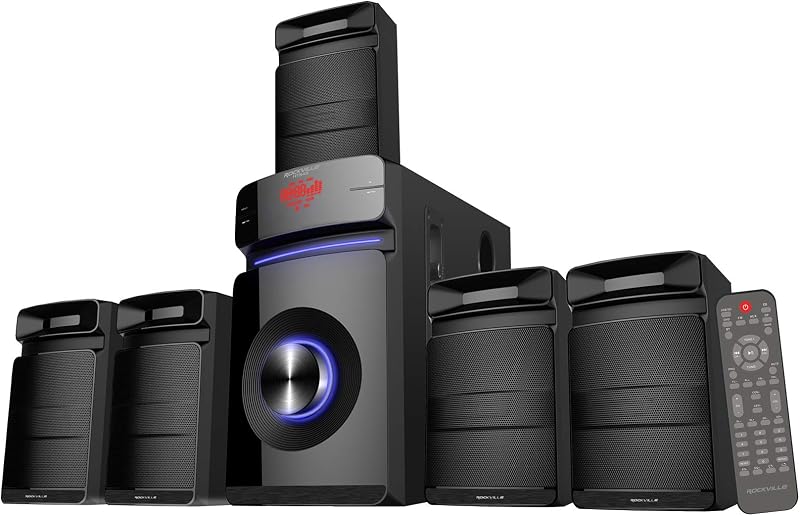
Best for Small editing suites needing compact placement
Pros
- Linear Class AB amplifier topology
- Optical and coaxial digital inputs
- Compact 5.25-inch subwoofer footprint
- Dedicated remote Bass Boost mode
Cons
- Smaller 5.25-inch woofer diameter
- Lower 800W peak power ceiling
The Rockville HTS45 5.1 Channel Bluetooth Home delivers a space-conscious surround sound solution for compact editing suites, bedrooms, and creator studios with limited floor space. Generating 800 watts of peak power, the package matches a 5.25-inch subwoofer driver with five compact 3-inch satellite speakers. Central to its performance is an integrated Class AB amplifier circuit, engineered for low distortion and smooth linear response across volume levels, reducing ear fatigue during extended editing sessions.
Connectivity on the rockville hts45 is versatile, providing digital optical, coaxial, stereo RCA, six DVD inputs, USB, SD, and Bluetooth streaming. Creators working on multi-display setups can use optical or coaxial lines to prevent ground noise from computer power supplies. While wireless options like an lg wireless surround sound kit eliminate physical wire runs, the hardwired links of the HTS45 ensure zero-latency synchronization between video playback and surround sound stems.
The subwoofer and satellites use MDF wood cabinets with plastic front panels, combining structural rigidity with a compact footprint. Rockville bundles wall-mounting hardware, a wireless remote, 30-foot rear speaker cables, and 12-foot front and center cables. A remote-controlled Bass Boost setting offers quick low-end reinforcement when checking sound design tracks. Although the 5.25-inch woofer cannot match the deepest sub-bass extension of the 8-inch drivers, the HTS45 excels as an efficient system for smaller rooms.
- Space-saving 5.25-inch subwoofer paired with five compact 3-inch satellite speakers
- Linear Class AB amplifier topology engineered for low distortion and balanced acoustic output
- Wide input selection including digital optical, coaxial, six DVD ports, RCA, USB, and SD playback
- Complete setup package featuring 30-foot rear wiring, wall-mount brackets, and remote control
What Sets These Models Apart
Comparing these three models highlights distinct hardware priorities across driver dimensions, amplification output, and cabinet formats. While each package delivers genuine 5.1 multi-channel audio processing and Bluetooth capability, their engineering details serve different room scales and listening requirements.
| Feature | Rockville HTS56 | Rockville HTS820 | Rockville HTS45 |
|---|---|---|---|
| Peak System Power | 1000 Watts | 1500 Watts (375W RMS) | 800 Watts |
| Subwoofer Driver Size | 8 Inches | 8 Inches | 5.25 Inches |
| Satellite Driver Architecture | Full-Range Satellites | Two-Way (3-Inch Mid + 0.75-Inch Tweeter) | 3-Inch Full-Range Satellites |
| Primary Specialty | Dual Mic Inputs, 5-Band EQ, LED Lights | 0.10% THD, 108 dB SPL, Dual Voltage | Class AB Amp, Bass Boost, Optical & Coaxial |
| Mounting Style | Tabletop Mount | Wall Mount | Wall Mount |
Buying Tips for Rockville Surround Sound Systems
When choosing a rockville surround sound system, begin by evaluating room volume and boundary acoustics. Larger rooms require substantial driver displacement to produce clean low frequencies, making an 8-inch subwoofer like those in the HTS56 and HTS820 essential. In smaller studio spaces or bedrooms, an oversized subwoofer can create boomy acoustic reflections; in those spaces, a 5.25-inch subwoofer like the HTS45 delivers balanced low-end control without overwhelming room boundaries.
Cable management and satellite placement require advance planning. Because Rockville powers all satellite channels directly from the central subwoofer cabinet, that master unit must sit where power and audio sources can reach easily. The included 30-foot rear speaker cables offer ample reach for standard rooms, but running wiring along baseboards prevents clutter. If wall mounting is your preferred layout, prioritize models like the HTS820 or HTS45 that feature dedicated wall-mount hardware.
Finally, match input connections with your source hardware. Creators using editing computers should look for digital optical or coaxial ports to ensure clean signal delivery without electrical interference. If your workflow involves podcast recording or vocal monitoring, onboard microphone inputs and hardware equalization controls will streamline your setup by removing the need for an external mixer.
FAQ
How should I place Rockville 5.1 satellite speakers for balanced audio imaging?
Position the center channel directly above or below your display at ear level to anchor dialogue. Place the front left and right satellite speakers angled inward toward your listening position, forming an equilateral triangle. Position the rear surround satellites slightly behind and to the sides of your seating area, angled inward. Using the included 30-foot rear speaker cables allows you to run wiring neatly along room edges.
Can I connect a television to these Rockville systems using an optical cable?
The Rockville HTS56 and Rockville HTS45 feature digital optical inputs, allowing direct connection to smart televisions and media boxes using a standard TOSLINK optical cable. For the Rockville HTS820, the listing does not specify optical input connectivity, though it provides Bluetooth, SD, USB, and analog connections. When using optical ports, set your source output menu to PCM or compatible bitstream formats.
Why is Class AB amplification beneficial in the Rockville HTS45?
Class AB amplifier architecture combines the audio fidelity of Class A designs with the efficiency of Class B circuits. By maintaining transistor conduction through signal zero-crossings, Class AB technology eliminates harsh crossover distortion at moderate listening levels. For creators spending long sessions editing video or tracking audio, this linear output provides clean sound reproduction that prevents ear fatigue.
Do Rockville surround sound systems need an external audio receiver?
No, all three Rockville systems in this guide are fully self-powered. The amplification, power supply, input switching, and surround processing components reside directly inside the primary subwoofer enclosure. All five satellite speakers connect directly into rear terminals on the subwoofer, which provides both signal and power without requiring a separate AV receiver.
What are the benefits of the two-way satellite design on the Rockville HTS820?
The two-way satellite design on the Rockville HTS820 pairs a 3-inch midrange driver with a separate 0.75-inch dome tweeter in each satellite. Splitting frequencies between two dedicated drivers allows the dome tweeter to deliver smooth high-frequency detail and vocal clarity, while the 3-inch cone reproduces midrange information without audio congestion or treble roll-off.


