Ultimea Audio & Headphones
Ultimea 5.1 and Surround Soundbars: Which Setup Fits Your Workflow?
Finding the right ultimea 5.1 surround sound bar comes down to matching channel architecture and driver placement to your specific listening environment. For video editors, streamers, and audio-conscious creators, weak display speakers collapse complex soundstages and make fine audio mixing difficult. Ultimea solves this by integrating multi-channel configurations, dedicated subwoofers, and proprietary signal processing into…

As Amazon Associates, we earn from qualifying purchases. This means we may receive a small commission at no extra cost to you if you click through and make a purchase.
Finding the right ultimea 5.1 surround sound bar comes down to matching channel architecture and driver placement to your specific listening environment. For video editors, streamers, and audio-conscious creators, weak display speakers collapse complex soundstages and make fine audio mixing difficult. Ultimea solves this by integrating multi-channel configurations, dedicated subwoofers, and proprietary signal processing into slim form factors. Whether you need physical rear satellite speakers to track panning effects across an editing timeline or a clean, all-in-one enclosure that fits under a studio monitor, selecting the right model ensures your audio playback remains accurate and dynamic.
This guide covers six distinct models from the brand to help you complete an informed ultimea soundbar comparison. Across these systems, you will find differences in physical footprint, driver counts, low-frequency cabinet volumes, and connection protocols. The lineup spans simple 2.1 channel platforms, virtualized side-firing arrays, true 5.1 discrete physical layouts, up-firing 5.1.2 channel Dolby Atmos enclosures, and expansive 7.1 channel multi-speaker home theater packages.
Which Ultimea Surround Soundbars Should You Buy
All 6 models on this page, side by side


Prices and ratings are read from the Amazon product listing and change there, not here. Every rating is the average left by Amazon buyers, not a score from this site.
Why each one is on the list
- Shoppers looking for a traditional ultimea 5.1 surround sound bar with discrete wired rear satellites and a wireless subwoofer should choose the ULTIMEA 5.1 Sound Bar for Smart.
- Creators who want genuine overhead audio reproduction via dedicated up-firing drivers will get the best experience from the ULTIMEA 5.1.2ch Sound Bar with Dolby.
- Users outfitting larger rooms who want multi-directional speaker coverage without an audio-video receiver should pick the ULTIMEA 7.1ch Sound Bar for TV.
- Desktop editors wanting immersive Dolby Atmos spatial rendering without running rear satellite cables should buy the ULTIMEA 5.1CH Surround Sound Bar System.
- Media enthusiasts prioritizing dialogue clarity and intelligent vocal redistribution across seven discrete channels should select the ULTIMEA 7.1ch Sound Bar with Subwoofer.
- Minimalist creators working in tight editing suites who want punchy low-end response and zero rear-speaker clutter should opt for the ULTIMEA Sound Bar with Wireless Subwoofer.
01 ULTIMEA 5.1 Sound Bar for Smart

Best for Budget creators wanting discrete rear audio
Pros
- Wired rear satellite speakers
- Wireless BASSMX subwoofer
- 121 app equalizer matrices
Cons
- Limited to HDMI ARC
- Lacks Dolby Atmos decoding
The ULTIMEA 5.1 Sound Bar for Smart serves as the brand’s benchmark discrete surround option, marketed under the Poseidon D50 series. It features a three-channel front soundbar, a standalone wireless subwoofer, and two wired rear satellite speakers connected via an included 19.6-foot cable. The system relies on SurroundX technology to convert standard 2.0 PCM stereo signals into a multi-channel soundstage, driven by 2.25-inch full-range speakers and aerospace-grade magnets that maintain crisp high-frequency fidelity during busy scenes.
For low-end reproduction, the 5.25-inch wireless subwoofer uses BASSMX technology to produce deep, resonant bass for games, sound design work, and action films. Creators who have previously looked into entry-level alternatives like a tcl surround sound system will appreciate the extensive software control provided here. Through the ULTIMEA app, users gain access to a 10-band customizable equalizer, 121 preset matrices across four sound styles, and six specialized modes including Movie, Voice, Game, and Night.
This model suits creative professionals and entertainment enthusiasts who have the floor space to place rear satellites behind their seating position. Connectivity covers HDMI ARC, optical, AUX, and Bluetooth, ensuring wide compatibility with gaming consoles, PCs, and smart televisions. However, if your desk or room cannot accommodate physical rear speaker wiring, you will be better served by the brand’s virtualized or all-in-one alternatives.
- Discrete 5.1 channel layout with two wired rear satellites and a 19.6-foot connection cable
- Wireless 5.25-inch subwoofer powered by BASSMX low-frequency technology
- ULTIMEA smartphone app control with a 10-band equalizer and 121 sound preset matrices
- Universal inputs featuring HDMI ARC, optical audio, 3.5mm AUX, and Bluetooth
02 ULTIMEA 5.1.2ch Sound Bar with Dolby

Best for Home theater enthusiasts wanting height channels
Pros
- True 5.1.2 Dolby Atmos
- Neodymium up-firing drivers
- Lossless HDMI eARC bandwidth
Cons
- Requires flat reflective ceiling
- Larger overall physical footprint
The ULTIMEA 5.1.2ch Sound Bar with Dolby represents a significant step up in spatial immersion, functioning as an authentic ultimea dolby atmos soundbar. It integrates dual up-firing drivers built with neodymium internal magnets and 18-core voice coils. These height channels project sound toward the ceiling to bounce audio downward, generating vertical spatial cues like overhead aircraft, weather effects, and atmospheric ambient layers with pinpoint accuracy.
To maintain the fidelity required for true spatial audio, the soundbar incorporates an HDMI eARC port capable of handling up to 37Mbps of bandwidth. This uncompressed audio pipeline ensures lossless 5.1.2-channel reproduction with consumer electronics control (CEC) support, allowing power and volume to sync directly with your monitor or TV. The system also includes two wired rear surround speakers and a 5.25-inch subwoofer, working together through 360° SurroundX algorithms to create a complete three-dimensional sound bubble.
This setup is ideal for video editors mixing spatial soundscapes and movie watchers who want realistic height effects in rooms with flat, standard-height ceilings. The ULTIMEA app provides a 13-step surround level adjustment (-6 to +6) and a 10-band graphic equalizer to dial in the listening environment. If your room features vaulted or heavily acoustic-treated ceilings that absorb upward reflections, you may prefer a traditional horizontal multi-satellite system instead.
- Authentic 5.1.2 Dolby Atmos architecture with dual upward-firing neodymium drivers
- Lossless HDMI eARC interface delivering up to 37Mbps transmission bandwidth
- Metal enclosure construction with tabletop and wall-mounting options
- Mobile app calibration offering 13-step surround adjustment and 121 sound presets
03 ULTIMEA 7.1ch Sound Bar for TV
Best for Creators wanting dynamic vocal stage management
Pros
- VocalMatrix dialogue redistribution
- Hybrid wireless rear connectivity
- Updated Bluetooth 6.0
Cons
- Front surrounds require wires
- Complex satellite placement

Best for Large rooms needing four surround satellites
Pros
- 410W high peak power
- Four dedicated surround satellites
- Enlarged 6.5-inch subwoofer
Cons
- Virtual 7.1 lacks Atmos
- Multiple satellite wires required
The ULTIMEA 7.1ch Sound Bar for TV, also designated as the Poseidon D70, targets larger viewing environments that demand broad physical speaker coverage. Unlike standard setups, this package bundles four wired surround satellites alongside the central soundbar and a wireless subwoofer. By positioning two speakers toward the front sides and two behind the listening position, the system creates an expansive sound field that prevents audio dead zones across wide studio couches or shared creative spaces.
With 410W of peak power and an enlarged 6.5-inch subwoofer driver, the Poseidon D70 delivers the deepest physical bass impact in the brand’s traditional lineup. Users who might otherwise consider a bulkier sony home theater system will appreciate that this package delivers seven discrete virtualized channels without the need for an external amplifier or complex receiver calibration menus. Physical inputs include HDMI ARC, optical, AUX, USB, and wireless Bluetooth streaming.
This unit is tailored specifically for media producers and home theater enthusiasts who prioritize wide lateral and rear sound coverage over vertical height channels. It should be noted that while the Poseidon D70 produces an expansive 7.1 virtual surround sound experience, the listing explicitly notes it does not support Dolby Atmos decoding. Creators whose production workflow relies strictly on native Atmos playback should consider the 5.1.2 channel model instead.
- Four wired surround speakers creating an expanded multi-directional listening field
- High-output 410W peak power system paired with a dedicated 6.5-inch wireless subwoofer
- Virtual 7.1 surround sound processing with customizable sound modes via the mobile app
- Flexible connectivity including HDMI ARC, optical, 3.5mm AUX, USB, and Bluetooth
04 ULTIMEA 5.1CH Surround Sound Bar System
Best for Compact desks needing Atmos without rears
Pros
- Dolby Atmos side-firing drivers
- Sub-0.5ms ultra-low latency
- Acoustic wooden subwoofer cabinet
Cons
- Wired subwoofer connection
- No physical rear speakers
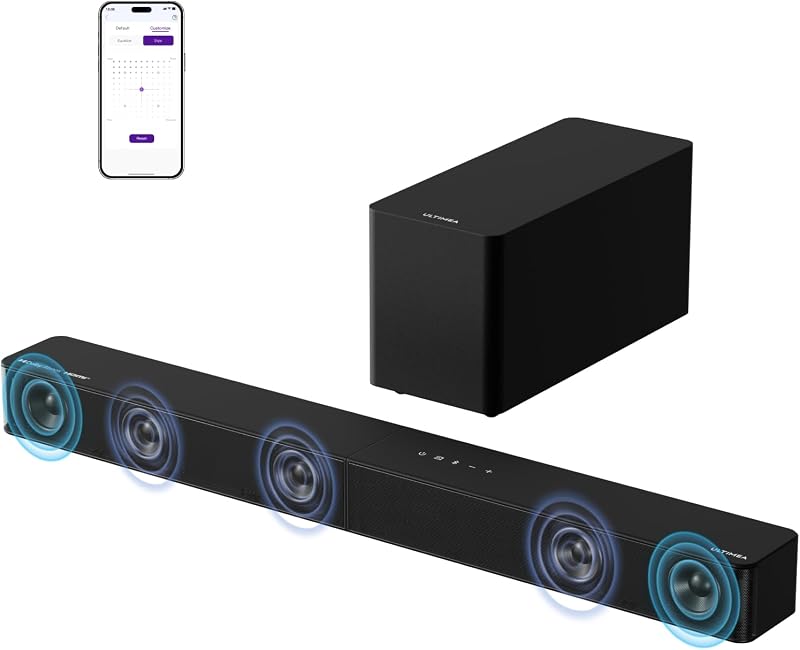
The ULTIMEA 5.1CH Surround Sound Bar System, known as the Poseidon M60, eliminates cable clutter by packaging a full five-channel soundstage into a single soundbar chassis. It houses five precision-tuned full-range drivers, including two angled side-firing speakers that project sound off side walls to create wide lateral separation without requiring physical rear satellites. Integrated digital signal processing maintains an ultra-low latency of under 0.5 milliseconds for seamless lip-sync performance during fast-paced video editing and gaming.
Despite its compact footprint, the Poseidon M60 delivers genuine Dolby Atmos decoding over a 37Mbps HDMI eARC connection. Low frequencies are handled by a dedicated wired wooden subwoofer featuring an 18mm high-excursion driver and a 5.3-liter tuned acoustic cabinet. The system generates up to 300W of peak power, reaching a maximum sound pressure level of 99 dB across a frequency response range of 45 Hz to 18 kHz. Dialogue clarity is further enhanced by VoiceMX algorithms that isolate speech frequencies from background music.
This model is the premier choice for creators working at compact editing desks, bedroom studios, or minimalist living setups where running satellite cables is impractical. The unit also includes Bluetooth 5.4 for responsive, low-latency mobile streaming. While it delivers excellent front and side immersion, listeners seeking true audio localization originating from directly behind their head will still prefer a system with physical rear hardware.
- Integrated 5.1-channel Dolby Atmos soundbar with dual side-firing spatial drivers
- VoiceMX dialogue isolation technology for clean vocal reproduction during dense scenes
- Wired wooden subwoofer with an 18mm high-excursion driver in a 5.3L tuned cabinet
- Modern Bluetooth 5.4 wireless connectivity and high-speed HDMI eARC support
05 ULTIMEA 7.1ch Sound Bar with Subwoofer
The ULTIMEA 7.1ch Sound Bar with Subwoofer, represented by the Aura A40 Pro, introduces an advanced multi-speaker configuration engineered for nuanced audio separation. The system combines three main forward channels in the soundbar with four external surround speakers. In this layout, two wired speakers serve as front surrounds, while two rear speakers handle back-channel duties using a hybrid link: the right rear satellite connects wirelessly to the soundbar, and the left rear satellite connects via cable directly to the right unit.
At the heart of the Aura A40 Pro is Ultimea’s proprietary VocalMatrix algorithm, which analyzes the incoming audio stream and dynamically redistributes speech frequencies across the rear channels to maintain precise vocal imaging. Dialogue performance is reinforced by VoiceMX hardware processing, boosting the 120 Hz to 6 kHz vocal band. Bass is anchored by an 18mm high-excursion driver housed in a 6.1-liter tuned subwoofer cabinet that extends low-frequency response down to 45 Hz using BassMX technology.
Creators who manage multi-layered audio projects or enjoy complex cinematic soundscapes will benefit from this system’s exceptional channel isolation. For workspaces where running long speaker cables across doorways is challenging, comparing this setup to a modular klipsch wireless home theater shows how Ultimea balances hybrid wireless connectivity with multi-channel fidelity. The system also features modern Bluetooth 6.0 with a 15-meter range, though users must plan for adequate outlet and cable management around the satellite clusters.
- VocalMatrix dynamic processing that redistributes vocal clarity across discrete channels
- Hybrid four-satellite layout featuring two wired front units and wireless-linked rear units
- BassMX subwoofer design with an 18mm driver and a 6.1L tuned acoustic enclosure
- Next-generation Bluetooth 6.0 connectivity with an extended 15-meter operational range
06 ULTIMEA Sound Bar with Wireless Subwoofer
Best for Minimalist editing desks wanting dialogue clarity
Pros
- Mica-reinforced low-distortion drivers
- Cable-free wireless subwoofer
- Fast Bluetooth 6.0 streaming
Cons
- 1 stereo output only
- No surround sound channels
The ULTIMEA Sound Bar with Wireless Subwoofer is a streamlined 2.1 channel audio system designed for efficiency, dialogue intelligibility, and minimal physical footprint. The main soundbar utilizes specialized mica-reinforced diaphragms, which increase driver rigidity by up to 30 percent. This material enhancement suppresses cone breakup and unwanted cabinet resonance, reducing distortion by up to 20 percent to deliver clear acoustic detail across spoken commentary, acoustic music, and editing timelines.
Despite its simplified stereo output mode, the system packs substantial dynamic punch with a 240W peak power rating and a maximum sound pressure level of 95 dB. It pairs with an independent wireless subwoofer featuring an 18mm high-excursion driver and a 6.5-liter tuned cabinet. The BassMX circuit optimizes low frequencies between 45 Hz and 150 Hz, ensuring punchy transients without low-end muddiness. Like its multi-channel siblings, it includes VoiceMX real-time DSP tuning across the critical 120 Hz to 6 kHz vocal spectrum.
This 2.1 platform is the ideal match for content creators, vloggers, and home office workers who need clean, reliable audio monitoring without the complexity of surround satellites. Connectivity is swift and stable thanks to Bluetooth 6.0, HDMI ARC, and optical audio inputs. However, if your media diet consists primarily of multi-channel surround tracks or discrete spatial audio gaming, one of Ultimea’s dedicated 5.1 or 7.1 systems will be a more appropriate investment.
- Mica-reinforced speaker diaphragms delivering up to 20 percent lower audio distortion
- Independent wireless subwoofer with an 18mm driver and a 6.5L tuned chamber
- 240W peak system output with a balanced frequency response of 45 Hz to 18 kHz
- Advanced Bluetooth 6.0 wireless streaming alongside HDMI ARC and optical inputs
What Sets These Models Apart
Understanding how these six Ultimea audio systems differ helps you match the right hardware to your physical room dimensions and workflow requirements. The primary differentiators across the catalog include channel architecture, spatial decoding capabilities, subwoofer integration, and satellite connectivity. The comparison table below highlights these key technical specifications.
| Model Name | Channel Configuration | Spatial Audio / Decoding | Subwoofer Type | Primary Connectivity |
|---|---|---|---|---|
| ULTIMEA 5.1 Sound Bar for Smart | 5.1 Channels | SurroundX Virtualization | Wireless (5.25-inch) | HDMI ARC, Bluetooth, Optical |
| ULTIMEA 5.1.2ch Sound Bar with Dolby | 5.1.2 Channels | Dolby Atmos (Up-Firing) | Wireless (5.25-inch) | HDMI eARC (37Mbps), App |
| ULTIMEA 7.1ch Sound Bar for TV | 7.1 Channels | Virtual 7.1 Surround | Wireless (6.5-inch) | HDMI ARC, Optical, USB |
| ULTIMEA 5.1CH Surround Sound Bar System | 5.1 Channels | Dolby Atmos (Side-Firing) | Wired Wood (18mm / 5.25-inch) | HDMI eARC (37Mbps), BT 5.4 |
| ULTIMEA 7.1ch Sound Bar with Subwoofer | 7.1 Channels | VocalMatrix & SurroundX | Wired / Hybrid (18mm) | Bluetooth 6.0, App Control |
| ULTIMEA Sound Bar with Wireless Subwoofer | 2.1 Channels | VoiceMX Stereo | Wireless (18mm / 6.5L) | HDMI ARC, Bluetooth 6.0 |
Buying Tips for Ultimea Surround Soundbars
When selecting an ultimea surround sound system, pay close attention to the specific HDMI protocol supported by your monitor or television. Standard HDMI ARC provides sufficient bandwidth for compressed multi-channel audio such as basic 5.1 PCM and standard surround formats. However, if you choose an ultimea dolby atmos soundbar like the 5.1.2 channel model or the Poseidon M60, you must connect via an HDMI eARC port to take full advantage of uncompressed 37Mbps Dolby Atmos data streams. Using a standard optical cable will downgrade these advanced formats to legacy stereo or core surround audio.
Physical room geometry should directly dictate your speaker configuration choice. Systems with discrete rear satellite speakers, such as the Poseidon D50 or the Aura A40 Pro, require open space behind your seating area and careful cable routing. The included 19.6-foot cables provide ample length for most mid-sized rooms, but you must ensure the cables do not create tripping hazards across walkways. In contrast, systems utilizing upward-firing drivers require flat, rigid ceilings between 8 and 12 feet in height to properly bounce vertical audio cues down to your ears.
Finally, make full use of the ULTIMEA mobile app to compensate for your room’s acoustic profile. Most models in this lineup feature a 10-band graphic equalizer and up to 121 preset tuning matrices. In rooms with hard surfaces like wood floors and bare walls that cause harsh high-frequency flutter, pulling down the upper frequency bands in the app will prevent listening fatigue. Conversely, engaging VoiceMX or boosting mid-range equalization helps dialogue remain intelligible at lower volumes during late-night editing sessions.
FAQ
Does an Ultimea 5.1 surround sound bar require an external AV receiver?
No, every Ultimea soundbar covered in this guide is an active, self-powered system with built-in amplification and digital signal processing. You do not need an external AV receiver. All source devices, including gaming consoles, PCs, and smart TVs, connect directly to the soundbar via HDMI, optical cables, AUX, or Bluetooth.
What is the difference between HDMI ARC and HDMI eARC on Ultimea soundbars?
HDMI ARC supports audio bandwidth up to roughly 1Mbps, which is suitable for standard stereo and compressed 5.1 surround formats. HDMI eARC expands that bandwidth up to 37Mbps, allowing the transmission of high-resolution, uncompressed audio formats like true Dolby Atmos found on models such as the Poseidon M60 and the 5.1.2 channel system.
How do the rear surround speakers connect in Ultimea multi-channel systems?
Rear speaker connectivity varies across models. In the Poseidon D50, the two rear satellites connect via a 19.6-foot audio cable to each other and the system, while the subwoofer connects wirelessly. In the Aura A40 Pro, the system uses a hybrid arrangement where the right rear satellite links wirelessly to the front soundbar, and the left rear speaker connects directly to the right satellite via a wire.
Can I calibrate the equalizer settings without using the mobile app?
While the included physical remote controls allow you to switch basic audio presets such as Movie, Music, and News, detailed adjustments require the ULTIMEA smartphone app. The app unlocks the full 10-band graphic equalizer, 13-step surround gain adjustments, and 121 curated preset matrices, as well as over-the-air firmware updates.
Does the Ultimea Poseidon D70 support Dolby Atmos audio?
No, the Poseidon D70 does not decode Dolby Atmos. It processes multi-channel audio through 7.1 virtual surround algorithms across its four physical satellites, soundbar, and subwoofer. If native Dolby Atmos decoding is essential for your creative workflow, you should choose the Poseidon M60 or the 5.1.2 channel model.


