Sonos Audio & Headphones
Sonos 8-Inch vs 6.5-Inch Ceiling Speakers: System Comparison
Deciding between the larger sonos 8 inch ceiling speakers and the standard 6.5-inch model centers on the physical scale of your listening room, acoustic dispersion requirements, and how you integrate dedicated amplification into your creative workspace. Architectural speakers installed overhead preserve clear sightlines, eliminate floor clutter, and provide seamless audio distribution across editing suites, production…

As Amazon Associates, we earn from qualifying purchases. This means we may receive a small commission at no extra cost to you if you click through and make a purchase.
Deciding between the larger sonos 8 inch ceiling speakers and the standard 6.5-inch model centers on the physical scale of your listening room, acoustic dispersion requirements, and how you integrate dedicated amplification into your creative workspace. Architectural speakers installed overhead preserve clear sightlines, eliminate floor clutter, and provide seamless audio distribution across editing suites, production studios, and living spaces. Choosing the appropriate overhead driver requires balancing physical woofer diameter against ceiling cavity depth, overall power handling, and sound coverage angles so you achieve rich acoustic balance without harsh reflections or dead listening spots.
This comprehensive sonos ceiling speakers comparison covers exactly three hardware models within the brand’s architectural lineup: the large-format 8-inch architectural speaker, the standard 6.5-inch architectural speaker, and the dedicated multi-room streaming amplifier designed to drive them. These three products differ in their driver dimensions, continuous wattage ratings, cabinet integration depths, and system roles. The two speaker pairs operate as passive ceiling-mounted transducers, while the amplifier provides the digital signal processing, streaming connectivity, and amplification required to make them perform at their highest capability.
Which Sonos Ceiling Speakers Should You Buy
All 3 models on this page, side by side
| Model | Buyer rating | Listing |
|---|---|---|
01 Sonos in-Ceiling Speakers 8" by Sonance Sonos in-Ceiling Speakers 8" by Sonance |
Price | |
02 Sonos in-Ceiling by Sonance Sonos in-Ceiling by Sonance |
Price | |
03 Sonos Amp Sonos Amp |
Price |
Prices and ratings are read from the Amazon product listing and change there, not here. Every rating is the average left by Amazon buyers, not a score from this site.
Why each one is on the list
When deciding which sonos ceiling speakers to buy, your primary considerations should be room volume, ceiling joist clearance, and whether you are installing an entire audio system from scratch or expanding an existing installation.
- Sonos in-Ceiling Speakers 8″ by Sonance: Best for spacious media rooms, open creative studios, and rooms with high ceilings that require 225 watts of power capacity and authoritative low-frequency output from an 8-inch woofer.
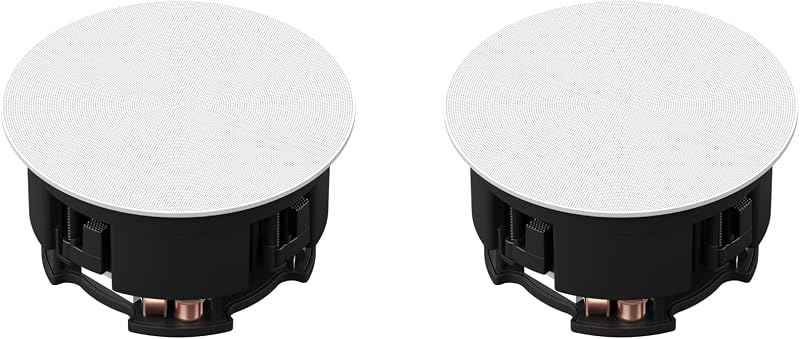
- Sonos in-Ceiling by Sonance: Best for standard-sized editing bays, bedrooms, and background listening zones where a compact 120 mm installation depth, wide 90-degree dispersion, and Trueplay tuning match everyday listening needs.
- Sonos Amp: Best for powering passive architectural drivers, integrating television eARC connections, connecting analog equipment like turntables, and driving up to three pairs of architectural speakers simultaneously.
01 Sonos in-Ceiling Speakers 8″ by Sonance

Best for Large creative studios needing high-power overhead audio
Pros
- 225 watts RMS power
- 8-inch polypropylene woofer
- Trimless white grille
Cons
- Not waterproof
- Larger ceiling cutout
The Sonos in-Ceiling Speakers 8″ by Sonance represent the brand’s largest architectural overhead model, engineered specifically for users who need expansive sound coverage in larger physical areas. Built around a substantial 8-inch woofer cone and a polypropylene tweeter, this stereo-configured speaker pair is designed for ceiling mount installation in spaces where smaller drivers might struggle to deliver adequate sonic presence. With a continuous power rating of 225 watts RMS and an 8-ohm nominal impedance, this hardware handles demanding dynamic peaks comfortably without pushing the drivers into distortion during extended playback sessions.
From an aesthetic and structural perspective, these round white architectural speakers feature a trimless grille design that allows the hardware to sit virtually flush against sheetrock surfaces. When considering the sonance in ceiling hardware catalog, this 8-inch model stands out because of its high output capability and indoor operational focus. The listing specifies that the unit is not waterproof, meaning installation should be limited to indoor locations such as studio control areas, living rooms, and dry media lounges rather than humid environments or outdoor eaves.
Controlling these passive wired transducers is handled entirely through the connected system via the mobile app once linked with appropriate hardware. For creators who run multi-monitor desk arrays or expansive studio workflows, having wide sound dispersion radiating down from overhead drivers eliminates the acoustic compromises often created by desktop boundary reflections. The sonos in ceiling speakers 8 by sonance provide the dynamic headroom required to fill expansive rooms while keeping visual distractions to an absolute minimum.
- 8-inch polypropylene woofer paired with a polypropylene tweeter for balanced stereo output
- 225 watts of continuous RMS power handling at an 8-ohm nominal impedance
- Trimless white round grille engineered for seamless overhead flush mounting
- Indoor ceiling-mount architecture optimized for app-controlled multi-room systems
02 Sonos in-Ceiling by Sonance
Best for Standard rooms seeking ambient background audio
Pros
- Trueplay room tuning
- Compact 120 mm depth
- Paintable grille design
Cons
- Requires external amplifier
- Indoor use only
The standard Sonos in-Ceiling by Sonance model provides a balanced acoustic profile tailored specifically for ambient listening and background music distribution. This model incorporates a 165 mm (6.5-inch) woofer alongside a 25 mm tweeter housed inside a 152 mm speaker assembly. Operating across a frequency response range of 36 Hz to 20 kHz (within ±3 dB when utilizing dedicated digital signal processing), this speaker achieves a maximum sound pressure level of 110 dB at one meter, giving it plenty of volume for residential listening and studio reference playback.
One of the primary benefits of this unit is its broad 90-degree nominal coverage angle, which disperses sound evenly across the room to eliminate distinct volume drops when moving between physical workstations. The physical packaging requires an installation depth of only 120 mm, allowing it to slip into shallower ceiling cavities where larger architectural models might collide with joists, conduit, or ductwork. The included round white grilles can be painted to match the surrounding ceiling surface, and an optional square grille format is available if your room geometry favors angular styling. Shoppers looking for architectural drivers while browsing sonos on sale components often choose this 6.5-inch option for its balance of physical dimensions and performance.
When paired with compatible amplification, this speaker unlocks Trueplay software calibration, an advanced acoustic tuning feature that accounts for room construction materials, furniture placement, and overall dimensions to adjust playback curves automatically. Like its larger sibling, this speaker is built exclusively for indoor use and features non-waterproof construction. It operates as a wired architectural unit that supports multi-room audio groupings, allowing creators to keep audio streams synchronized as they transition from their desk to adjoining creative spaces.
- 165 mm woofer and 25 mm tweeter delivering a frequency range of 36 Hz to 20 kHz with DSP
- Shallow 120 mm installation depth designed to accommodate tight ceiling cavities
- Wide 90-degree nominal coverage angle for smooth and uniform ambient sound dispersion
- Paintable magnetic grilles in a round profile with support for optional square grilles
03 Sonos Amp

Best for Powering multi-room architectural speakers with streaming
Pros
- 125 watts per channel
- Powers three speaker pairs
- HDMI eARC connectivity
Cons
- Plastic exterior chassis
The Sonos Amp serves as the dedicated powerhouse that drives passive architectural ceiling drivers, converting digital streaming sources and physical inputs into clean amplified audio. Delivering a robust 125 watts per channel into stereo speaker channels, this versatile amplifier features direct digital input technology that eliminates redundant analog conversion steps, resulting in pristine, undistorted playback. The matte black enclosure is constructed from durable plastic and incorporates a specially developed internal heatsink that optimizes airflow and heat management during sustained multi-channel use.
A notable technical strength of the amplifier is its ability to power up to three pairs of Sonos by Sonance architectural ceiling speakers from a single hardware chassis. This capability allows you to wire six architectural speakers across a single zone, providing wide-area audio distribution across large studios, interconnected hallways, or open floor plans. The rear panel provides an HDMI eARC input for direct television integration, stereo analog RCA line-in ports for connecting turntables and CD players, and heavy-duty speaker terminals designed for standard speaker wire runs. Users building mixed home theater arrangements can also coordinate their audio setup alongside wireless sonos rear speakers for surround performance.
In addition to standard shelf placement, the chassis is engineered with standard AV rack mounting and wall-mount compatibility, making it simple to organize inside centralized media closets. Network connectivity includes built-in Wi-Fi and direct streaming support for over 100 audio services, along with Apple AirPlay 2 and app control. The amplifier also unlocks Trueplay tuning specifically on connected architectural drivers, ensuring that passive ceiling speakers benefit from digital acoustic correction tailored to the specific dimensions of your workspace.
- 125 watts per channel output power designed for high-fidelity architectural audio
- Direct digital input pipeline with built-in Wi-Fi, Apple AirPlay 2, and app control
- Rear inputs featuring HDMI eARC for video displays and analog line-in for turntables
- AV rack-mountable and wall-mountable chassis with an integrated cooling heatsink
What Sets These Models Apart
A careful analysis of these three products highlights the distinction between passive overhead drivers and active streaming amplification. The table below details the core engineering differences, physical parameters, and hardware roles across the lineup.
| Product Model | Hardware Category | Power Specification | Key Installation Metric |
|---|---|---|---|
| Sonos in-Ceiling Speakers 8″ by Sonance | Passive In-Ceiling Speaker | 225 Watts RMS (8 Ohms) | 8-Inch Woofer, Trimless Grille |
| Sonos in-Ceiling by Sonance | Passive In-Ceiling Speaker | Tuned for Amp (Max 110 dB) | 120 mm Depth, 6.5-Inch Woofer |
| Sonos Amp | Class-D Streaming Amplifier | 125 Watts Per Channel | AV Rack Mountable, Built-in Wi-Fi |
Examining sonos 8 vs 6.5 ceiling speakers comes down to a trade-off between installation clearance and low-frequency acoustic scale. The 8-inch model offers superior power handling at 225 watts RMS and uses an expanded woofer surface to project low-end energy into large open volumes. In contrast, the 6.5-inch model requires only 120 mm of clearance inside the ceiling drywall, making it significantly easier to place in areas with shallow joists or existing utility lines while maintaining an exceptionally uniform 90-degree dispersion pattern. Meanwhile, the streaming amplifier provides the computational DSP and raw wattage necessary to make either speaker model function within a modern multi-room ecosystem.
Buying Tips for Sonos Ceiling Speakers
Before cutting drywall for your sonos architectural ceiling speakers, verify the interior depth and joist spacing of your ceiling. The 6.5-inch model requires an installation depth of 120 mm, whereas the 8-inch speaker requires a deeper cavity and a wider circular cutout to seat its larger frame. Use a stud finder to map the location of ceiling joists, electrical conduit, and HVAC runs before using the included cut templates. If your joist bays contain insulation, ensure the material is clear of the mounting clips so the speaker clamps securely against the drywall without causing uneven pressure along the ceiling surface.
Plan your speaker wire routing and amplifier location early in the design phase. Because both the 8-inch and 6.5-inch sonos in ceiling speakers are passive units, you must run quality in-wall rated speaker wire from each speaker back to the amplifier. The dedicated amplifier can power up to three pairs of these architectural speakers simultaneously, presenting a stable impedance load without requiring external speaker selectors or impedance-matching volume controls. Placing the amplifier in a well-ventilated media cabinet or standard AV rack guarantees that its internal heatsink can maintain optimal airflow during long production sessions.
Take advantage of aesthetic customization and acoustic calibration features once installation is complete. The grilles on both ceiling models can be painted with diluted latex paint using a spray gun or roller to match the exact shade of your ceiling paint, allowing the speakers to disappear into the room design. After securing the grilles and connecting your wiring to the amplifier, run the Trueplay room calibration routine through the mobile app. This measurement process analyzes early room reflections and adjusts the amplifier’s internal equalizers to eliminate acoustic anomalies caused by hardwood floors, large desks, and untreated drywall.
FAQ
How do the 8-inch and 6.5-inch ceiling speakers compare in sound coverage?
The 6.5-inch model features a defined 90-degree nominal coverage angle engineered to distribute ambient sound evenly across standard room layouts, preventing hot spots directly under the speaker. The 8-inch model incorporates a larger woofer surface area and 225 watts RMS power capacity, allowing it to move more air and project low-frequency sound more effectively through large volumes, high-ceiling studios, and open architectural spaces.
Can a single Sonos Amp power both 8-inch and 6.5-inch ceiling speakers together?
The amplifier is capable of driving up to three pairs (six individual speakers) of architectural speakers concurrently when wired in parallel. While you can technically connect different pairs of architectural speakers to the same amplifier, doing so means all connected speakers share the same volume level and audio stream. For independent volume control across different rooms, each zone should be powered by its own dedicated amplifier.
Are these architectural ceiling speakers safe to install in bathrooms or outdoor patios?
According to the product specifications, both the 8-inch and 6.5-inch ceiling speakers are not waterproof and are designed specifically for indoor installations. Installing them in high-humidity bathrooms, saunas, or outdoor porch eaves exposes the internal crossover components and driver materials to moisture damage. For exterior spaces, dedicated outdoor architectural models designed to withstand weather exposure should be used instead.
What extra equipment is required to operate passive ceiling speakers?
Because these ceiling units are passive wired speakers without internal power supplies, they require a dedicated amplifier to generate sound and process audio signals. Pairing them with the brand’s streaming amplifier provides 125 watts per channel of clean amplification, Wi-Fi multi-room streaming, app management, and access to Trueplay room tuning calibration.
Can I connect a turntable or television to ceiling speakers?
Yes, but the physical connections must be made through the central amplifier rather than directly to the ceiling speakers. The amplifier features an HDMI eARC input for direct television connection and standard analog RCA line-in ports for connecting a turntable with a built-in or external phono preamplifier. Once connected, that audio source can be routed seamlessly to your overhead ceiling channels.


